Engineering Insights

Articles

433 articles on embedded systems, firmware, FPGA, and engineering recruitment.

Asymmetric Multiprocessing (AMP): Managing Inter-Processor Communication Without Latency Spikes
Technical11 September 2026

Asymmetric Multiprocessing (AMP): Managing Inter-Processor Communication Without Latency Spikes

When an application core and a real-time core must exchange telemetry, control commands, or high-throughput sensor streams, naive IPC implementations frequently introduce unpredictable latency spikes. A single unexpected 50-microsecond delay in message delivery can cause missed deadline constraints, dropped audio frames, or catastrophic control loop instability in motor drives. Achieving sub-microsecond, zero-jitter IPC performance across an AMP boundary requires a deep, hardware-aware understanding of shared memory structures, cache coherence protocols, interrupt handling overhead, and software framework optimizations.

Read More >>
Neuromorphic Edge Silicon: Processing Spiking Neural Networks (SNNs) on Sub-Milliwatt Hardware
Technical10 September 2026

Neuromorphic Edge Silicon: Processing Spiking Neural Networks (SNNs) on Sub-Milliwatt Hardware

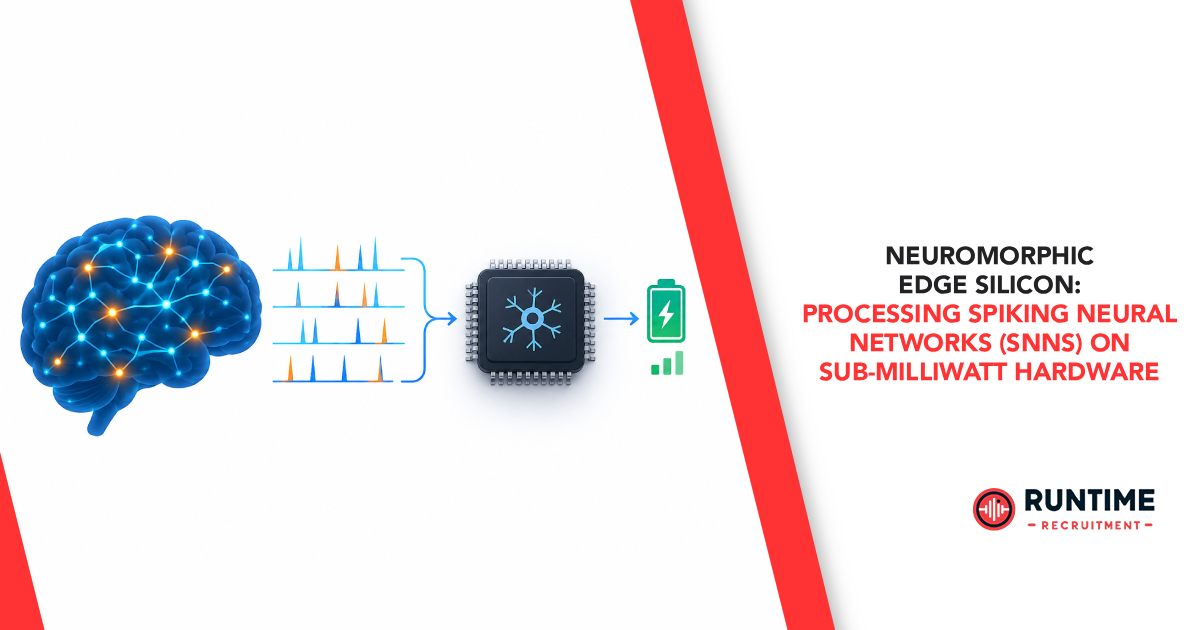
Edge AI system design is constrained by the energy cost of data movement. Traditional microcontrollers (MCUs) with vector extensions, micro-NPUs, and conventional Digital Signal Processors (DSPs) rely on the von Neumann architecture. They process continuous data streams — from micro-electromechanical systems (MEMS) accelerometers, acoustic microphones, or image sensors — by repeatedly sampling signals at fixed clock intervals, buffering frame tensors in SRAM or DRAM, and performing dense Multiply-Accumulate (MAC) matrix operations across hundreds of thousands of weight parameters. Even on modern 22nm Ultra-Low Power (ULP) or Fully-Depleted Silicon-On-Insulator (FD-SOI) processes, running a dense Convolutional Neural Network (CNN) or continuous Recurrent Neural Network (RNN) consumes anywhere from tens to hundreds of milliwatts (10 mW— 500mW). For battery-powered edge devices, energy-harvesting IoT nodes, implantable medical electronics, and always-on smart sensors, a multi-milliwatt power profile is unsustainable. A standard 220mAh CR2032 coin cell battery drained continuously at 20mW will deplete in under two days.

Read More >>
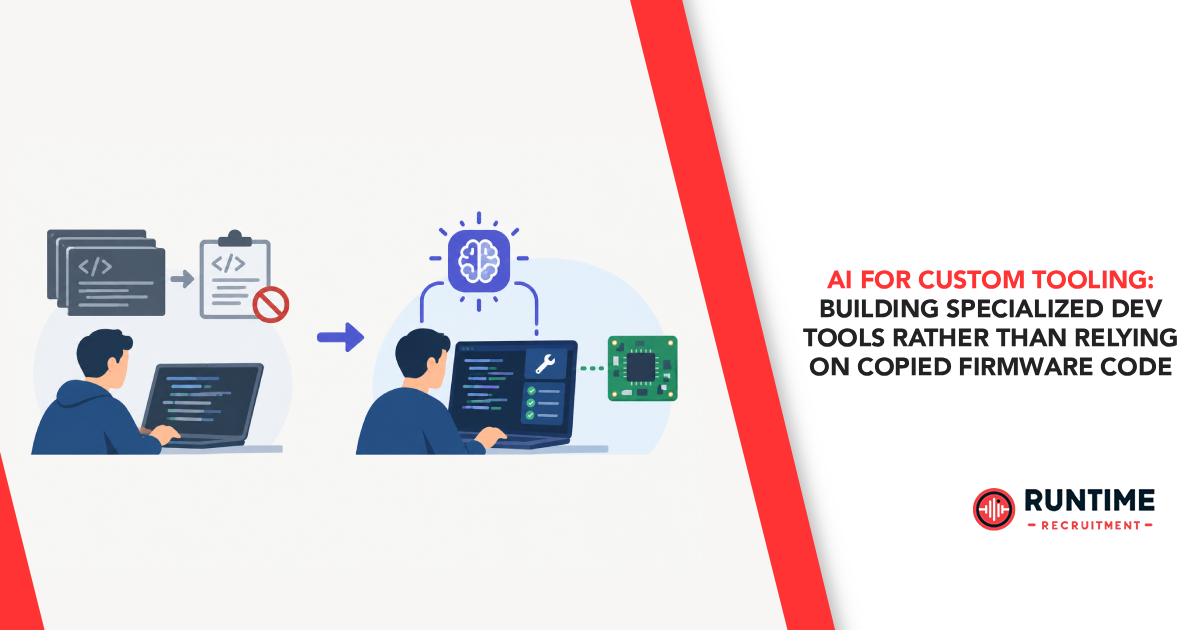
AI for Custom Tooling: Building Specialized Dev Tools Rather Than Relying on Copied Firmware Code
Technical9 September 2026

AI for Custom Tooling: Building Specialized Dev Tools Rather Than Relying on Copied Firmware Code

In embedded systems engineering, however, the physics of the environment are unforgiving. Firmware runs directly on bare-metal silicon or real-time operating systems (RTOS) with hard deterministic deadlines, strict memory constraints, volatile memory-mapped registers, and precise clock configurations. Asking a large language model (LLM) to generate C, C++, or Rust firmware directly—and copy-pasting that output straight into a target microcontroller's flash memory—is a high-risk strategy. An LLM running in a remote cloud data center lacks physical awareness of your hardware target. It does not understand your specific silicon revision, board layout trace impedances, peripheral errata, memory-mapped register states, or interrupt handler priorities. Dropping raw, AI-generated code onto a target device routinely introduces subtle timing glitches, priority inversions, unhandled edge cases, and memory corruption that can take days or weeks to diagnose with an oscilloscope, logic analyzer, or JTAG debugger.

Read More >>
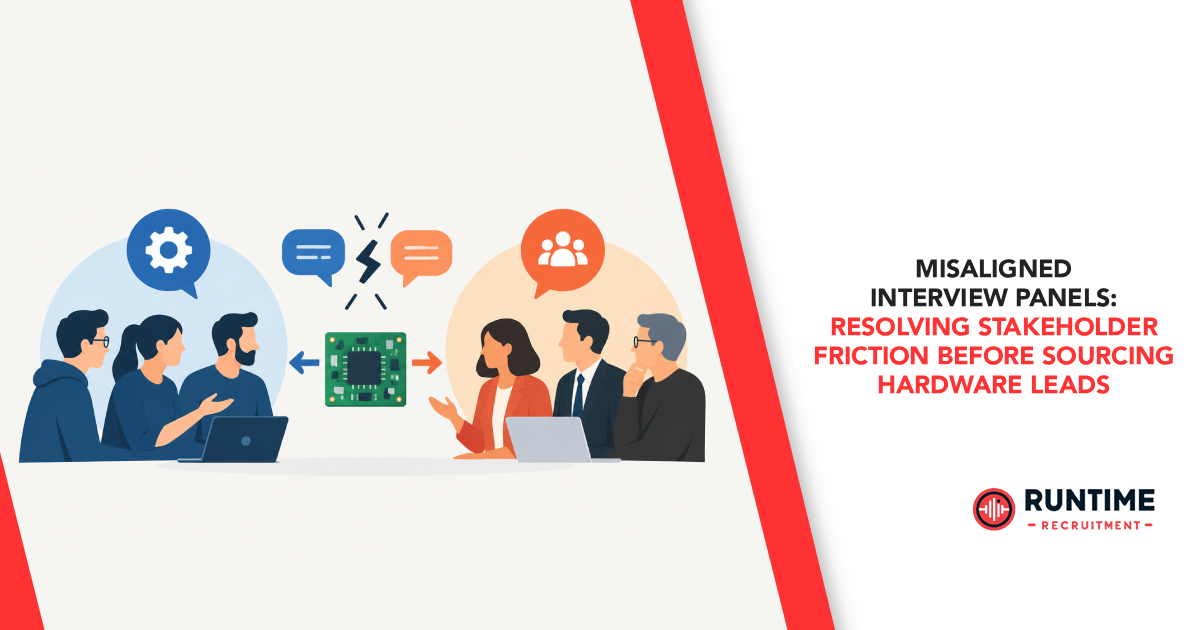
Misaligned Interview Panels: Resolving Stakeholder Friction Before Sourcing Hardware Leads
Hiring8 September 2026

Misaligned Interview Panels: Resolving Stakeholder Friction Before Sourcing Hardware Leads

When an organization sets out to recruit a Hardware Lead, the immediate focus usually shifts outward: crafting the job description, reaching out to niche professional networks, and screening candidates for expertise in high-speed PCB design, SoC selection, power management, or regulatory compliance. Yet, weeks or months into the search, a familiar and frustrating pattern often emerges. Promising candidates pass through four or five rounds of interviews only to be rejected late in the game, or job offers stall indefinitely due to split, contradictory panel feedback. Sourcing a Hardware Lead without first achieving deep alignment across your interview panel is the engineering equivalent of routing a complex 12-layer printed circuit board without defining the stackup or setting constraints in your CAD tool. You generate noise, incur severe rework, and risk burning through top-tier candidate goodwill. To hire technical leaders who can ship reliable physical products on schedule and within budget, engineering organizations must systematically resolve panel misalignment before the talent search ever launches.

Read More >>
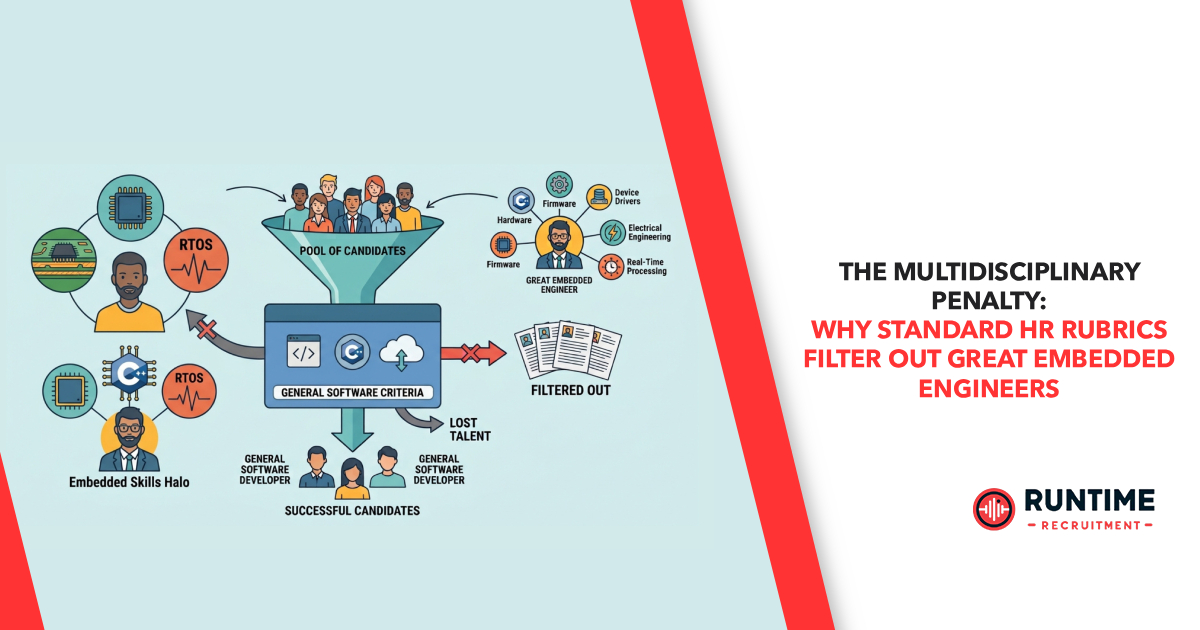
The Multidisciplinary Penalty: Why Standard HR Rubrics Filter Out Great Embedded Engineers
Hiring

The Multidisciplinary Penalty: Why Standard HR Rubrics Filter Out Great Embedded Engineers

Embedded systems engineering is, by definition, a T-shaped discipline. The vertical bar of the “T” represents deep, hard-won expertise in low-level software, real-time operating systems, or digital hardware. The horizontal bar represents a terrifyingly broad understanding of everything else: electronics, physics, mechanical constraints, supply chain limitations, compiler behavior, and often the business logic of the product itself. To be a great embedded engineer is to be a translator between the abstract world of software and the unforgiving reality of physical hardware. Yet, when it comes time to hire, the industry often forgets this. We grade embedded engineers using rubrics designed for software developers or, worse, for generic "IT professionals." The result is a talent pipeline that is clogged with false negatives—brilliant systems thinkers who are discarded by keyword-matching algorithms before a human ever sees their resume.

Read More >>
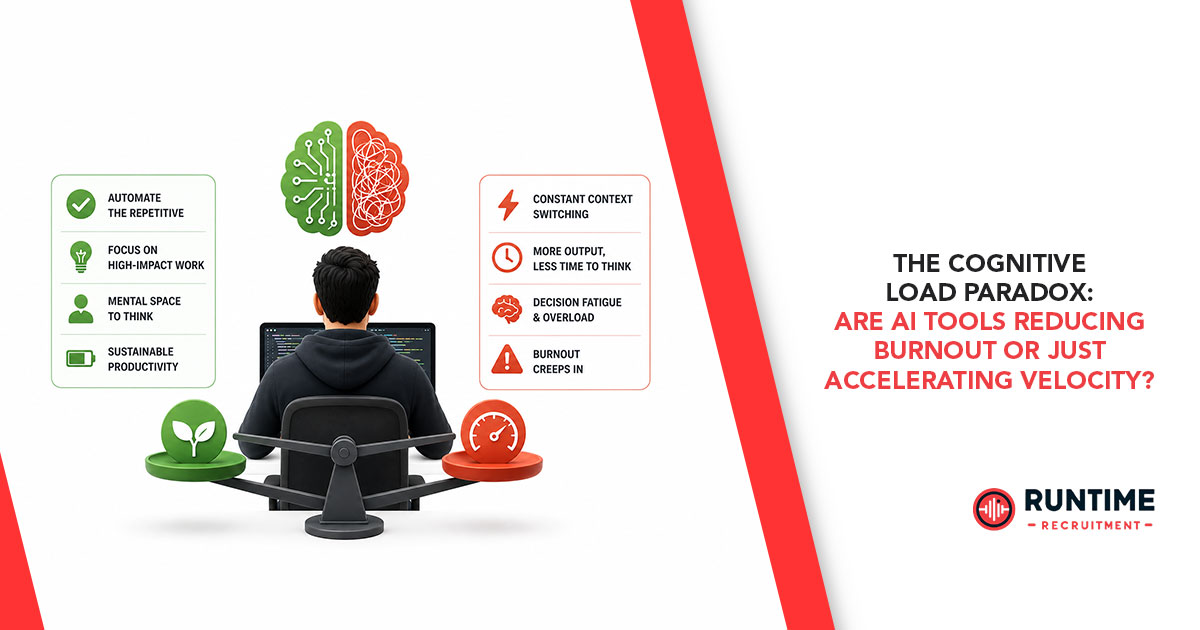
The Cognitive Load Paradox: Are AI Tools Reducing Burnout or Just Accelerating Velocity?
Technical26 August 2026

The Cognitive Load Paradox: Are AI Tools Reducing Burnout or Just Accelerating Velocity?

The modern embedded systems engineering landscape is undergoing a tectonic shift. For decades, firmware developers and embedded hardware engineers operated under a steady rhythm dictated by datasheets, silicon errata, register maps, and strict hardware abstraction layers (HALs). Crafting low-level C or C++ code for microcontrollers, configuring direct memory access (DMA) controllers, and debugging real-time interrupt service routines (ISRs) required painstaking precision. A single misplaced bitwise operation could result in a hard fault, a silent memory corruption, or bricked hardware on the bench. Yet, as these AI tools achieve widespread integration across development teams, an unexpected phenomenon has emerged—what industry veterans are calling The Cognitive Load Paradox. Instead of feeling liberated, many embedded engineers report feeling more exhausted, perpetually rushed, and mentally drained. While AI assistants have undoubtedly accelerated line-by-line coding velocity, they have simultaneously compressed development cycles, elevated expectations for throughput, and shifted the primary engineering effort from authoring code to relentlessly auditing synthetic outputs.

Read More >>
Vendor Lock-In in the Age of AI: Navigating Proprietary Copilot Ecosystems vs. Open-Source Weights
Technical25 August 2026

Vendor Lock-In in the Age of AI: Navigating Proprietary Copilot Ecosystems vs. Open-Source Weights

For embedded systems engineers, the allure of generative AI is undeniable. The day-to-day reality of writing low-level code involves navigating labyrinthine reference manuals, configuring complex register maps, debugging race conditions in real-time operating systems (RTOS), and wrangling peripheral drivers. When AI-powered copilots first emerged, promising instant boilerplate generation, automated unit tests, and quick explanations for obscure compiler warnings, they felt like a long-overdue revolution. However, as engineering teams transition from experimental adoption to deep production integration, a shadow has fallen across the workbench. We are witnessing the rapid crystallization of a new kind of technical debt: AI vendor lock-in.

Read More >>
The Walled Garden: Why Hermetic Build Environments Are Non-Negotiable for Embedded Engineering
Technical24 August 2026

The Walled Garden: Why Hermetic Build Environments Are Non-Negotiable for Embedded Engineering

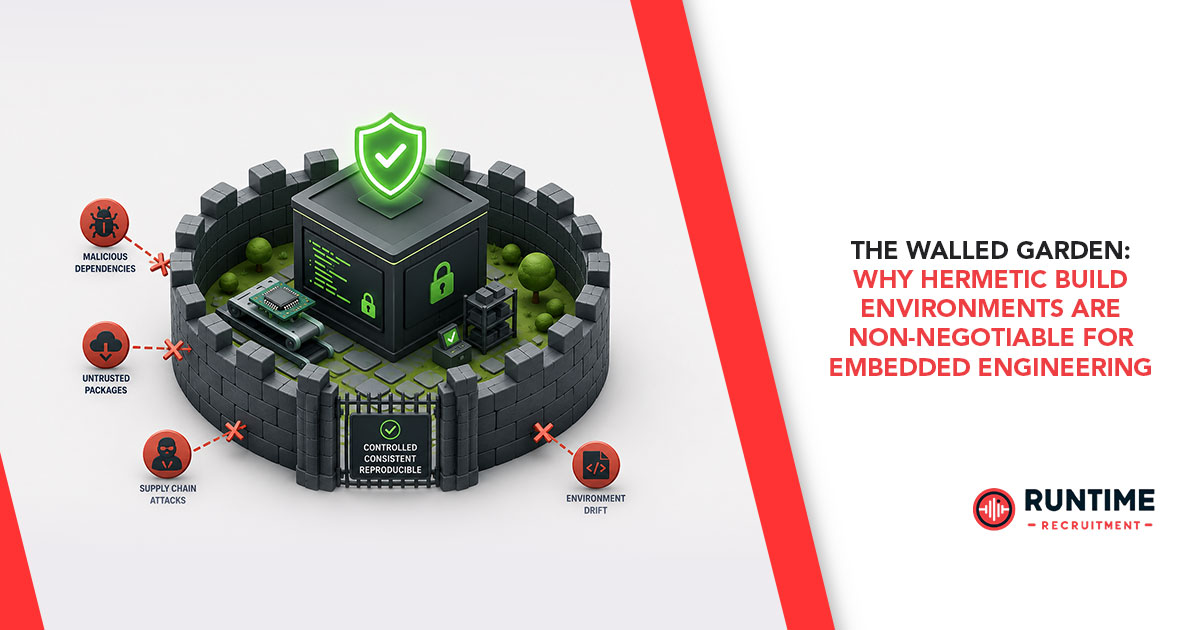
Every embedded software team has lived through a version of the same engineering tragedy. A customer reports a critical edge-case failure on a legacy microcontroller deployed in the field five years ago. A developer is tasked with opening the firmware repository, applying a hotfix, and rebuilding the binary. However, upon checking out the repository, chaos ensues. The project requires a legacy GCC ARM toolchain—specifically version 7-2018-q2-update—alongside a bespoke Python 2.7 build script, a deprecated vendor-specific HAL library, and a precise configuration of GNU Make that only runs correctly under an outdated Linux kernel or an unpatched Windows 7 virtual machine. This fragility is the direct consequence of non-hermetic build environments. For decades, embedded development has relied on locally installed, host-dependent toolchains. Unlike modern cloud-native software development—where applications are packaged alongside their execution runtime—embedded engineering has traditionally treated the host workstation as a dirty canvas of globally installed tools. When build environments are tied to the host operating system's global paths, host library versions, and user configuration settings, bit-for-bit reproducibility across team members and automated build systems becomes virtually impossible.

Read More >>
Passive NFC Field Diagnostics: Reading Error Logs and Extracting Telemetry from Fully Powered-Down Devices
Technical21 August 2026

Passive NFC Field Diagnostics: Reading Error Logs and Extracting Telemetry from Fully Powered-Down Devices

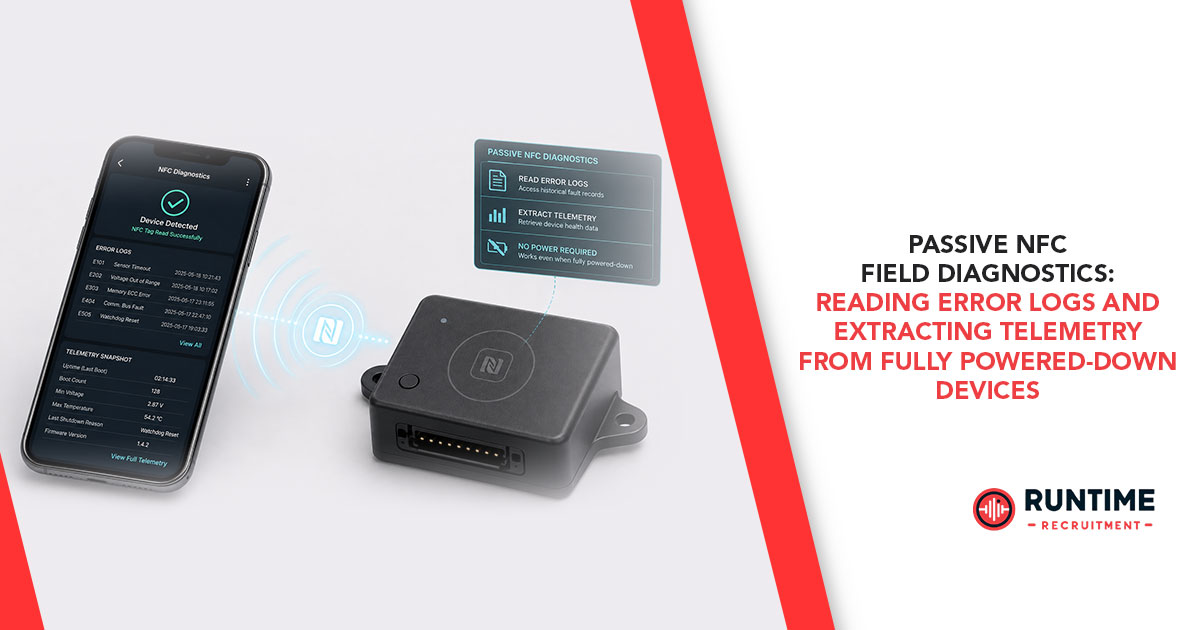
Every embedded engineer who has deployed hardware into harsh industrial, remote, or outdoor environments knows the dread of receiving a "bricked" return merchandise authorization (RMA) unit. The device arrives on the bench in a completely unresponsive state: the power supply rail is dead, the main lithium battery is depleted or chemically locked, status LEDs remain dark, and the primary microcontroller (MCU) refuses to boot. To make matters worse, modern industrial sensors, medical devices, smart meters, and automotive modules are frequently rated IP68 or fully encapsulated in potting compound. Diagnosing the failure using traditional methods—cracking open the sealed enclosure, soldering microscopic fly-wires to debug pads, and probing JTAG or UART interfaces—is destructive, labor-intensive, and invalidates the failure analysis context.

Read More >>
Designing for Disassembly: Engineering Modular Hardware to Meet Right-to-Repair Directives
Technical20 August 2026

Designing for Disassembly: Engineering Modular Hardware to Meet Right-to-Repair Directives

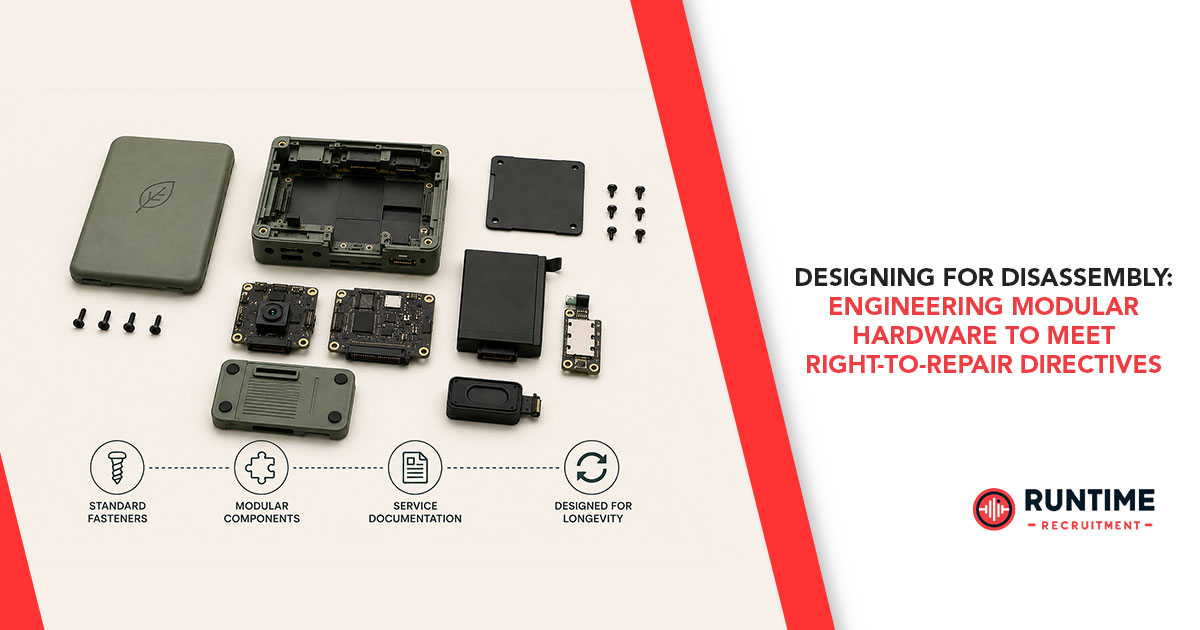
For decades, embedded hardware design has been driven by a push toward miniaturization, functional density, and manufacturing cost reduction. This trajectory gave rise to monolithic hardware architectures characterized by surface-mount technology (SMT), structural adhesives, glob-top potting, direct chip-on-board (COB) bonding, and integrated flex-rigid assemblies. While these methods maximized mechanical compactness and reduced bill-of-materials (BOM) costs for high-volume automated production, they rendered field servicing and component-level repair virtually impossible. Products became single-use electronic artifacts: upon the failure of a single ceramic capacitor, power MOSFET, or battery cell, the entire assembly was destined for landfill or energy-intensive recycling. For embedded systems engineers, this legislative momentum fundamentally changes the engineering brief. Compliance cannot be retrofitted via post-hoc service manuals or aftermarket adhesive solvents; it must be architected into the hardware and firmware from the earliest conceptual design phase. Design for Disassembly (DfD) has evolved from a sustainability concept into a core engineering requirement alongside Design for Manufacturability (DFM), Design for Testability (DFT), and Design for EMC (DEMC). Mastering DfD requires embedded engineers to re-evaluate mechanical fastening strategies, PCB partitioning, high-density interconnect selection, thermal management, and firmware attestation architectures.

Read More >>
Privacy-Preserving Edge Personalization: Combining Local Training with Encrypted Inference
Technical18 August 2026

Privacy-Preserving Edge Personalization: Combining Local Training with Encrypted Inference

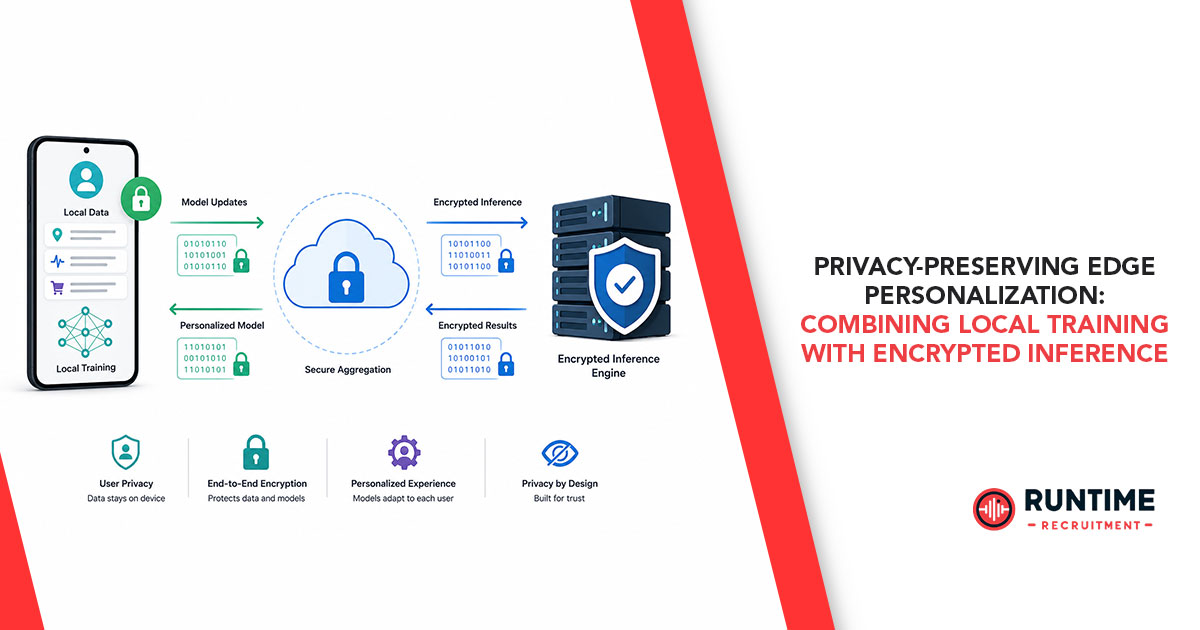
Deploying machine learning models to resource-constrained edge devices presents a fundamental engineering paradox: maximally personalized user experiences require continuous learning from private local data, yet running heavy neural networks on constrained hardware often forces offloading computations to untrusted external environments. In domains such as wearable health monitors, smart home automation, industrial sensing, and biometric authentication, sending raw sensor feeds to the cloud violates privacy regulations (such as GDPR, HIPAA, and the EU Cyber Resilience Act) and introduces unacceptable latency. Conversely, relying solely on static, pre-trained global models yields sub-optimal inference accuracy for non-stationary, user-specific data distributions.

Read More >>
The Missing Middle: How the Collapse of Junior Embedded Hiring Created an Unfillable Senior Talent Gap
Hiring17 August 2026

The Missing Middle: How the Collapse of Junior Embedded Hiring Created an Unfillable Senior Talent Gap

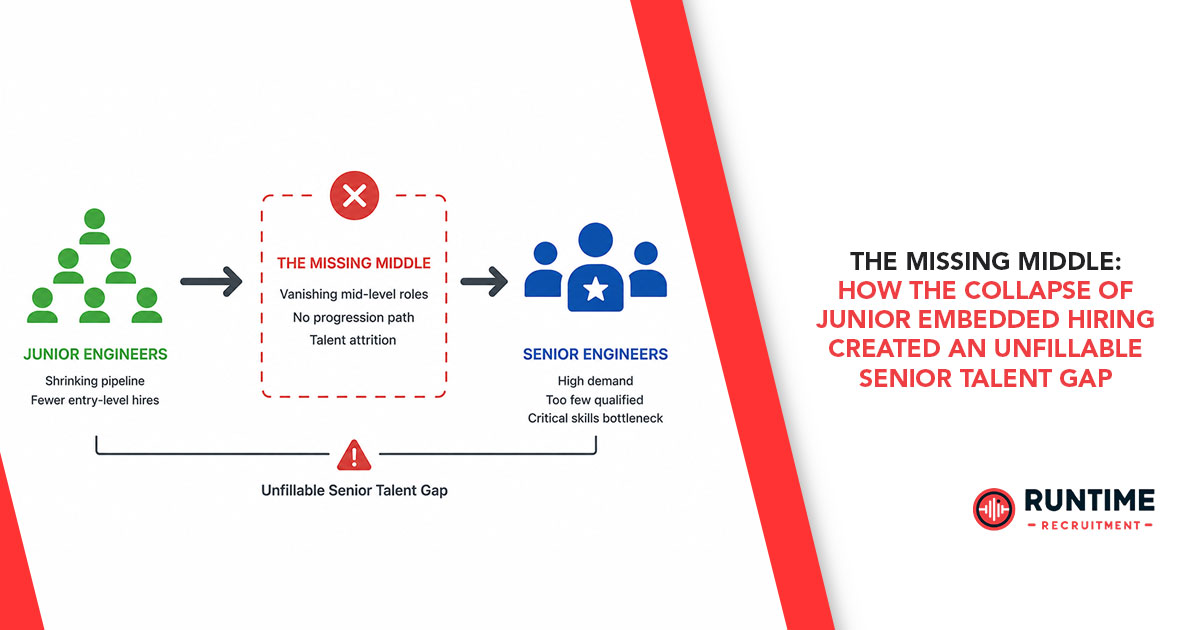
Job boards are flooded with requisitions for Principal Firmware Architects, Senior Embedded Software Engineers, and Systems Engineers with 8 to 15 years of experience. Companies are dangling eye-watering compensation packages, sign-on bonuses, and remote flexibility to lure talent capable of untangling complex multi-core ARM architectures, configuring Real-Time Operating Systems (RTOS), and debugging bare-metal C/C++ hardware interfaces. Yet, despite these lucrative offers, these roles often sit vacant for 6 to 12 months. To the casual observer, this looks like a straightforward shortage of technical talent. But inside engineering departments, the real root cause is clear: this is not a sudden shortage; it is a self-inflicted structural collapse.

Read More >>
The Emulation Trap: Why QEMU and Software Simulators Miss Hardware-Level Timing Glitches
Technical14 August 2026

The Emulation Trap: Why QEMU and Software Simulators Miss Hardware-Level Timing Glitches

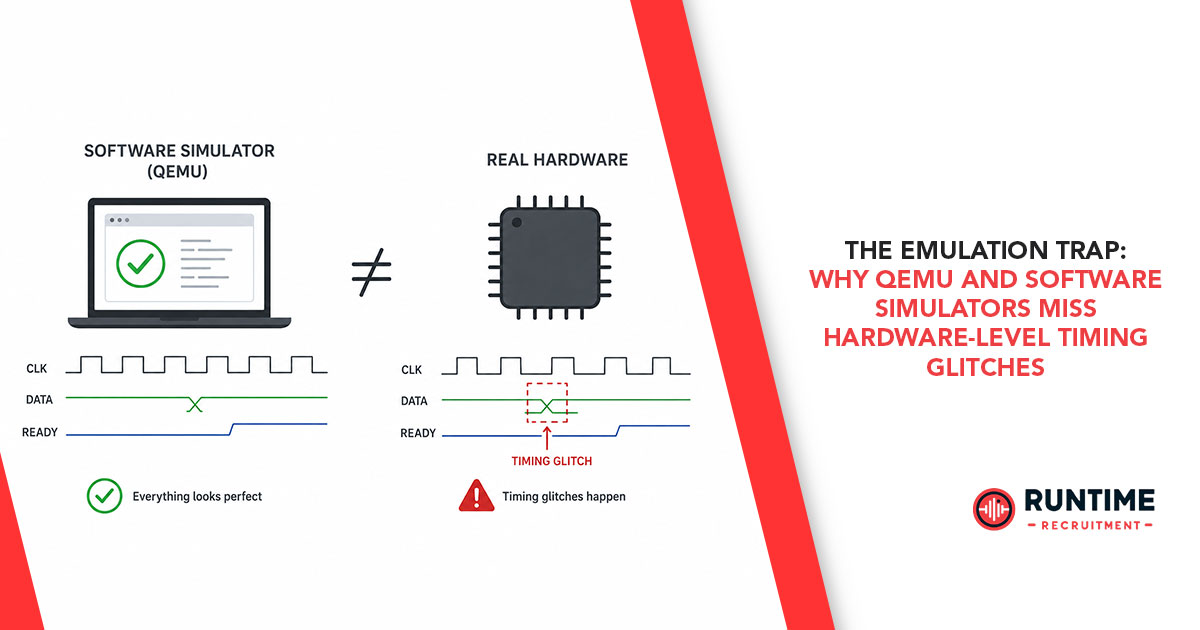
Every embedded systems engineer has experienced a version of this nightmare: your firmware builds cleanly, passes every unit test in a QEMU-based Continuous Integration (CI) pipeline, and executes seamlessly across millions of virtualized instruction cycles. Confident in the stability of the build, you flash the binary onto target silicon. Within hours—or worse, under heavy thermal throttling in field testing—the system locks up, corrupts a DMA buffer, or drops critical CAN bus frames. Virtual platforms like QEMU, Renode, and OVPSim are modern engineering marvels. They enable shift-left software development, allowing firmware teams to architect application logic, integrate RTOS kernels, and run automated regression suites long before physical silicon leaves the fab. However, a dangerous misconception persists across modern engineering organizations: confusing functional instruction equivalence with temporal microarchitectural accuracy.

Read More >>
Dual-Bank Flash Swaps: Preventing Unrecoverable Bricks During Power Interruption Mid-A/B Update
Technical11 August 2026

Dual-Bank Flash Swaps: Preventing Unrecoverable Bricks During Power Interruption Mid-A/B Update

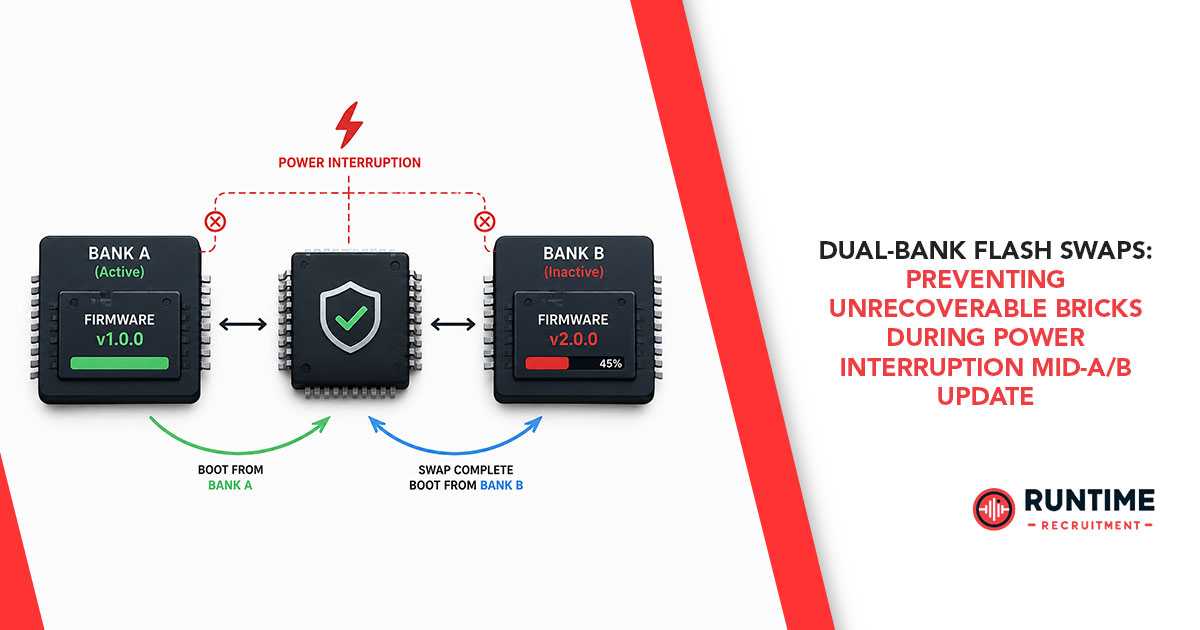
Every embedded engineer has experienced the cold sweat of a potential field failure. Imagine a fleet of remote industrial sensors, automotive ECUs, or medical devices deployed across thousands of customer sites. An Over-The-Air (OTA) firmware update is broadcast across the network. Midway through writing the new binary image into internal flash memory, a power failure occurs—a drained battery, a grid brownout, or an operator accidentally pulling the plug. If the system relies on a traditional single-bank flash memory architecture, this single event can be catastrophic. The existing application code is partially erased or corrupted, leaving the device stranded in an incomplete bootloader loop or completely unresponsive—a state known as "bricking". Recovering thousands of bricked devices in the field requires expensive manual intervention, physical JTAG re-flashing, or costly RMA returns.

Read More >>
Secure by Default, Not by Patch: Moving Threat Modeling to the Very Beginning of the Embedded Lifecycle
Technical10 August 2026

Secure by Default, Not by Patch: Moving Threat Modeling to the Very Beginning of the Embedded Lifecycle

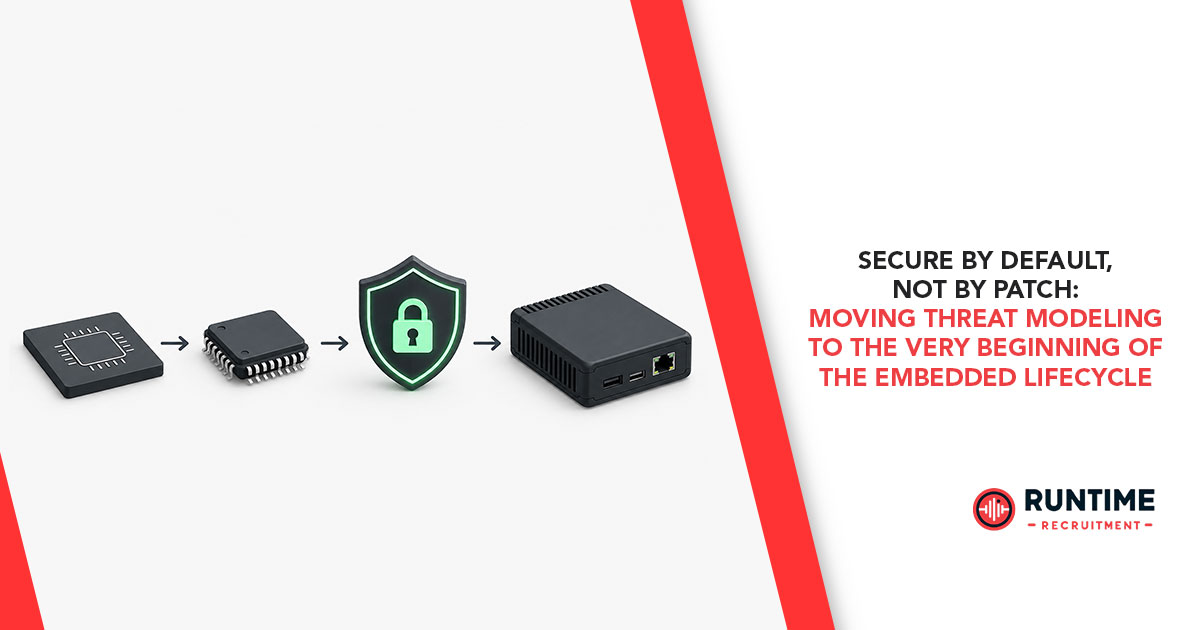
For years, the technology industry has leaned on a "move fast and break things" philosophy, treating security as a bolt-on feature handled via post-release patches. While web developers can afford to push a hotfix to a cloud server in ten minutes, embedded engineers operate in the physical world. In our domain, pushing a faulty Over-The-Air (OTA) update to a fleet of agricultural tractors over a spotty 2G connection can brick the entire fleet. The era of "patching it later" is over. Regulatory frameworks and the sheer physics of connected devices are forcing a paradigm shift. To build truly resilient products, we must adopt a Secure by Default methodology. And that begins with moving Threat Modeling to the very beginning of the embedded lifecycle—Phase Zero.

Read More >>
AI Isn’t Replacing Firmware Engineers: Why Stricter Expectations are Exposing Weak Embedded Architectures
General7 August 2026

AI Isn’t Replacing Firmware Engineers: Why Stricter Expectations are Exposing Weak Embedded Architectures

While high-level application developers may worry about AI writing web frameworks from scratch, firmware development exists at the unforgiving intersection of software algorithms and physical silicon. Microcontrollers (MCUs), real-time operating systems (RTOS), DMA controllers, memory protection units (MPUs), and hardware registers do not operate in an abstract cloud sandbox with limitless RAM and elastic compute resources. They operate under deterministic timing budgets, strict power envelopes, hard physical safety requirements, and vendor silicon errata. AI code generation tools are becoming remarkably capable at writing standard HAL initialization routines, synthesizing simple state machines, and generating repetitive board support package (BSP) scaffolding. However, this sudden influx of high-velocity code creation is actually exposing a long-standing vulnerability within the embedded industry: poor software architecture.

Read More >>
Custom RISC-V AI Extensions: The Hardware Verification Nightmare of Tailored Vector Acceleration
Technical6 August 2026

Custom RISC-V AI Extensions: The Hardware Verification Nightmare of Tailored Vector Acceleration

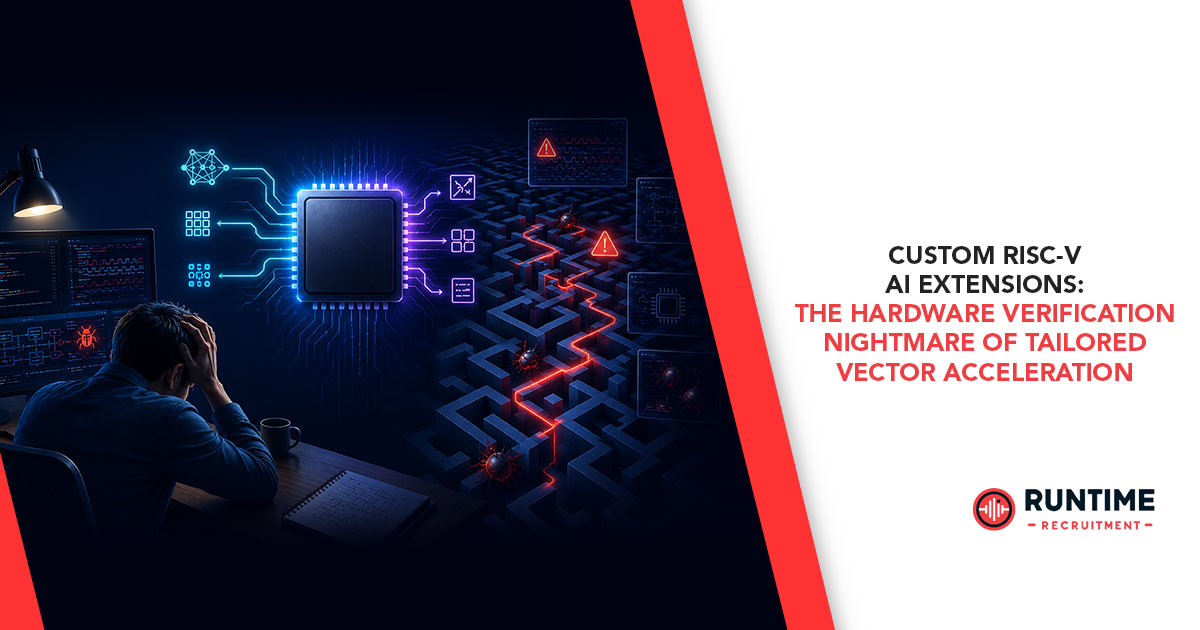
The promise of the RISC-V Instruction Set Architecture (ISA) has fundamentally reshaped domain-specific hardware design. The open, modular standard grants microarchitects uninhibited freedom to break free from rigid, off-the-shelf processor architectures and engineer bespoke hardware primitives tailored precisely to target workloads. In the high-stakes domain of Edge Artificial Intelligence and TinyML, where microcontrollers and embedded System-on-Chips (SoCs) must execute dense neural network inference within milliwatt power envelopes, standard scalar—or even standard vector—execution often falls short. However, architectural freedom comes with a severe microarchitectural tax. While defining a custom instruction opcode and implementing its Register-Transfer Level (RTL) datapaths may take weeks, verifying it to production-grade functional correctness often takes months—or years. Custom RISC-V vector extensions transform standard processor design verification (DV) into a multidimensional nightmare. The moment custom state, dynamic vector configurations, asynchronous execution queues, and packed quantization types cross paths with complex processor pipeline hazard handling, traditional verification flows crumble.

Read More >>
Thread Mesh Meltdowns: Diagnosing Routing Loops and Dropped Nodes in Dense Smart Building Deployments
Technical5 August 2026

Thread Mesh Meltdowns: Diagnosing Routing Loops and Dropped Nodes in Dense Smart Building Deployments

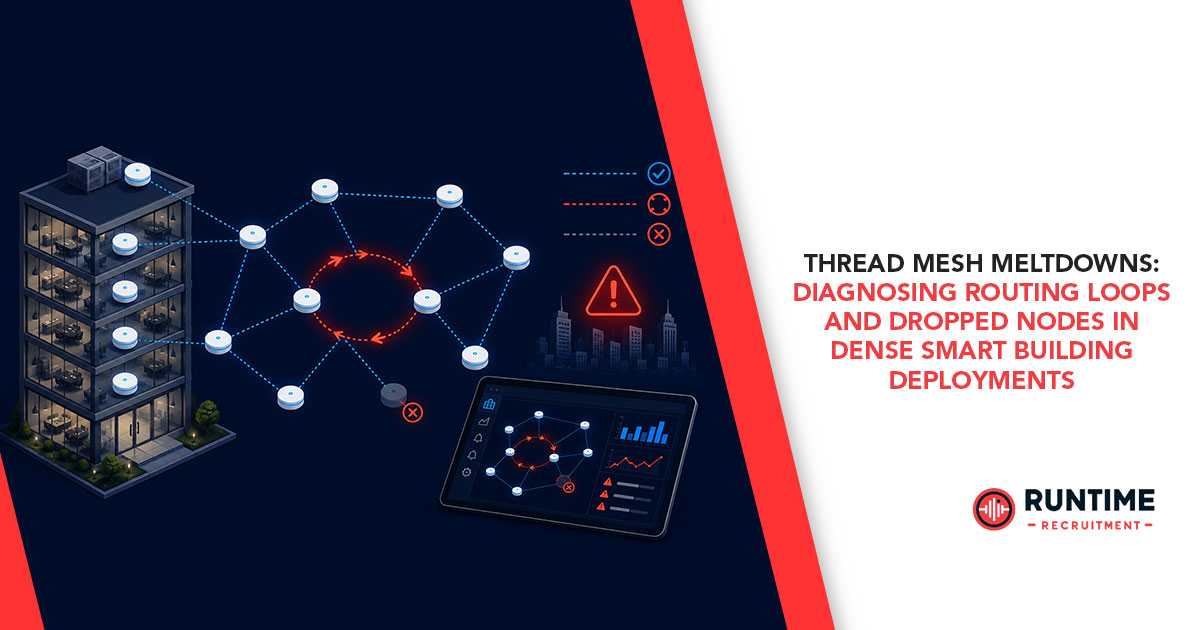
The rapid adoption of Thread protocol, built upon the IEEE 802.15.4 standard and IPv6, has fundamentally changed the landscape of low-power wireless communications. Originally popularized by the smart home sector and the Matter standard, Thread is increasingly being pushed into commercial environments. We are now seeing dense smart building deployments where hundreds, or even thousands, of nodes, ranging from intelligent HVAC dampers and occupancy sensors to massive interconnected lighting arrays, are expected to operate seamlessly on a single mesh network. However, the transition from a typical 50-node residential setup to a 500-plus node commercial floor plan introduces immense complexity. When deployed at this scale, embedded engineers often encounter a harsh reality: network topologies that look robust on a whiteboard can rapidly deteriorate in the field. What begins as a few delayed lighting commands can cascade into a full-scale Thread mesh meltdown, characterized by severe routing loops, skyrocketing latency, and completely dropped nodes.

Read More >>
The Copy-Paste Firmware Crisis: How AI Code Generation is Eroding Deep Hardware-Software Integration Expertise
Technical4 August 2026

The Copy-Paste Firmware Crisis: How AI Code Generation is Eroding Deep Hardware-Software Integration Expertise

While AI can certainly assist in writing C, C++, or Rust, a troubling trend is emerging across the industry. Let's call it the "copy-paste firmware crisis." Driven by tight project deadlines and the illusion of AI infallibility, a growing number of developers are treating LLMs as a shortcut around the datasheet. They are pasting AI-generated peripheral configurations, protocol wrappers, and hardware abstraction layer (HAL) integrations directly into their IDEs. The result? Code that compiles flawlessly but fails spectacularly on silicon. More importantly, this over-reliance on AI for low-level implementation is slowly eroding the most critical skill an embedded engineer possesses: deep hardware-software integration expertise. When developers become mere "prompt jockeys," the foundational understanding of how code physically interacts with electrons is lost.

Read More >>
The Open-Source License Risk: Vetting Firmware Candidates on IP Awareness
Hiring3 August 2026

The Open-Source License Risk: Vetting Firmware Candidates on IP Awareness

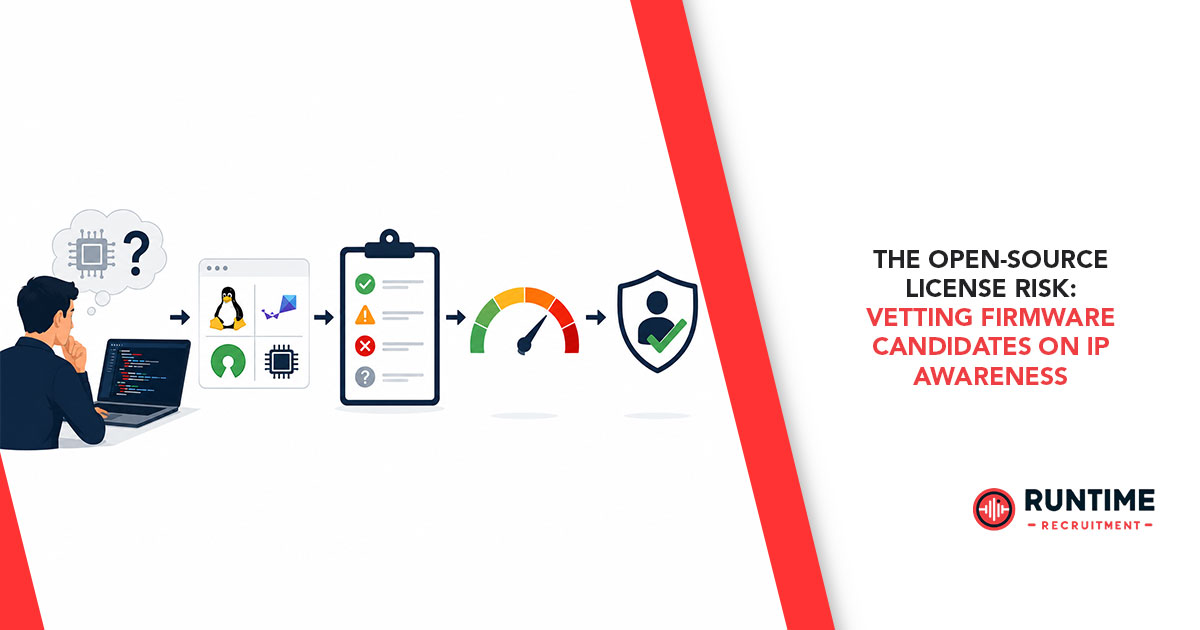
In modern embedded systems engineering, velocity is paramount. Driven by tight market windows, shrinking hardware margins, and escalating feature complexity, firmware teams rarely build software stacks from absolute scratch. From vendor-supplied Hardware Abstraction Layers (HALs) and Real-Time Operating Systems (RTOS) like FreeRTOS or Zephyr to network stacks (lwIP), cryptographic libraries (mbedTLS), and protocol parsers, open-source software (OSS) forms the foundational bedrock of virtually every deployed microcontroller (MCU) and system-on-chip (SoC) today. Consequently, technical leadership can no longer treat open-source license awareness as a downstream administrative task reserved for legal departments. IP risk mitigation must begin at the hiring pipeline. Vetting firmware candidates for IP awareness and license literacy is as critical to product health as evaluating their proficiency in C/C++ memory management, low-level debugging, or register-level peripheral control.

Read More >>
The "Self-Taught" Hardware Engineer Trap: Evaluating Hands-On Project Experience Over Theoretical Degrees
Career29 July 2026

The "Self-Taught" Hardware Engineer Trap: Evaluating Hands-On Project Experience Over Theoretical Degrees

The software development world has spent the last two decades celebrating the rise of the self-taught developer. Bootcamps, open-source repositories, and interactive tutorials proved that you do not need a four-year Computer Science degree to ship scalable web applications, write clean APIs, or build responsive user interfaces. While hands-on project experience is invaluable, there is a subtle, high-stakes phenomenon emerging across tech hiring: The "Self-Taught" Hardware Engineer Trap. Evaluating hardware candidates strictly by their visible project output while dismissing formal theoretical foundations—or conversely, assuming a theoretical Electrical Engineering (EE) degree automatically guarantees hardware proficiency—creates significant hiring blind spots.

Read More >>
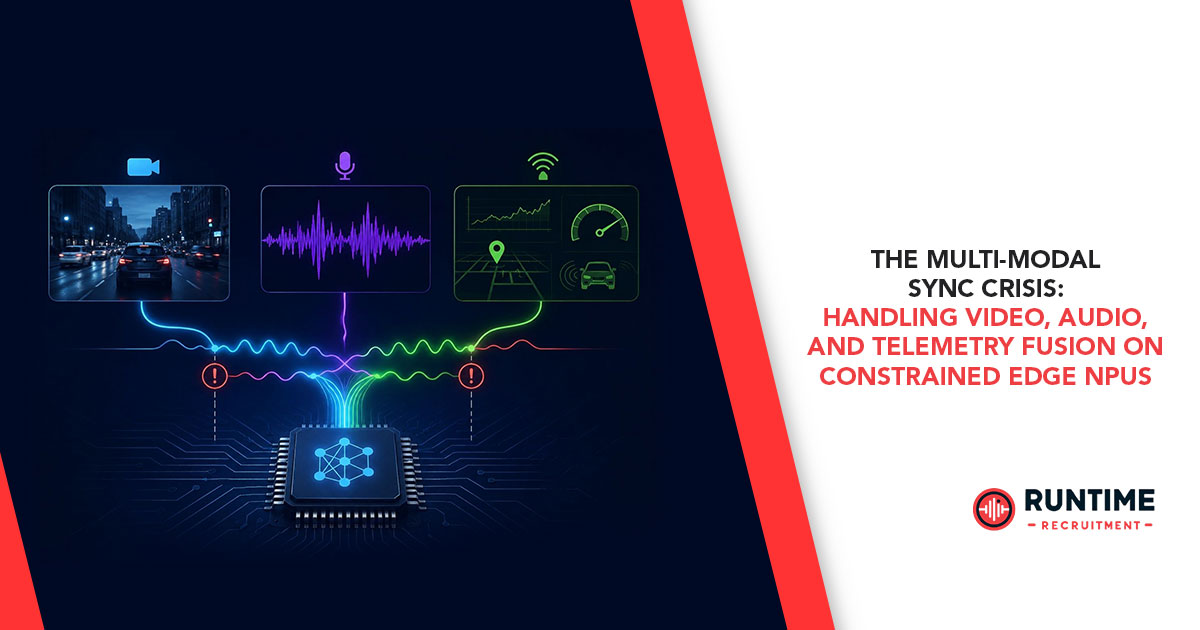
The Multi-Modal Sync Crisis: Handling Video, Audio, and Telemetry Fusion on Constrained Edge NPUs
Technical23 July 2026

The Multi-Modal Sync Crisis: Handling Video, Audio, and Telemetry Fusion on Constrained Edge NPUs

The embedded engineering landscape is undergoing a radical paradigm shift. We have moved past the era of single-sensor intelligence. Today’s edge devices—ranging from autonomous drones and industrial robotics to advanced wearable health monitors—are expected to understand their environment by simultaneously ingesting high-definition video, multi-channel audio, and high-frequency telemetry data. We are demanding that deeply embedded systems perceive the world much like humans do: in a continuous, synchronized, multi-modal stream. However, beneath the marketing promises of "Edge AI," a significant engineering hurdle remains largely unaddressed: the multi-modal synchronization crisis.

Read More >>
Side-Channel Attacks in 2026: Patching Power-Analysis Vulnerabilities Exclusively via Firmware
Technical22 July 2026

Side-Channel Attacks in 2026: Patching Power-Analysis Vulnerabilities Exclusively via Firmware

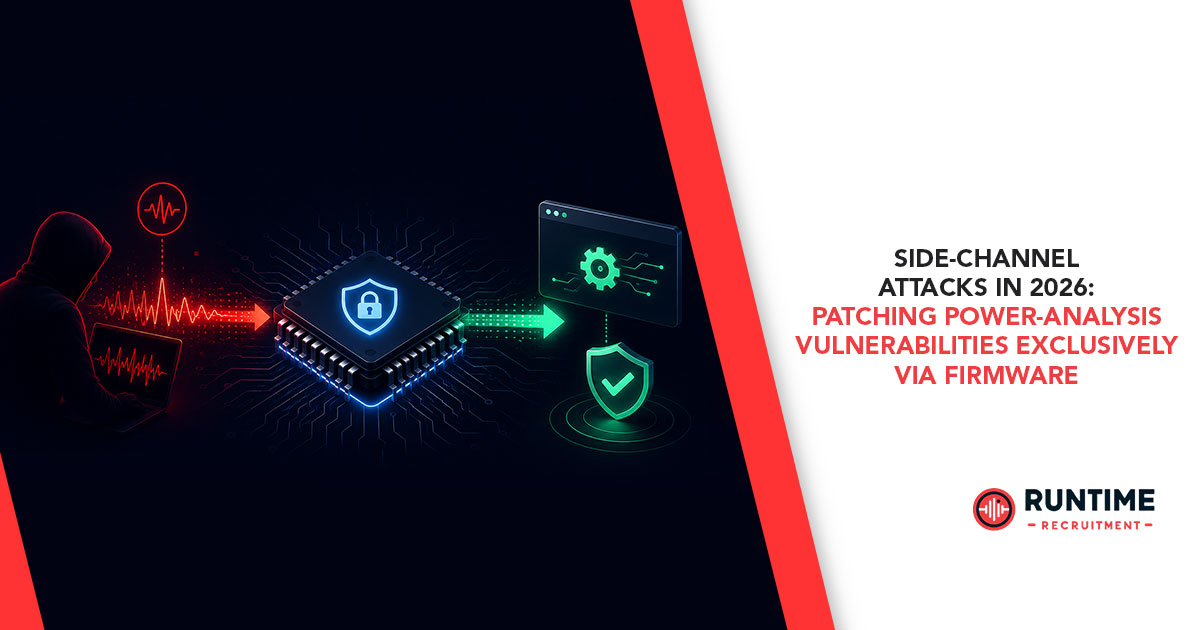
Historically, physical side-channel attacks—specifically Simple Power Analysis (SPA), Differential Power Analysis (DPA), and Correlation Power Analysis (CPA)—were treated as hardware-level problems. If a microcontroller lacked built-in current flattening, localized shielding, or hardware cryptographic accelerators with dual-rail transient logic, the security architecture was considered compromised. However, millions of legacy and cost-constrained devices currently deployed in critical infrastructure, automotive systems, and IoT networks cannot be physically recalled or re-spun. Re-spinning silicon to mitigate newfound power leakage vectors is financially non-viable. Firmware engineering has evolved to bridge this gap. In 2026, mitigating power analysis attacks exclusively through software and low-level firmware updates is no longer a temporary workaround—it is a mandatory engineering practice.

Read More >>