
The Copy-Paste Firmware Crisis: How AI Code Generation is Eroding Deep Hardware-Software Integration Expertise
4 August 2026 · Lance Harvie
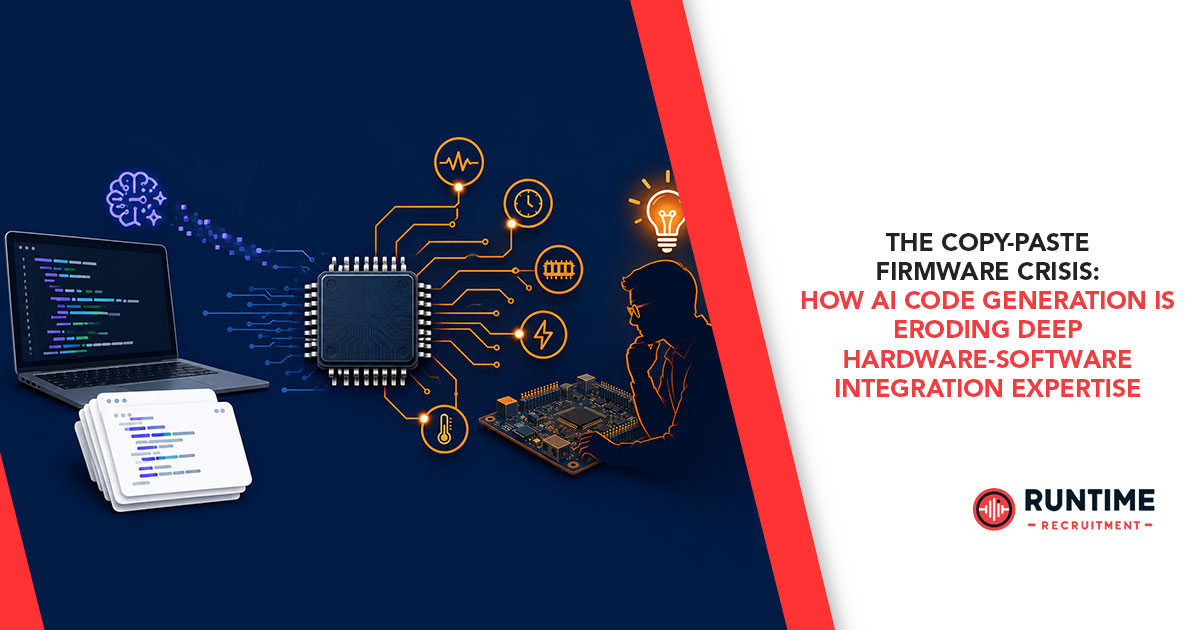
The generative AI revolution has fundamentally altered the landscape of software development. In the realms of web, desktop, and cloud computing, large language models (LLMs) are routinely generating thousands of lines of functional code, refactoring legacy systems, and dramatically accelerating product cycles. But when these same tools are pointed at the bare metal of embedded systems, the narrative abruptly changes.
For embedded engineers, the environment is unforgiving. We operate in a domain governed by strict constraints: limited flash memory, fragmented RAM, deterministic timing requirements, and highly specific, hardware-dependent register maps.
While AI can certainly assist in writing C, C++, or Rust, a troubling trend is emerging across the industry. Let's call it the "copy-paste firmware crisis." Driven by tight project deadlines and the illusion of AI infallibility, a growing number of developers are treating LLMs as a shortcut around the datasheet. They are pasting AI-generated peripheral configurations, protocol wrappers, and hardware abstraction layer (HAL) integrations directly into their IDEs.
The result? Code that compiles flawlessly but fails spectacularly on silicon. More importantly, this over-reliance on AI for low-level implementation is slowly eroding the most critical skill an embedded engineer possesses: deep hardware-software integration expertise. When developers become mere "prompt jockeys," the foundational understanding of how code physically interacts with electrons is lost.
The Phenomenon of "Silent Failures"
If you write a web application using an AI assistant and a bug is introduced, you typically receive a stack trace, a server error, or a clear console log. The failure is loud, verbose, and highly diagnostic. In embedded firmware development, failures are notoriously silent.
Consider a scenario where an engineer tasks an AI to write an I2C driver for a new proximity sensor on an ESP32 or an STM32 microcontroller. The LLM, trained on millions of lines of open-source GitHub repositories and vendor SDKs, will confidently output a structurally perfect block of code. It will feature correct function names, plausible initialization sequences, and even well-formatted Doxygen comments.
The developer pastes the code, hits compile, and flashes the binary to the board. The device powers on, the status LED blinks once, and then... nothing. No error codes are thrown. No runtime crash occurs. There is just a dead UART terminal and a corrupted boot sequence.
Why does this happen? Because an AI assistant has never seen your specific board schematic. It doesn't know that the SDA line was routed to GPIO 4 instead of the default GPIO 21 because the hardware board designer needed the default pin for an IMU interrupt line. It doesn't know that your hardware team decided to omit a physical pull-up resistor, requiring an internal pull-up to be manually configured via software registers.
LLMs are highly prone to "hallucinating" hardware details. They will confidently reference non-existent hardware registers, suggest incorrect pin multiplexing assignments, or utilize inappropriate peripheral initialization sequences. In the embedded world, one wrong bit in a configuration register doesn't just throw a catchable exception; it can cause a fatal bus collision on an SPI line, violate strict timing requirements on a CAN bus, or prevent the system from ever booting. When engineers blindly copy and paste this code, they are importing these silent failures directly into their core architecture.
The Erosion of the "Full Stack" Embedded Mindset
True embedded engineering is not merely about writing software; it is about forcing software to yield to the physical realities of hardware. This requires a unique "full-stack" mindset where the stack stretches from the application layer all the way down to the physical silicon gates. It demands the patience and ability to read a 1,000-page microcontroller reference manual, cross-reference it with the silicon errata sheet, and physically verify the electrical signals with a logic analyzer or oscilloscope.
The copy-paste firmware crisis threatens to hollow out this specialized expertise. When an AI generates a complex Direct Memory Access (DMA) initialization sequence, it abstracts away the critical, hands-on learning process. The engineer no longer wrestles with understanding the bus matrix, the arbitration priorities, or the specific memory alignment requirements of the hardware. They get the result without the rigorous journey.
Historically, junior embedded engineers cut their teeth by staring at hex dumps, debugging misaligned pointers, and manually toggling GPIO pins to verify timing with an oscilloscope. This painful but necessary rite of passage built an intuitive mental model of the microcontroller architecture. By outsourcing this foundational struggle to an LLM, we are depriving the next generation of engineers of the very experiences that build mastery. They may ship their first feature faster, but they will hit a definitive ceiling when they encounter a bug that the AI cannot solve, lacking the low-level intuition required to manually diagnose the hardware.
This lack of deep integration knowledge becomes catastrophic during the debugging phase. Embedded codebases are notorious for complex edge cases: intermittent race conditions in Interrupt Service Routines (ISRs), unaligned memory accesses, or clock stretching issues on a communication bus. If an engineer did not write the foundational hardware-interaction code, and more importantly, does not deeply understand how the underlying bare-metal registers operate, they are entirely unequipped to debug these physical layer issues.
We are risking a generational knowledge gap. As the rapid generation of code outpaces human review capacity, we are accumulating vast amounts of AI-generated firmware without a corresponding accumulation of human understanding. When the inevitable hardware-specific bug arises—perhaps a peripheral locking up due to a nuanced silicon erratum that the AI model wasn't trained on—the team is left stranded, staring at a black box of their own making.
The Perils of Non-Deterministic and Inefficient Code
Another severe consequence of utilizing general-purpose AI for firmware generation is the subtle introduction of non-deterministic behavior. Embedded systems, particularly those running Real-Time Operating Systems (RTOS) or strict bare-metal schedulers, cannot tolerate the inefficiencies often found in high-level software paradigms.
AI models are trained heavily on languages like Python, Java, and high-level C++ where memory and processing resources are virtually unlimited. Consequently, when asked to solve a problem in embedded C, an AI might instinctively suggest using dynamic memory allocation (malloc/free), deep recursion, or blocking behaviors.
In a resource-constrained microcontroller with only 64 KB of RAM, dynamic allocation is a death sentence, inevitably leading to memory fragmentation, heap exhaustion, and hard faults. An AI might generate a UART communication handler that utilizes dynamic queues and complex callback structures. While perfectly acceptable on a Linux server, in a hard real-time environment, this approach introduces unacceptable interrupt latency and massive context-switching overhead.
Furthermore, AI models often struggle to grasp concurrency in an RTOS environment. They might generate code that misuses mutexes and semaphores, inadvertently introducing priority inversion or deadlocks. Firmware requires stack-safe, recursion-free designs, low-level bitmask operations, and highly optimized, interrupt-driven flows. It requires a deep understanding of instruction cycle counts, hardware timer configurations, and ISR nesting. AI tools often gloss over these critical constraints, providing code that is functionally "correct" in a vacuum but fundamentally unsuitable and unsafe for deployment on a resource-constrained microcontroller.
Technical Debt and the Certification Nightmare
The embedded industry is deeply intertwined with safety-critical applications—automotive Engine Control Units (ECUs), life-saving medical devices, and heavy industrial motor controllers. These sectors are governed by strict functional safety standards like IEC 61508 and rigorous coding guidelines such as MISRA C.
When firmware teams embrace "vibe coding"—describing a problem to an LLM, copying the output, and trusting that it works—they are instantly generating massive amounts of technical debt. Regulatory bodies and the MISRA consortium require deterministic, verifiable, and traceable design decisions. Every single line of code must be justified, and its behavior across memory boundaries and timing constraints must be mathematically or empirically proven.
Generative AI does not operate in the space of verifiable system behavior; it operates in the space of statistical probability. If a team populates their codebase with AI-generated HAL wrappers and peripheral drivers, they face a nightmare during the certification and compliance phase. How do you trace a strict safety requirement back to a block of code generated by a black-box LLM? How do you guarantee the absolute absence of dead code, unintended infinite loops, or unsafe type conversions when the initial author was a statistical model?
Beyond functional safety, the accumulation of AI-generated code introduces significant cybersecurity risks. In the era of connected IoT devices and edge computing, firmware security is paramount. General-purpose LLMs can inadvertently introduce classic vulnerabilities, such as buffer overflows or improper input validation, especially when handling unconstrained data streams over UART or Ethernet. If an engineer is merely copy-pasting an AI-generated network stack or a cryptographic initialization routine without deeply understanding the memory handling, they are leaving the device wide open to exploitation. Auditing AI-generated code for security flaws requires the exact deep hardware-software expertise that the tool is simultaneously eroding.
The accumulation of this unverified, unoptimized code leads to bloated binaries and highly fragile software architectures. Instead of focusing on innovative, differentiating product features, senior embedded engineers are forced to spend their valuable time untangling Frankenstein codebases, attempting to retrofit safety, compliance, and determinism into AI-generated chaos.
Reclaiming the Craft: A Disciplined Approach to AI in Firmware
None of this is to say that Artificial Intelligence has no place in the firmware development lifecycle. Generative AI is already inside firmware teams, and it provides immense value when applied correctly and cautiously. The key is to shift the mindset from absolute reliance to skeptical assistance, treating the AI output not as a finished, production-ready product, but as a rough draft that must be aggressively interrogated.
To prevent the erosion of hardware-software integration expertise, engineering teams must adopt a highly disciplined, spectrum-aware workflow:
Isolate AI to Boilerplate and Scaffolding: AI is exceptional at structural generation. Use it to generate vendor SDK initialization patterns, scaffold complex driver interfaces, or write the tedious boilerplate for configuration data structures. However, never trust it to define the precise bit-fields of a hardware configuration register.
Mandatory Datasheet Verification: Every single memory address, GPIO pin assignment, and timing configuration generated by an AI must be manually cross-referenced against the official silicon datasheet and the physical board schematic. Use Ctrl+F in the official PDF document, rather than relying on an AI summary that might hallucinate a feature.
Leverage AI for Rigorous Test Generation: One of the most powerful and low-risk uses of AI in embedded systems is writing unit tests. Use LLMs to brainstorm obscure edge cases, boundary conditions, and failure modes for your functions, and have the AI generate the test scaffolding. This improves the robustness of the system without putting AI-generated logic directly on the critical execution path.
Embrace the "Code Review" Mentality: Treat the LLM like an enthusiastic, fast-typing, but highly inexperienced junior engineer. Assume the code is subtly wrong out of the gate. Compile it with strict compiler warnings (-Wall, -Werror), run rigorous static analysis tools (like cppcheck or Coverity), and verify its precise resource usage (flash and RAM footprint) before it ever gets merged into the main branch.
Conclusion
The future of embedded engineering will undoubtedly involve Artificial Intelligence. However, the true, enduring value of an embedded engineer does not lie in their ability to type out C syntax rapidly; it lies in their deep, hard-won expertise in hardware-software integration.
The copy-paste firmware crisis is a vital wake-up call for the industry. We cannot allow the sheer convenience of generative tools to abstract away the fundamental, electrical physics of our craft. Code that compiles perfectly is entirely meaningless if it fundamentally misunderstands the silicon it runs on.
To build the next generation of reliable, secure, and highly optimized embedded systems, we must fiercely reject the allure of the blind copy-paste. We must utilize AI to clear away the tedium, freeing up our cognitive bandwidth to do what we do best: diving deep into the reference manuals, mastering the logic analyzer, and writing the deterministic, highly efficient firmware that makes the physical world come alive. Expertise is forged in the fires of debugging and the intimate knowledge of the hardware; we must not let AI extinguish that vital spark.
Navigating the complexities of modern embedded systems requires engineers with uncompromising hardware-software expertise.
If you're building a highly capable technical team, or if you're an engineer ready for your next challenge, connect with RunTime Recruitment today to find future-proof engineering talent.