
Side-Channel Attacks in 2026: Patching Power-Analysis Vulnerabilities Exclusively via Firmware
22 July 2026 · Lance Harvie
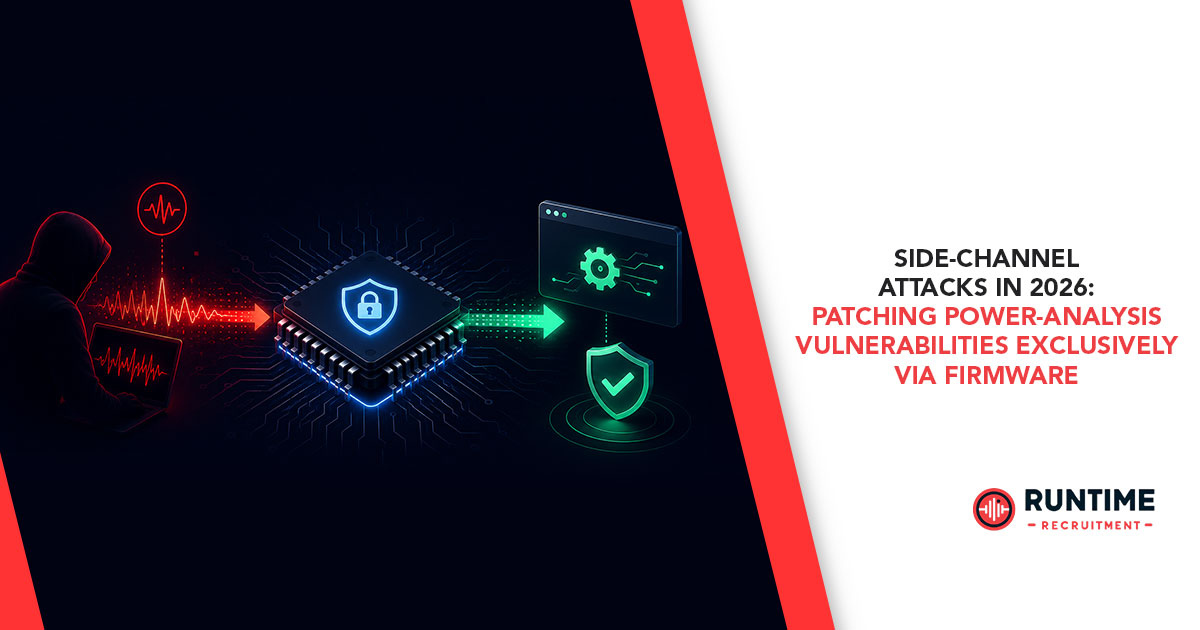
Historically, physical side-channel attacks—specifically Simple Power Analysis (SPA), Differential Power Analysis (DPA), and Correlation Power Analysis (CPA)—were treated as hardware-level problems. If a microcontroller lacked built-in current flattening, localized shielding, or hardware cryptographic accelerators with dual-rail transient logic, the security architecture was considered compromised.
However, millions of legacy and cost-constrained devices currently deployed in critical infrastructure, automotive systems, and IoT networks cannot be physically recalled or re-spun. Re-spinning silicon to mitigate newfound power leakage vectors is financially non-viable.
Firmware engineering has evolved to bridge this gap. In 2026, mitigating power analysis attacks exclusively through software and low-level firmware updates is no longer a temporary workaround—it is a mandatory engineering practice.
1. The Anatomy of Power-Analysis Attacks on Legacy Microcontrollers
Power analysis attacks exploit dynamic power dissipation in CMOS logic. When a transistor switches states (transitioning from a logical 0 to 1 or vice versa), it draws dynamic current from the power supply (VDD).
Journal of Integrated Circuits and Systems
Attackers exploit two primary mathematical models of leakage:
Hamming Weight (HW) Model: Assumes power consumption is proportional to the number of active high bits in a data word being processed or transferred across a bus.
Hamming Distance (HD) Model: Assumes power consumption is proportional to the number of bit flips occurring between two successive state registers:

By capturing high-frequency current traces across a shunt resistor or decoupling capacitor during cryptographic operations (such as AES key expansion or RSA modular exponentiation), attackers correlate power spikes with estimated bit transitions. Advanced neural network profiling techniques allow attackers to filter through hardware noise, making raw hardware vulnerable without algorithmic software defenses.
2. Firmware-Only Mitigation Strategies
When hardware countermeasures (such as integrated voltage regulators or internal noise generators) are absent, firmware must deliberately obfuscate, temporalize, or equalize power consumption.
+-------------------------------------------------------+
| Firmware Mitigation Techniques |
+------------------------------------------------------+
|
+------------------------------+------------------------------+
| |
+--------------+ +--------------+
| Algorithmic | | Microarchitectural
| Countermeasures | Controls
+--------------+ +--------------+
|-- Boolean Masking |-- Instruction Balancing
|-- Arithmetic Masking |-- Jitter & Noise Injection
|-- Exponent Blinding |-- Dynamic Dynamic Voltage/Clocking
Algorithmic Countermeasures: Masking and Blinding
Masking decouples the physical power trace from sensitive intermediate data by combining the secret value with a randomized variable (the "mask") before processing.
Boolean Masking
For symmetric encryption routines like AES, Boolean masking splits a secret variable S into two distinct shares using a random mask M:

The algorithm computes the cryptographic function on Smasked and M independently. Because M changes dynamically for every execution cycle, the Hamming Weight of the intermediate data processed by the ALU displays zero statistical correlation with the actual key.
Exponent and Scalar Blinding
For asymmetric cryptography (RSA, ECC), power traces leak key bits during scalar multiplication or modular exponentiation due to conditional branch execution. In RSA, exponent blinding randomizes the private key d using a random value r and the Euler totient ϕ(N):

Because md′≡md(modN), the mathematical result remains identical, but the execution pattern and power trace vary completely on each run.
Microarchitectural and Pipeline Balancing
Hardware accelerators execute instructions in constant time, but general-purpose cores (e.g., ARM Cortex-M, RISC-V) leak power based on instruction types, operand values, and pipeline stalls.
Constant-Time and Equalized Code Execution
Firmware must eliminate conditional branching dependent on secret data. Consider a naive conditional byte-comparison loop versus a constant-time, constant-power assembly routine:
// VULNERABLE: Branching leaks power profile and timing
bool check_key_vulnerable(const uint8_t a, const uint8_t b, size_t len) {
for (size_t i = 0; i < len; i++) {
if (a[i] != b[i]) return false; // Early exit changes power/timing signature
}
return true;
}
// MITIGATED: Constant execution time and balanced instruction sequences
uint8_t check_key_mitigated(const uint8_t a, const uint8_t b, size_t len) {
uint8_t result = 0;
for (size_t i = 0; i < len; i++) {
result |= (a[i] ^ b[i]); // Bitwise execution maintains uniform ALU toggling
}
return result; // 0 indicates match
}
Instruction Dummy Insertion and Execution Jitter
To disrupt the temporal alignment required for Differential Power Analysis (DPA), firmware can inject execution jitter—randomized dummy operations (e.g., NOPs, dummy memory fetches) and dummy loop iterations.
void execute_crypto_with_jitter(void) {
uint32_t random_delay = get_hardware_trng() & 0x1F;
// Inject dynamic cycle delay to desynchronize alignment in attack traces
for (volatile uint32_t i = 0; i < random_delay; i++) {
asm volatile ("nop");
}
perform_masked_crypto_op();
}
3. Advanced Firmware Techniques for Modern Embedded Platforms
As embedded microcontrollers gain features like Dynamic Voltage and Frequency Scaling (DVFS), high-resolution internal timers, and programmable clock trees, firmware engineers gain sophisticated tools to mitigate power analysis.
Dynamic Clock Randomization & Power-Gating Jitter
By reconfiguring the internal Phase-Locked Loop (PLL) or clock prescalers at runtime, firmware can randomly adjust the CPU clock frequency during cryptographic execution. This randomizes the temporal spacing of dynamic power consumption peaks, degrading the signal-to-noise ratio (SNR) of captured traces.
Memory Access Equalization
Power leakage occurs not only inside the CPU core, but also across internal SRAM address and data buses. Accessing memory locations with disparate Hamming Weights creates distinct current draws. Firmware mitigates this by applying data-bus clearing routines—writing interleaved dummy patterns (0x00000000 and 0xFFFFFFFF) to memory buses between secret-key accesses to reset bus capacitance to a uniform state.
4. Engineering Trade-offs: Memory, Performance, and Energy
Implementing pure-firmware defenses against physical power analysis introduces strict system-level trade-offs:

Firmware engineers must carefully budget the performance penalty. In battery-powered, resource-constrained systems, increased execution time directly degrades total energy efficiency.
Secure Your Next Technical Hire with RunTime Recruitment
Developing side-channel resilient firmware requires a deep understanding of low-level hardware architectures, assembly-level instruction profiling, and advanced cryptographic engineering. Finding embedded software engineers who excel at this intersection can be challenging.
RunTime Recruitment specializes in connecting engineering organizations with top-tier embedded systems, firmware, and hardware security talent. Whether you need specialists to audit your codebase for physical vulnerabilities or senior engineers to architect end-to-end secure systems, we can help.
Connect with RunTime Recruitment today to build your engineering team.