
Privacy-Preserving Edge Personalization: Combining Local Training with Encrypted Inference
18 August 2026 · Lance Harvie
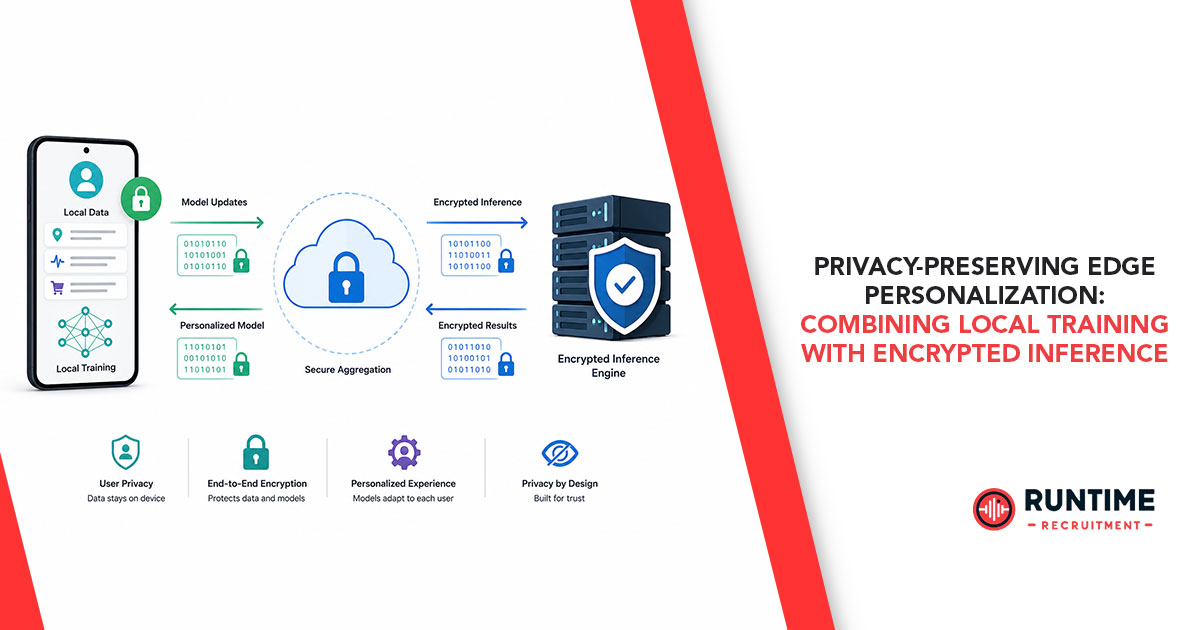
Deploying machine learning models to resource-constrained edge devices presents a fundamental engineering paradox: maximally personalized user experiences require continuous learning from private local data, yet running heavy neural networks on constrained hardware often forces offloading computations to untrusted external environments.
In domains such as wearable health monitors, smart home automation, industrial sensing, and biometric authentication, sending raw sensor feeds to the cloud violates privacy regulations (such as GDPR, HIPAA, and the EU Cyber Resilience Act) and introduces unacceptable latency. Conversely, relying solely on static, pre-trained global models yields sub-optimal inference accuracy for non-stationary, user-specific data distributions.
To resolve this trade-off, embedded systems engineers are adopting a hybrid paradigm: Privacy-Preserving Edge Personalization. This architecture decouples feature adaptation from heavy backbone inference by combining on-device local training (via lightweight parameter updates) with encrypted cloud/edge offloading (via Fully Homomorphic Encryption or Secure Multi-Party Computation).
1. The Architectural Paradox: Personalization vs. Data Sovereignty
Traditional edge AI deployment models fall into two extreme patterns:
Pure Edge Inference (Static Model): A frozen neural network Mθ is compiled down to C code via frameworks like TensorRT, TFLite Micro, or TVM, and executed on a microcontroller (MCU) or Neural Processing Unit (NPU). While 100% private and low-latency, it cannot adapt to domain drift or user-specific quirks without a complete OTA firmware re-flash.
Cloud-Offloaded Training & Inference: Raw sensor payloads x are continuously streamed over MQTT/gRPC to a cloud cluster. The server performs both model retrain operations and heavy inference execution. This offers high compute capacity but completely destroys data sovereignty, expands the attack surface, and incurs immense network bandwidth overhead.

Privacy-Preserving Edge Personalization introduces a two-tier execution split:
Local On-Device Layer: Processes high-frequency, highly private sensor streams locally on the MCU/DSP. It trains a hyper-compact personalization adapter ϕ (such as last-layer weights or low-rank adapters) directly on the device using incoming local feedback.
Encrypted Compute Layer: When local processing capacity is exceeded by the backbone architecture BΘ, the edge device encrypts its intermediate activations h=fϕ(x) using a public cryptographic key. The cloud/edge aggregator evaluates the heavy backbone BΘ(h) directly in the encrypted domain without ever decrypting the underlying data.
2. On-Device Training Under Extreme TinyML Constraints
Executing backpropagation on microcontrollers with sub-megabyte SRAM (e.g., ARM Cortex-M55/M85, ESP32-S3, or RISC-V cores) requires rethinking traditional training loops. Full model backpropagation requires storing intermediate activation tensors for every layer during the forward pass to compute gradients during the backward pass—a memory footprint that quickly exceeds local SRAM limits.
Selective Backpropagation & Low-Rank Adaptation (LoRA)
Rather than updating all parameters Θ∈Rd, embedded local training restricts gradient computation to a small parameter subspace ϕ⊂Θ, where ∣ϕ∣≪∣Θ∣.

Where W0∈Rd×k represents the frozen pre-trained weights, B∈Rd×r, and A∈Rr×k are low-rank decomposition matrices with rank r≪min(d,k).

By constraining the update step to A and B, the memory overhead for activation caching and optimizer state (e.g., Adam momentum buffers) drops by multiple orders of magnitude:

Quantization-Aware Local Updates
Running backpropagation in floating-point math (FP32) on low-power microcontrollers introduces significant cycle penalties. To perform local training efficiently:
Integer-Only Forward/Backward Passes: Activations and weights are maintained in fixed-point representations (INT8 or INT4).
Gradient Accumulation without Double-Buffering: Gradients ∇AL are accumulated directly into a quantized accumulator buffer using 32-bit integer arithmetic (INT32) to prevent vanishing/exploding updates before applying stochastic gradient descent (SGD):

Where Q(⋅) maps continuous gradients back into fixed integer quantization scale factors.
3. Encrypted Inference: Executing Cloud Backbones Securely
Once local feature representations hi=fϕi(xi) are updated on the edge device, running deeper feature extraction or classification across global fleet representations requires cloud orchestration. To prevent the cloud host from learning the user's local state, inference is performed over encrypted payloads.
Fully Homomorphic Encryption (CKKS Scheme)
GitHub Pages documentation
Homomorphic Encryption allows an untrusted server to compute functions directly on ciphertexts. For real-valued vector computations in neural networks, the Cheon-Kim-Kim-Song (CKKS) scheme is the primary cryptographic construction.
CKKS operates over polynomial rings Rq=Zq[X]/(Xn+1), mapping real-valued activation vectors into high-degree polynomial ciphertexts:

Where e is a controlled small noise component that preserves floating-point precision down to a configured threshold.

The Linearization Challenge & Polynomial Approximation
Homomorphic encryption natively supports only two operations: polynomial addition and polynomial multiplication. Arbitrary non-linear activations common in neural networks—such as ReLU(x)=max(0,x), GeLU(x), or Softmax(x)—cannot be directly evaluated on ciphertexts.
To bypass this hardware and cryptographic constraint, non-linear activations in the cloud backbone model must be replaced during training with low-degree Chebyshev Polynomial Approximations:

Where Tk(x) is the k-th Chebyshev polynomial of the first kind, typically configured to degree d∈[3,7] to balance approximation fidelity against homomorphic multiplicative depth costs.
4. Hardware Implementation & Pipeline Architecture
The end-to-end processing pipeline for a privacy-preserving personalized edge device consists of five discrete pipeline stages across hardware boundaries:

Stage-by-Stage Breakdown
Local Sensing & Preprocessing: The MCU samples raw telemetry (e.g., audio samples, accelerometer signals, or photoplethysmography data) into ring buffers inside local SRAM. Features (such as MFCCs or FFT bins) are computed using hardware DSP extensions (e.g., ARM SIMD/Helium instructions).
MDPILocal Adapter Training: The MCU runs an INT8 forward pass on its local task head. Based on user interaction or explicit feedback (e.g., active label correction), an INT8 backward pass calculates gradients specifically for local projection weights, updating local memory states.
Activation Encryption & Packing: Intermediate feature vectors h∈Rm are packed into SIMD slots inside a CKKS plain text structure and encrypted using the embedded device's locally generated public key pk.
Encrypted Cloud Backbone Execution: The ciphertext payload is sent over TCP/gRPC to a high-throughput server running FHE accelerators (e.g., AVX-512 vector pipelines or custom FHE ASICs). The server computes linear tensor transformations and Chebyshev activations without ever accessing plaintext user features.
Decryption & Execution: The cloud returns the encrypted prediction vector ctout to the edge device. The MCU decrypts the result using its private key sk inside a secure hardware root-of-trust (e.g., ARM TrustZone-M or a dedicated Secure Element), executing downstream system control logic.
5. Architectural Trade-Off Analysis
Integrating local training with homomorphic inference introduces critical performance tradeoffs that embedded engineers must evaluate:

6. Engineering Realities: Ciphertext Expansion & Noise Budgets
When designing firmware for this paradigm, two primary cryptographic constraints must be managed in C/C++ embedded codebases:
Ciphertext Expansion Ratios
Homomorphic encryption converts small floating-point payloads into massive polynomial coefficient structures. A 128-element activation vector of 32-bit floats (512 bytes) can expand into a CKKS ciphertext structure requiring 128 KB−2 MB of buffer allocation depending on security parameters (such as polynomial ring dimension N=8192 or 16384, with 128-bit post-quantum security levels).
Firmware architectures must utilize DMA (Direct Memory Access) and streaming transport buffers (such as chunked HTTP/2 streaming) to transmit packed ciphertexts without overflowing local static RAM.
Cryptographic Noise Management
Every multiplication operation performed on a CKKS ciphertext increases internal polynomial noise. If the noise exceeds the multiplicative level budget L, decryption fails and yields corrupted output.

Embedded systems must co-design the model topology with the cryptographic parameters: shallow neural networks with low multiplicative depth D≤4 allow smaller polynomial ring sizes N, reducing both the cryptographic compute load on the MCU and the network transmission payload.
Conclusion
Combining on-device adapter training with homomorphic inference provides a viable path toward high personalization without sacrificing privacy. By managing on-device memory through low-rank parameter updates and utilizing polynomial activations in cloud backbones, embedded systems can deliver responsive, user-tailored intelligence while adhering to international data protection standards.
Need Specialized Embedded Systems Talent?
Building cutting-edge edge AI architectures requires deep expertise in low-level firmware optimization, cryptographic engineering, and hardware acceleration. RunTime Recruitment connects leading technology firms with world-class embedded software and hardware engineers.
Connect with RunTime Recruitment today to find the specialized talent needed to engineer your next-generation intelligent edge systems.