
Vendor Lock-In in the Age of AI: Navigating Proprietary Copilot Ecosystems vs. Open-Source Weights
25 August 2026 · Lance Harvie
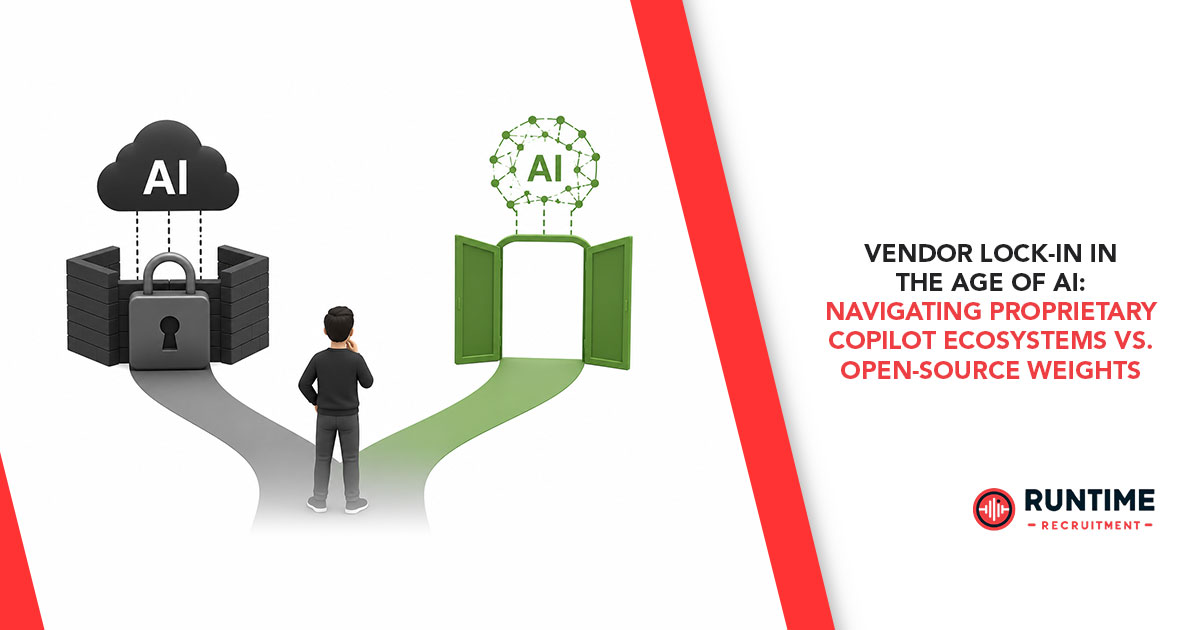
For embedded systems engineers, the allure of generative AI is undeniable. The day-to-day reality of writing low-level code involves navigating labyrinthine reference manuals, configuring complex register maps, debugging race conditions in real-time operating systems (RTOS), and wrangling peripheral drivers. When AI-powered copilots first emerged, promising instant boilerplate generation, automated unit tests, and quick explanations for obscure compiler warnings, they felt like a long-overdue revolution.
However, as engineering teams transition from experimental adoption to deep production integration, a shadow has fallen across the workbench. We are witnessing the rapid crystallization of a new kind of technical debt: AI vendor lock-in.
Unlike traditional software stacks where lock-in typically manifests as cloud provider dependencies or closed database formats, AI-driven lock-in reaches much deeper. It permeates the developer workflow, dictates toolchain choices, ties code generation to proprietary cloud backends, and binds intellectual property to external model providers. For embedded systems engineers—whose products demand rigorous determinism, stringent safety certifications, and decades-long product lifecycles—trading long-term architectural sovereignty for short-term coding velocity is a dangerous bargain.
The Anatomy of AI Lock-In in Embedded Systems
To understand how embedded teams find themselves trapped, we must examine how modern AI tooling infiltrates the development lifecycle. The lock-in mechanism rarely looks like a forced subscription or a blatant restriction. Instead, it arrives wrapped in convenience.
Major silicon vendors, integrated development environment (IDE) creators, and cloud giants are aggressively shipping proprietary AI extensions. Whether it is an integrated copilot embedded directly into a proprietary vendor IDE, or a cloud-tethered assistant configured to parse internal hardware abstraction layers (HALs), these tools create multi-layered dependencies:
API and Cloud Tethering: Your codebase is continuously analyzed, indexed, and processed through vendor-controlled endpoints. The underlying context-window management, prompt tuning, and Retrieval-Augmented Generation (RAG) pipelines are entirely black-boxed.
Ecosystem Silos: Silicon vendors increasingly bundle proprietary machine learning models with their hardware development kits (SDKs). Writing optimized firmware for a specific microcontroller family suddenly requires utilizing that specific vendor’s AI assistant, which is uniquely trained on their proprietary documentation and register definitions.
Implicit Workflow Customization: Over time, engineers build prompt histories, custom instructions, and workflow dependencies tailored explicitly to one model’s idiosyncrasies. Migrating to an alternative toolchain means losing months of accumulated institutional context.
When an organization becomes fundamentally dependent on a single vendor's AI ecosystem, switching costs escalate exponentially. If that vendor changes its pricing model, alters its data privacy terms, deprecates a critical feature, or faces regulatory roadblocks, your entire engineering pipeline is thrown into turmoil.
Proprietary Copilot Ecosystems: Convenience at a Steep Cost
Proprietary copilots—often backed by tech monoliths or specialized SaaS providers—excel at immediate gratification. Ask them to write an SPI DMA transfer routine or a custom circular buffer in C, and they will output syntactically valid code in milliseconds. But this convenience masks several structural vulnerabilities that are particularly acute in embedded development.
1. Intellectual Property and Data Leakage Risks
Embedded engineering is heavily driven by proprietary hardware designs, custom gate arrays, and tightly guarded firmware algorithms. When development teams plug their codebases, register maps, and schematic notes into commercial cloud copilots, questions of data governance immediately arise. Even when vendors promise enterprise-grade privacy, the reality of training data pipelines, telemetry collection, and third-party sub-processors leaves many security-conscious engineering managers uneasy. Exposing proprietary device drivers or security keys to a shared commercial model ecosystem is a risk few hardware firms are willing to take.
2. The Illusion of Determinism in Non-Deterministic Code
Embedded systems engineers live in a world of hard constraints: memory footprints measured in kilobytes, cycle-accurate timing, and deterministic execution. Proprietary cloud models are trained on general internet corpora, which include vast amounts of poorly written, non-idiomatic, or outright dangerous low-level code. A proprietary copilot may suggest a memory allocation pattern or a concurrency workaround that compiles cleanly on a desktop simulator but introduces subtle race conditions, stack overflows, or memory leaks when deployed to a resource-constrained microcontroller. Because the model's weights and training corpus are opaque, tracing the root cause of an AI-induced bug becomes an exercise in forensic archaeology.
3. Subscription Volatility and Sudden Deprecation
SaaS-based pricing models for AI tools are notoriously volatile. What begins as a subsidized or low-cost developer perk can quickly scale into a prohibitive line item as an engineering organization grows. Furthermore, proprietary ecosystems are subject to sudden shifts in corporate strategy. If a vendor decides to sunset an IDE plugin, alter its API structure, or restrict access to specific model tiers, your development team is forced into emergency migration projects under active product deadlines.
The Rise of Open-Source Weights and Local Inference
As a counterweight to proprietary silos, the open-source AI community—bolstered by open weights models like Meta’s Llama family, Mistral, Gemma, and specialized code-generation models—has unlocked a viable alternative: sovereign AI infrastructure.
For embedded engineers, open-source weights represent a philosophy that feels entirely natural: ownership, transparency, and local control. Rather than routing sensitive code through a remote cloud API, teams can download open-weight models, quantize them down to manageable sizes (such as 4-bit or 8-bit representations), and run them locally on developer workstations or dedicated on-premise inference servers.

1. Absolute Data Sovereignty
When you run open-source weights locally, your codebase never leaves your local network. Proprietary register maps, secret encryption keys, and proprietary RTOS wrappers remain entirely within your perimeter. For defense contractors, medical device manufacturers, and industrial automation firms, this air-gapped approach is not just a preference—it is a strict regulatory requirement.
2. Custom Fine-Tuning for Embedded Domains
General-purpose models often stumble when asked to write niche embedded code, such as bare-metal ARM Cortex-M startup files or custom RISC-V assembly macros. With open-source weights, organizations have the freedom to fine-tune models locally on internal codebases, vendor datasheets, and legacy firmware repositories. The result is a domain-specific copilot that actually understands your team's coding standards, proprietary hardware abstraction layers, and architectural conventions.
3. Zero Licensing Vulnerabilities and Cost Predictability
Running open-source models eliminates per-seat SaaS fees and unpredictable token-based billing. Once the local hardware infrastructure—such as a workstation with an enterprise-grade GPU—is procured, the marginal cost of running inference drops to electricity. There are no sudden licensing changes or terms-of-service updates that can disrupt your team's workflow overnight.
Architectural Strategies for Defending Freedom
Transitioning away from proprietary lock-in does not mean abandoning AI assistance; it means structuring your engineering environment to maintain optionality. Just as good embedded software architecture utilizes abstraction layers (like hardware abstraction layers and board support packages) to decouple application logic from physical silicon, your AI toolchain should be modular and decoupled.
Adopt Model-Agnostic Gateways
Instead of hard-coding a specific proprietary API into your internal developer scripts or automation pipelines, route your team's AI interactions through an internal abstraction layer. Tools that support OpenAI-compatible APIs allow you to swap the underlying model backend—shifting from a cloud provider to a local open-source instance—with a simple configuration change rather than a massive code rewrite.
Build Local RAG Over Official Documentation
One of the most valuable aspects of an AI assistant is its ability to search documentation. Instead of relying on a public copilot that may hallucinate silicon bugs or reference deprecated register definitions, set up a local Retrieval-Augmented Generation (RAG) pipeline. Feed it strictly verified PDFs, manufacturer errata sheets, internal coding guidelines, and approved board support packages. This ensures that your engineers get precise, verified answers grounded entirely in your specific hardware ecosystem.
Evaluate Tools Through an Open Standards Lens
When adopting new development tools, make interoperability a core procurement requirement. Ask vendors hard questions: Can this tool run against local weights? Can we export our prompt history and fine-tuning data? Does it rely on proprietary protocols that prevent migration? Treating AI tooling with the same rigorous skepticism you apply to third-party RTOS kernels will save your organization from painful lock-in down the road.
The Cultural and Organizational Shift for Embedded Teams
Avoiding AI vendor lock-in is ultimately as much about culture as it is about architecture. Engineering leadership must recognize that velocity achieved at the expense of long-term control is a false economy.
As the complexity of edge computing, IoT security, and safety-critical firmware continues to accelerate, the most successful embedded teams will be those that treat AI as a utility rather than a master. By championing open-source weights, maintaining strict data boundaries, and designing modular toolchains, embedded engineers can harness the genuine productivity multipliers of artificial intelligence without mortgaging their technical freedom.
Connect with RunTime Recruitment
Looking to scale your engineering team with experts who understand the nuances of embedded systems, toolchain sovereignty, and modern software architectures? Connect with RunTime Recruitment today to find top-tier engineering talent tailored to your organization's precise needs.