
The Missing Middle: How the Collapse of Junior Embedded Hiring Created an Unfillable Senior Talent Gap
17 August 2026 · Lance Harvie
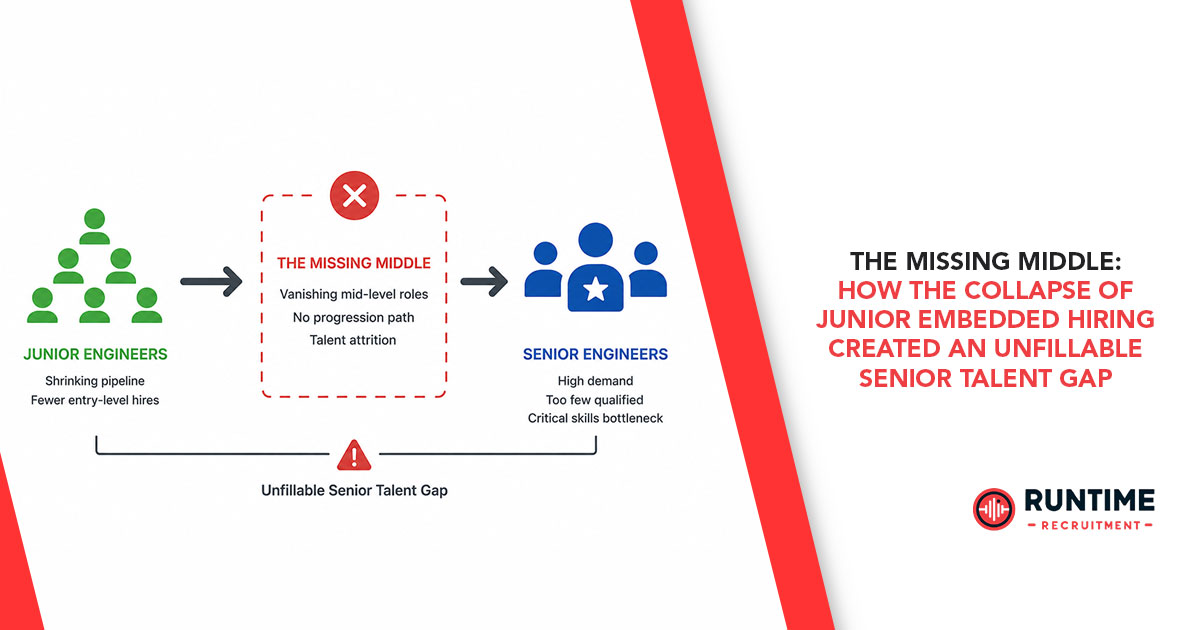
If you talk to engineering directors, VP of Hardware, or firmware team leads today, you will hear a uniform chorus of frustration: "We simply cannot find Senior Embedded Engineers."
Job boards are flooded with requisitions for Principal Firmware Architects, Senior Embedded Software Engineers, and Systems Engineers with 8 to 15 years of experience. Companies are dangling eye-watering compensation packages, sign-on bonuses, and remote flexibility to lure talent capable of untangling complex multi-core ARM architectures, configuring Real-Time Operating Systems (RTOS), and debugging bare-metal C/C++ hardware interfaces.
Yet, despite these lucrative offers, these roles often sit vacant for 6 to 12 months.
To the casual observer, this looks like a straightforward shortage of technical talent. But inside engineering departments, the real root cause is clear: this is not a sudden shortage; it is a self-inflicted structural collapse.
The current senior talent crisis is the direct, mathematical result of a decade spent quietly eroding entry-level and junior embedded engineering roles. By slashing graduate pipelines, eliminating mentorship budgets, and demanding "Day 1 productivity," tech companies severed the bottom rungs of the career ladder.
Now, the pipeline has run dry. The "middle" of the talent curve—the mid-level engineers who were supposed to mature into today’s senior architects—does not exist in sufficient numbers. And the embedded systems industry is facing a crisis that no amount of signing bonuses can solve.
1. Anatomy of the Collapse: How the Junior Pipeline Was Severed
To understand why senior engineers are virtually impossible to hire today, we have to trace the economic and operational decisions made across the technology landscape over the past eight to ten years.
PAST TALENT PIPELINE (2015)
[ Junior / Entry ] ---> [ Mid-Level Dev ] ---> [ Senior Architect ]
(Structured Mentors) (Subsystem Ownership) (System Design)
CURRENT TALENT PIPELINE (2026)
[ COLLAPSED ] - - > [ MISSING MIDDLE ] ---> [ SENIOR SQUEEZE ]
(No Entry Positions) (Severe Shortage) (Burnout & Bottlenecks)
The Death of "Paid to Learn"
In the era of zero-interest-rate policy (ZIRP) and rapid expansion, companies had the financial runway to hire junior engineers and absorb a 6-to-12-month ramp-up period. Embedded engineering has always had a steeper learning curve than web or application software. Writing firmware requires understanding registers, memory maps, timing diagrams, oscilloscope traces, and hardware-software interaction. A computer science or electrical engineering graduate rarely hits production-grade firmware output on week one.
When macroeconomic conditions shifted and interest rates rose, corporate CFOs began demanding immediate ROI. Training budgets were among the first items on the chopping block. Executive leadership made a fatal calculation: Why spend $90,000 plus mentoring resources on a junior who won't be fully independent for a year, when we can just hire a senior who can write Board Support Packages (BSPs) on day two?
Virtually every major hardware and embedded player adopted this strategy simultaneously. Entry-level job postings in tech dropped sharply year-over-year.
The Flawed "AI Will Replace Juniors" Assumption
The collapse was further accelerated by the emergence of Generative AI coding assistants. Non-technical executives looked at high-level code generation for web apps and assumed the same logic applied to low-level engineering. The narrative became: "AI tools like Copilot will make seniors three times as productive, so we don't need junior developers to write boilerplate code anymore."
In embedded systems, this assumption failed fundamentally. AI models can generate boilerplate C functions, but they cannot hook up a logic analyzer to detect a floating I2C bus, debug a subtle DMA race condition, or understand why a custom PCB is overheating due to misconfigured GPIO states.
By reducing junior hiring based on high-level software assumptions, embedded organizations cut off their own talent supply while gaining virtually none of the promised productivity shortcuts in real-world hardware integration.
The Complexity Surge
Simultaneously, embedded systems grew exponentially more complex. Ten years ago, a typical embedded project might have involved an 8-bit or 32-bit microcontroller running a simple main loop or a basic RTOS like FreeRTOS. Today, embedded engineers are expected to navigate:
Heterogeneous multi-core architectures (e.g., ARM Cortex-M alongside Cortex-A or DSPs).
Low-power Edge AI and machine learning inference engines at the micro-watt scale.
Complex regulatory and safety frameworks like ISO 26262 (Automotive), IEC 62304 (Medical), and the Cyber Resilience Act (CRA).
Advanced communication stacks including CAN-FD, Industrial Ethernet, BLE 5.x, and Thread.
As job requirements expanded, the gap between what universities teach and what industry demands widened. Rather than investing in bridging this gap through structured internal training, companies simply added more years of required experience to their job descriptions, turning "Entry-Level" roles into positions requiring 3 to 5 years of hands-on firmware experience.
2. The "Missing Middle": The Structural Void in Engineering Teams
The elimination of junior roles created a temporal gap that is now surfacing in engineering org charts.
In a healthy software or hardware organization, team dynamics follow a steady distribution:

Because entry-level hiring was severely curtailed over the past decade, the pipeline failed to produce the mid-level engineers who should be filling team lead and senior roles today.
This missing middle tier breaks the operational dynamic of embedded product development.
Mid-level engineers are the workhorses of firmware development. They possess enough hands-on experience to work independently on peripheral drivers, protocol implementations, and power optimization routines without requiring constant oversight. They free up Senior Engineers to focus on high-level system trade-offs, security architectures, and inter-departmental alignment.
Without mid-level engineers to delegate to, senior talent is forced to operate at two extremes at once: designing complex multi-layer system architectures while simultaneously writing low-level driver updates and triaging basic build failures.
3. The Senior Squeeze: The Unintended Consequences on Staff Talent
The collapse of the junior pipeline didn't just lock new graduates out of the industry; it created a toxic working environment for the remaining Senior Embedded Engineers.
The "Review and Maintenance Tax"
In teams lacking a balanced distribution of experience levels, senior engineers bear a heavy operational burden. Without junior and mid-level team members growing into subsystem ownership, senior leads become permanent single-point-of-failure bottlenecks.
They are stuck maintaining legacy C/C++ codebases, debugging silicon errata, writing board support packages, and managing CI/CD hardware-in-the-loop (HIL) test rigs. Instead of spending time on innovative architectural improvements or evaluating next-generation microcontrollers, their days are consumed by execution-level context switching.
"We don't have time to design better systems because we are spending 60 hours a week keeping existing hardware builds from falling apart." — Lead Firmware Engineer, Medical Device Sector
Senior Burnout and Velocity Loss
This operational reality directly impacts turnover rates among experienced engineers. Senior embedded talent isn't quitting because they dislike embedded systems; they are leaving due to burnout caused by systemic understaffing.
When a senior lead resigns, they take years of domain-specific context with them—knowledge regarding undocumented hardware quirks, proprietary registers, and legacy state machines. Because there are no mid-level engineers on the team ready to step up, the company is forced back into the hyper-competitive recruitment market to replace a senior engineer, restarting a painful and costly cycle.
+---------------------------------------------------+
| Company Freezes Junior Hiring |
+--------------------------------------------------+
|
v
+--------------------------------------------------+
| No Mid-Level Engineers Pipeline |
+--------------------------------------------------+
|
v
+-------------------------------------------------------+
| Senior Engineers Overburdened |
| By Low-Level Execution & Maintenance |
+-------------------------------------------------------+
|
v
+----------------------------------------+
| Senior Burnout, Fatigue, & Attrition |
+----------------------------------------+
|
v
+---------------------------------------------------+
| Unfillable "10+ Year Senior" Vacancy |
+---------------------------------------------------+
4. The Hidden Costs on Product Development and Innovation
The senior talent gap is no longer just a recruitment problem for Human Resources—it is an operational risk that directly impacts product roadmaps, time-to-market, and firmware stability.
1. Architectural Stagnation
When teams lack the bandwidth to train talent or experiment with modern techniques, they default to legacy decisions. Companies remain tethered to outdated microcontrollers, aging RTOS versions, or unmaintained internal libraries simply because nobody has the cycles to port the code to modern architectures (like migrating to RISC-V or adopting Rust for embedded safety).
2. Code Quality and Safety Risks
Embedded systems operate under strict real-time and memory constraints. When senior engineers are overworked and forced to rush execution without adequate peer-review layers, subtle defects slip into production firmware:
Dynamic memory allocation edge-cases leading to stack overflows.
Unhandled interrupt priorities causing race conditions under peak loads.
Incomplete security implementations in secure boot or OTA (Over-The-Air) update mechanisms.
In consumer web applications, a bug results in a 500 server error. In embedded engineering—whether automotive, industrial automation, defense, or medical devices—a firmware failure can cause hardware damage, costly recalls, or physical safety risks.
3. Slower Product Iteration
Without an engine of junior and mid-level developers cranking through routine board support, test cases, and feature ports, hardware release cycles slip. New product introductions (NPIs) stall during the prototype-to-production handoff, not because of silicon availability or factory delays, but because the firmware team cannot complete board bring-up in time.
5. Strategic Roadmap: How Embedded Teams Can Fix the Talent Crisis
Rebuilding a functional engineering pipeline requires moving away from the short-sighted hiring practices of the last decade. Companies that want to build resilient, high-performing embedded teams must implement a deliberate long-term talent strategy.
Rebuild the Junior Pipeline with Intent
The idea that companies can simply "buy" senior talent indefinitely is a statistical impossibility. Engineering organizations must re-establish entry-level hires, but structure them for success:
Structured Mentorship Programs: Pair entry-level engineers directly with senior architects for targeted 6-month rotations focusing on driver development, board bring-up, and RTOS fundamentals.
Low-Risk Sandbox Tasks: Assign junior developers to build automated HIL (Hardware-in-the-Loop) test frameworks, internal debugging tools, and regression test suites. This builds deep hardware comprehension without risking production code safety.
Upskill Adjacent Engineering Disciplines
One of the fastest ways to build mid-level embedded capacity is to cross-train adjacent technical professionals:
Hardware/PCB Engineers: EE professionals who understand schematics, board layouts, and signal integrity can be trained in embedded C and RTOS principles.
High-Level Software Engineers: C++ desktop or backend developers can be onboarded to low-level systems programming through targeted training in hardware interface protocols and memory-constrained architectures.
Modernize Tooling and Abstraction Layers
Reducing the friction of embedded onboarding allows developers to become productive faster:
Leverage standardized Hardware Abstraction Layers (HALs) and modern build systems (CMake, West) to decouple application logic from low-level register manipulation.
Implement robust simulation environments (such as QEMU or Renode) so firmware engineers can write and test code before physical prototype PCBs arrive from fabrication.
Shift Hiring Criteria from "Keywords" to "Systems Thinking"
Legacy recruitment processes often reject candidates who lack hyper-specific chip vendor experience (e.g., filtering out candidates who know STM32 because the job requires NXP i.MX). Senior technical leadership must guide talent acquisition to look for fundamental engineering principles: hardware comprehension, debugging methodologies, RTOS fundamentals, and strong C/C++ memory management skills. A capable engineer can learn a new MCU ecosystem in weeks if their core fundamentals are sound.
The Path Forward for Embedded Organizations
The "Senior Talent Shortage" is not an unsolvable mystery. It is the logical outcome of an industry that stopped investing in its own talent creation.
Companies that continue to demand 10+ years of specific embedded experience while offering zero entry ramps will find themselves trapped in an increasingly expensive, uncompetitive hiring loop. Conversely, engineering leaders who take control of their talent pipeline—by fostering junior talent, upskilling adjacent engineers, and creating structured mid-level growth paths—will build sustainable hardware development teams capable of shipping complex systems on schedule.
The ladder must be rebuilt from the bottom up. The organizations that realize this today will be the ones defining the hardware innovations of tomorrow.
Need Specialized Embedded & Engineering Talent?
At RunTime Recruitment, we specialize in connecting forward-thinking engineering teams with elite embedded systems, firmware, and hardware talent. Whether you need senior architects to lead your next product line or strategic advice on structuring your engineering pipeline, we can help. Connect with RunTime Recruitment today to secure the engineering expertise your team needs.