
Misaligned Interview Panels: Resolving Stakeholder Friction Before Sourcing Hardware Leads
8 September 2026 · Lance Harvie
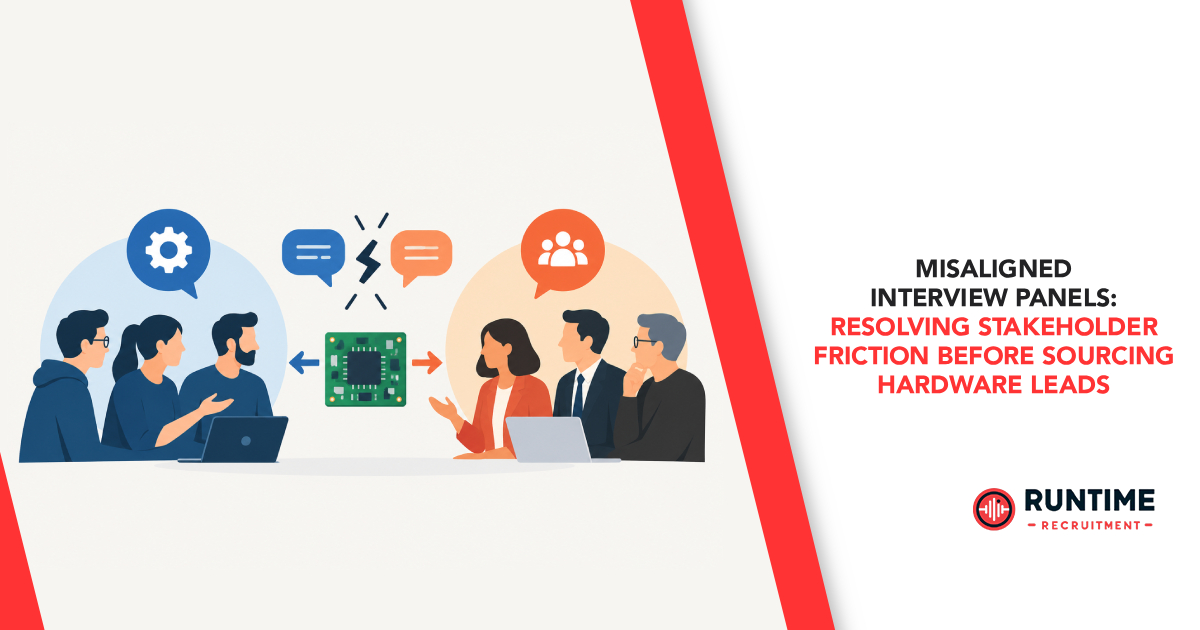
When an organization sets out to recruit a Hardware Lead, the immediate focus usually shifts outward: crafting the job description, reaching out to niche professional networks, and screening candidates for expertise in high-speed PCB design, SoC selection, power management, or regulatory compliance. Yet, weeks or months into the search, a familiar and frustrating pattern often emerges. Promising candidates pass through four or five rounds of interviews only to be rejected late in the game, or job offers stall indefinitely due to split, contradictory panel feedback.
The root cause of this breakdown is rarely a shortage of talented candidates. In hardware engineering—where iteration loops are long, unit economics are unyielding, and design errors demand costly board spins or mask revisions—the greatest single hazard to a successful recruitment drive sits inside the hiring company. It is stakeholder friction: an interview panel composed of cross-functional leaders who hold fundamentally incompatible views on what a "Hardware Lead" should actually prioritize.
Sourcing a Hardware Lead without first achieving deep alignment across your interview panel is the engineering equivalent of routing a complex 12-layer printed circuit board without defining the stackup or setting constraints in your CAD tool. You generate noise, incur severe rework, and risk burning through top-tier candidate goodwill. To hire technical leaders who can ship reliable physical products on schedule and within budget, engineering organizations must systematically resolve panel misalignment before the talent search ever launches.
The High Cost of Stakeholder Friction in Hardware Recruitment
Unlike pure software development—where continuous integration, canary rollouts, and hotfixes can frequently soften the impact of architectural oversights—hardware engineering operates under rigid physical and economic constraints. A Hardware Lead makes pivotal technical decisions that dictate product gross margins, manufacturing yield, electromagnetic compatibility (EMC/EMI), thermal performance, and field reliability for years.
Because this role sits directly at the nexus of electrical design, mechanical engineering, firmware development, supply chain logistics, and factory operations, almost every functional group in an engineering organization holds a stake in who fills the seat. However, these stakeholders evaluate success through radically different operational lenses:
VP of Engineering / CTO: Prioritizes time-to-market, long-term roadmap scalability, execution velocity, and team leadership capability.
Firmware / Software Lead: Seeks a hardware lead who understands register maps, interrupt latency, memory safety, and driver stability so that hardware architectural choices do not burden software timelines.
Operations & Manufacturing Director: Demands a rigorous focus on Design for Manufacturability (DFM), Design for Testability (DFT), bill-of-materials (BOM) cost reduction, component lifecycle availability, and high factory test yields.
Product Management: Demands rapid prototyping agility, feature richness, and the ability to absorb changing customer requirements without inflating unit costs or slipping release dates.
When these stakeholders join an interview panel without prior consensus on key priorities, they evaluate candidates against competing standards. A Firmware Lead might penalize a candidate for lacking deep embedded Linux kernel expertise, while an Operations Manager penalizes that exact same candidate for selecting cutting-edge custom silicon over lower-risk, off-the-shelf modules. The result is "The Unicorn Trap": a perpetual, costly search for a mythical candidate who scores 100% across mutually exclusive demands.
Identifying the 4 Archetypal Panel Silos
To eliminate friction, hiring managers must first recognize how stakeholder silos manifest inside interview feedback loops. Panel friction typically stems from four distinct perspectives, each asking questions designed to defend their own operational territory:

1. The Pure Architect
This panelist treats the Hardware Lead role as an exercise in schematic elegance, signal integrity, and high-performance component selection. In interviews, they dive into complex circuit math, differential impedance control, or advanced FPGA synthesis.
The Misalignment: They often discount practical project management and vendor negotiation skills, labeling pragmatic engineering leaders as lacking "technical depth".
2. The Software Advocate
The firmware or embedded software panelist views the hardware lead primarily through the lens of hardware-software interaction. Their questioning centers on board support package (BSP) handovers, DMA buffer corruption, interrupt handling, and bus lockup recovery.
Startup Jobs
The Misalignment: They evaluate the candidate as if they were hiring an embedded software developer rather than a hardware system architect, penalizing candidates who delegate driver implementation to software specialists.
3. The Supply Chain & Manufacturing Pragmatist
This panelist focuses heavily on risk mitigation, component lead times, vendor diversification, and production line yields. They ask candidates to detail past factory line failures, component obsolescence mitigation, and second-sourcing strategies.
The Misalignment: They tend to favor ultra-conservative candidates who avoid modern components in favor of legacy silicon, clashing directly with executives seeking innovative product capabilities.
4. The Schedule-Driven Delivery Manager
Focusing on execution velocity and cross-functional throughput, this stakeholder probes project management methodologies, sprint cadences in hardware development, and crisis management.
The Misalignment: They may discount deep domain expertise in favor of polished communication, pushing for candidates who talk well in status meetings but may struggle during complex board bring-up emergencies.
Without clear alignment rules, these four silos exercise veto power over one another, trapping the company in an endless loop of rejected applicants.
The Pre-Sourcing Realignment Framework
Resolving panel friction requires an intentional, structured framework executed before candidate resumes enter the pipeline. Engineering leaders should execute this three-step alignment process to ensure the interview panel functions as a single, calibrated evaluation unit.
Step 1: Define Core Trade-Off Priorities
Hardware design is fundamentally an exercise in navigating trade-offs: power versus performance, unit BOM cost versus time-to-market, custom discrete designs versus integrated modules. Before drafting job specs, bring all panel stakeholders together for a mandatory Trade-Off Alignment Session.
Force the panel to explicitly rank the following four parameters for this specific hire:
Development Velocity: Speed to prototype, quick validation, and early customer feedback.
Unit BOM & Scale Optimization: Extreme margin focus, custom silicon, and cost minimization for high-volume manufacturing.
Technical Innovation Limits: Pushing performance, thermal, or miniaturization boundaries.
Supply Chain & Risk Resilience: Leveraging proven, multi-sourced components with long lifecycle guarantees.
If the VP of Engineering ranks Development Velocity first while the Operations Director ranks Unit BOM Optimization first, this contradiction must be resolved immediately. Establishing that "for this product phase, time-to-market takes precedence over strict BOM optimization" instantly recalibrates how the entire panel evaluates candidate design choices.
Step 2: Establish 'Non-Negotiable Core' vs. 'Trainable Adjacencies'
A major trigger for panel friction is treating every line item on a job description as a deal-breaker. The hiring manager must require the panel to distinguish between non-negotiable core competencies and skills that can be acquired on the job.

Step 3: Construct a Role Alignment Matrix (RAM)
Eliminate interview overlap and bias by building a Role Alignment Matrix (RAM). Rather than asking four panelists to conduct general "technical interviews," assign each panel member a dedicated, non-overlapping competency domain:

Assigning explicit domains stops panelists from conducting unstructured interviews outside their area of expertise and ensures candidate skills are evaluated systematically.
Designing a Panel-Unified Technical Case Study
Standard hardware interviews often fail because they are either too abstract (asking candidates to write basic EE formulas on a whiteboard) or too narrow (asking them to debug a specific schematic snippet).
To evaluate a Hardware Lead effectively while keeping the entire panel aligned, deploy a System Architecture & Trade-Off Case Study.
The Architecture Scenario
Provide candidates with a high-level system prompt 48 hours prior to the technical interview. For example:
"Design the hardware architecture for a battery-powered, edge-connected industrial monitoring device. The product requires sampling high-frequency vibration data, performing local inference, and transmitting summary data via BLE/Cellular. Target constraints: enclosure thermal cap of 45°C, $40 unit BOM at 25,000 units/year, and a minimum 3-year battery life on standard cells."
The Panel Presentation & Defense
During the 60-minute panel review:
Candidate Presentation (20 Minutes): The candidate presents their system block diagram, component selection rationale (SoC, PMIC, sensors, wireless radio), power tree analysis, and board layout stackup strategy.
BarRaiserTargeted Panel Interrogation (30 Minutes): Each panelist questions the candidate strictly from their assigned RAM domain:
Firmware Lead: Asks how power state transitions, sleep modes, and bootloader memory spaces are structured.
Hardware Specialist: Probes power converter efficiency, signal integrity on high-speed buses, and decoupling capacitor strategies.
Operations Lead: Inquires about component single-sourcing risks, test pad access for bed-of-nails fixtures, and assembly yields.
Dynamic Constraint Injection (10 Minutes): The panel introduces a sudden real-world change: "The selected primary SoC has just gone onto a 36-week allocation lead time. How do you adjust your hardware strategy?"
This practical exercise reflects actual operating conditions. It provides every stakeholder with direct visibility into how the candidate thinks through multi-variable engineering problems, balances conflicting inputs, and communicates trade-offs across functional boundaries.
Calibrating Debriefs and Managing Veto Rights
Even with a strong pre-sourcing matrix and a unified case study, panel friction can resurface during post-interview debrief meetings if evaluation rules are undefined. Implement these three governance standards during candidate debriefs:
1. Mandatory Asynchronous Scoring
Require all panel members to submit written scorecards containing concrete evidence before entering the live debrief meeting. This prevents "anchoring bias," where a senior executive or vocal panel member sways the consensus before others present their technical observations.
2. Evidence-Based Feedback Standards
Vague feedback like "I wasn't confident in their technical depth" or "They didn't seem like a culture fit" should be disallowed by the hiring manager. Interviewers must point to specific observations tied directly to the Role Alignment Matrix criteria (e.g., "The candidate could not explain how they would minimize ground bounce in high-speed memory routing").
3. Clear Domain Veto Rules
Establish explicit veto boundaries before interview scorecards are opened:
The Firmware Lead holds veto authority over candidates who demonstrate a lack of understanding regarding hardware-software boundaries. However, they do not hold unilateral veto authority over a candidate's manufacturing or vendor strategy choices.
The Operations Lead holds veto authority over candidates who ignore basic DFM/DFT principles.
The Hiring Manager retains final decision authority, balancing input across domain owners to prevent single-issue deadlocks.
Transforming Alignment Into a Hiring Advantage
In a competitive market for experienced embedded hardware and system design leaders, recruitment delays caused by internal friction carry real business risk. High-caliber candidates who experience disjointed, repetitive, or contradictory interview loops quickly withdraw, taking their talents to organizations with streamlined hiring processes.
By establishing trade-off priorities before opening a role, enforcing a structured Role Alignment Matrix, deploying a unified system architecture case study, and governing debriefs with domain-specific rules, engineering leaders convert hiring from an internal bottleneck into a strategic strength. You eliminate deadlocks, shorten cycle times, and secure hardware leads who are equipped to ship successful products from day one.
Partner With Hardware Hiring Experts
Streamline your engineering recruitment and eliminate hiring panel friction before it delays your product roadmap. Connect with RunTime Recruitment to source high-impact hardware and embedded systems leaders with precision and speed.