
The Open-Source License Risk: Vetting Firmware Candidates on IP Awareness
3 August 2026 · Lance Harvie
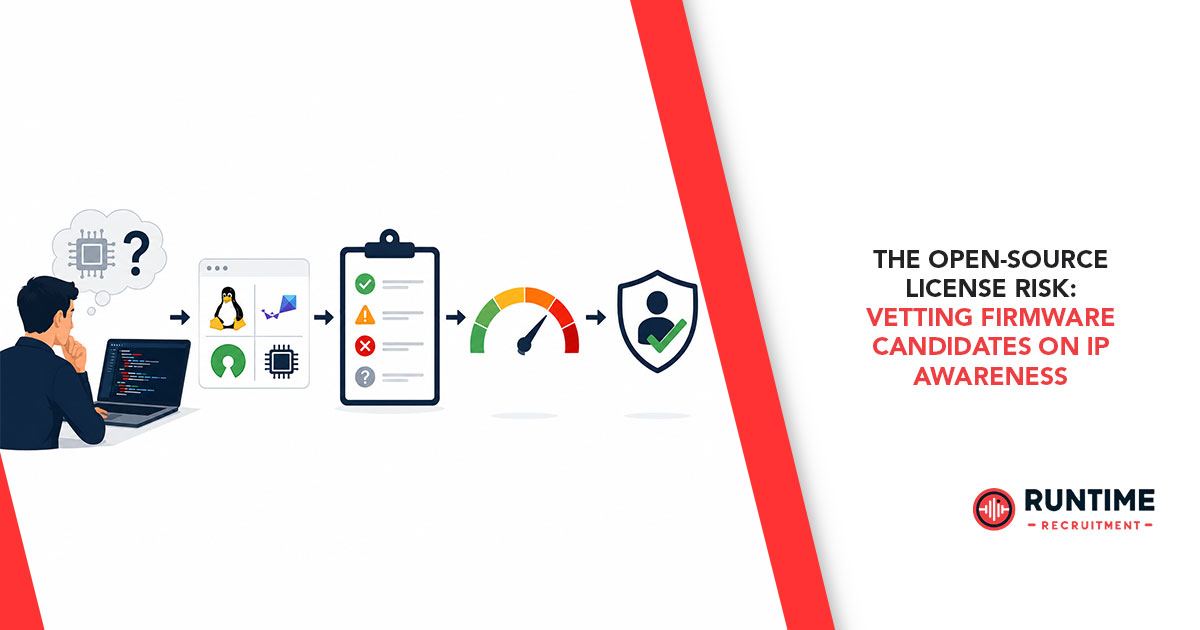
In modern embedded systems engineering, velocity is paramount. Driven by tight market windows, shrinking hardware margins, and escalating feature complexity, firmware teams rarely build software stacks from absolute scratch. From vendor-supplied Hardware Abstraction Layers (HALs) and Real-Time Operating Systems (RTOS) like FreeRTOS or Zephyr to network stacks (lwIP), cryptographic libraries (mbedTLS), and protocol parsers, open-source software (OSS) forms the foundational bedrock of virtually every deployed microcontroller (MCU) and system-on-chip (SoC) today.
However, this rapid integration comes at a hidden, frequently underestimated price: intellectual property (IP) license compliance. While software engineers in high-level web or enterprise desktop environments operate within modular ecosystems where dynamic linking and microservice isolation provide legal buffer zones, embedded developers work in a radically different paradigm. Microcontroller firmware is overwhelmingly compiled into unified monolithic binary blobs, statically linked into non-volatile flash memory, and executed directly on bare-metal or minimal RTOS abstractions. In this execution model, the boundaries between open-source components and proprietary code blur instantly.
A single misconfigured license header, an unheeded viral copyleft clause, or a misunderstood linking exception can compromise an entire corporate product line. During mergers, acquisitions, venture funding rounds, or medical and automotive Tier-1 audits, IP due diligence frequently uncovers catastrophic license violations. Resolving these issues can cost hundreds of thousands of dollars in emergency clean-room re-engineering, legal settlements, or forced public disclosure of proprietary source code.
Consequently, technical leadership can no longer treat open-source license awareness as a downstream administrative task reserved for legal departments. IP risk mitigation must begin at the hiring pipeline. Vetting firmware candidates for IP awareness and license literacy is as critical to product health as evaluating their proficiency in C/C++ memory management, low-level debugging, or register-level peripheral control.
The Firmware Licensing Spectrum: Permissive, Weak Copyleft, and Viral Copyleft
To evaluate whether a firmware candidate possesses sound IP judgment, engineering managers must first establish a rigorous baseline of the licensing spectrum as it applies specifically to embedded architecture. Open-source licenses generally fall into three distinct tiers, each presenting drastically different operational risks when deployed on microcontrollers or embedded Linux gateways.
1. Permissive Licenses (MIT, BSD, Apache 2.0)
Permissive licenses represent the lowest legal friction for commercial firmware development. Licenses such as MIT and BSD (2-Clause or 3-Clause) grant downstream developers almost unrestricted freedom to modify, static-link, distribute, and commercialize software without obligating them to publish derivative source code. The primary requirement is retaining the original copyright notice in source files or product documentation.
The Apache License 2.0 adds an essential layer of protection for hardware-software co-design: explicit patent grants. However, engineering candidates must understand nuances like Apache 2.0 compatibility constraints with older licenses (such as GPLv2) and how the "LLVM Exception" enables proprietary binary distribution without triggering attribution constraints in compiled machine code.
2. Strong Copyleft / Viral Licenses (GPLv2, GPLv3)
The GNU General Public License (GPL) family operates on reciprocal open source. If firmware incorporates GPL-licensed code, the derivative work—including proprietary algorithms linked into the same binary executable—must be made available under the same GPL terms upon distribution.
In microcontroller development, where static linking is standard, incorporating a single GPLv2 or GPLv3 static library into a proprietary firmware build usually renders the entire monolithic firmware image a derivative work. This obligates the manufacturer to provide complete source code, build scripts, and linker files to any end user receiving the device.
GPLv3 introduces additional hazards tailored specifically to hardware enforcement, notably anti-tivoization clauses. Section 6 of GPLv3 mandates that distributors provide the "Installation Information" (such as cryptographic keys) required to flash modified firmware onto hardware. For secure boot devices, medical electronics, automotive ECUs, or encrypted IoT nodes, GPLv3 software can render security architectures legally or operationally impossible.
3. Weak Copyleft and RTOS Exceptions (LGPL, FreeRTOS Exception, eCos)
Weak copyleft licenses aim to bridge open source with commercial proprietary extensions. The GNU Lesser General Public License (LGPL) allows proprietary code to link against an LGPL library without infecting the proprietary code, provided specific conditions are met. Under LGPL, if a user modifies the library, those modifications must be released. Furthermore, end-users must be capable of re-linking the application with a modified version of the LGPL library.
Here lies the fatal trap for MCU developers: re-linking under LGPL requires dynamic linking or providing unlinked relocatable object files (.o files) alongside build scripts to the customer. On memory-constrained microcontrollers lacking dynamic loaders or MMUs, fulfilling LGPL compliance without exposing object code is exceptionally difficult.
To solve this dilemma in the RTOS world, modified licenses emerged. FreeRTOS historically utilized a modified GPLv2 with an explicit exception clause allowing applications to link against FreeRTOS via its API without subjecting proprietary application code to GPL terms. Today, FreeRTOS operates under the MIT license, while projects like Zephyr RTOS utilize the permissive Apache 2.0 license, dramatically lowering IP risk for modern designs.
Architectural Pitfalls and Technical Realities of Binary Linking
A candidate who understands license text in theory may still introduce massive IP risk if they do not comprehend how compiler, linker, and hardware abstractions interact with legal definitions of derivative work.
Static Linking vs. Dynamic Linking in Embedded Memory Architecture
In desktop operating systems, application code resides in isolated user-space memory and interacts with system libraries via dynamically loaded shared objects (.so or .dll files). Courts and legal frameworks generally accept that dynamic linking across well-defined operating system ABI boundaries can isolate proprietary code from copyleft contamination.
In resource-constrained embedded systems (e.g., ARM Cortex-M, RISC-V RV32I, ESP32), memory constraints eliminate dynamic linking. The compiler and linker merge application code, board support packages (BSPs), vendor HALs, third-party libraries, and RTOS kernels into a single ELF file, from which a flat binary (.bin) or Hex file (.hex) is generated. When a proprietary control algorithm directly calls a function within a GPL-licensed library compiled into the same flash segment, the entire binary legally fuses into a derivative work. Candidates who fail to recognize that static compilation obliterates software boundaries are prime liability vectors.
Kernel-Space vs. User-Space in Embedded Linux
For embedded systems running Embedded Linux (e.g., Yocto, Buildroot), the licensing paradigm shifts. The Linux kernel is licensed under GPLv2. Linux maintains a strict boundary between kernel space and user space. System calls across the kernel boundary do not cause user-space applications to become derivative works of the Linux kernel.
However, firmware engineers working on custom hardware drivers frequently write loadable kernel modules (LKMs). If a candidate writes a kernel module that hooks directly into internal kernel APIs or utilizes symbols exported via EXPORT_SYMBOL_GPL, that driver module automatically falls under GPLv2 reciprocity. Attempting to ship a proprietary driver using binary shims or unapproved kernel hooks is a widespread violation that triggers immediate legal challenge from open-source compliance organizations.
Vetting Candidate IP Awareness: The Technical Interview Framework
When evaluating candidates for senior embedded or firmware roles, technical leaders must probe beyond generic coding exercises. Integrating direct IP scenario questions into technical interviews reveals whether an engineer possesses mature technical judgment to protect company assets.
Scenario 1: The Third-Party Stack Trap
Question for Candidate: "We need to add a specialized protocol parser (e.g., CANopen, Modbus TCP, or MQTT) to our ARM Cortex-M4 project under a tight deadline. You find an excellent, fully tested implementation on GitHub that fits our requirements, but it is licensed under GPLv3. How do you approach integrating this into our product?"
Red Flag Answers:
"I'll copy the .c and .h files into our project tree, change function names, and compile it. No one will check the binary." (Indicates total disregard for legal compliance).
"We can static link it as a pre-compiled .a library file so our main source code remains closed." (Demonstrates ignorance of static linking mechanics under GPL).
Green Flag Answers:
"We cannot directly link GPLv3 code into our monolithic binary without forcing our proprietary application to be open-sourced, nor can we meet GPLv3 anti-tivoization requirements if secure boot is enabled. I would search for a permissively licensed alternative (MIT/Apache 2.0/BSD), check if a commercial version is available, or evaluate writing our own clean-room implementation."
Scenario 2: Hardware Abstraction Layer (HAL) Contamination
Question for Candidate: "During board bring-up, you discover that a chip vendor provided a low-level peripheral driver with mixed headers—some files are BSD licensed, but an essential optimization library contains a GPLv2 header. What steps do you take before committing this code?"
Green Flag Answers:
"I would flag this immediately to the lead architect or legal liaison. We must refrain from committing GPLv2 source directly into our proprietary firmware tree. I would contact the vendor FAE to request license clarification or a dual-licensed version, while assessing whether clean re-implementation is necessary."
Evaluating Familiarity with Compliance Tools & Standards
A seasoned firmware engineer should be familiar with automated toolchains and standard metadata formats:
SPDX Identifiers: Does the candidate routinely use standardized SPDX license identifiers (e.g., // SPDX-License-Identifier: MIT) in source headers?
Automated License Scanning: Has the candidate worked with tools like FOSSology, Black Duck, or Mend in CI/CD pipelines?
Clean-Room Development: Does the candidate understand clean-room protocols—where one engineer documents specifications from copyrighted code, and a second engineer writes the new implementation without viewing original code?
Engineering Architecture Guidelines for IP Risk Mitigation
Beyond hiring the right talent, engineering managers must establish an architectural environment that enforces IP safety by design. Candidates should be asked how they would implement such controls within an organization.
Clean Isolation Interfaces and Abstraction Layers: To prevent license propagation, hardware and software architectures should enforce modular boundaries. Hardware Abstraction Layers (HALs) and Operating System Abstraction Layers (OSALs) serve dual purposes: enabling portable code and creating clear architectural perimeters. In Linux systems, separating proprietary business logic into user-space daemons communicating via standard IPC protects high-value IP from GPL kernel contamination.
CI/CD License Scanning Integration: Manual code reviews are prone to human oversight. Modern firmware build pipelines (using Jenkins, GitHub Actions, or GitLab CI) should execute automated license compliance checks on every pull request. Tools like ScanCode or enterprise scanners parse source code headers and alert developers before non-compliant code is merged into release branches.
Software Bill of Materials (SBOM) Readiness: With global standards such as the EU Cyber Resilience Act (CRA) mandating strict software traceability, producing an accurate Software Bill of Materials (SBOM) is essential. A mature firmware pipeline must automatically generate an SBOM (in CycloneDX or SPDX formats) during compilation, cataloging every RTOS kernel, vendor HAL, static library, and open-source utility included in the production binary.
Conclusion
As embedded devices become increasingly interconnected and software-defined, the line between hardware competitive advantage and software IP liability grows ever thinner. An unwitting firmware engineer who static-links a copyleft library into a flagship product can instantly erase years of proprietary R&D value and expose the organization to crippling legal and financial risks.
By embedding IP awareness into your technical recruitment process, screening candidates on license mechanics, and implementing automated compliance guardrails, engineering leadership can foster an agile development culture that leverages open-source software while resolutely safeguarding core company intellectual property.
Connect with RunTime Recruitment
Looking for elite embedded engineers who combine hardware mastery with rigorous IP awareness? Connect with RunTime Recruitment today to source top-tier firmware and embedded systems talent tailored to your technical and compliance needs.