
The "Self-Taught" Hardware Engineer Trap: Evaluating Hands-On Project Experience Over Theoretical Degrees
29 July 2026 · Lance Harvie
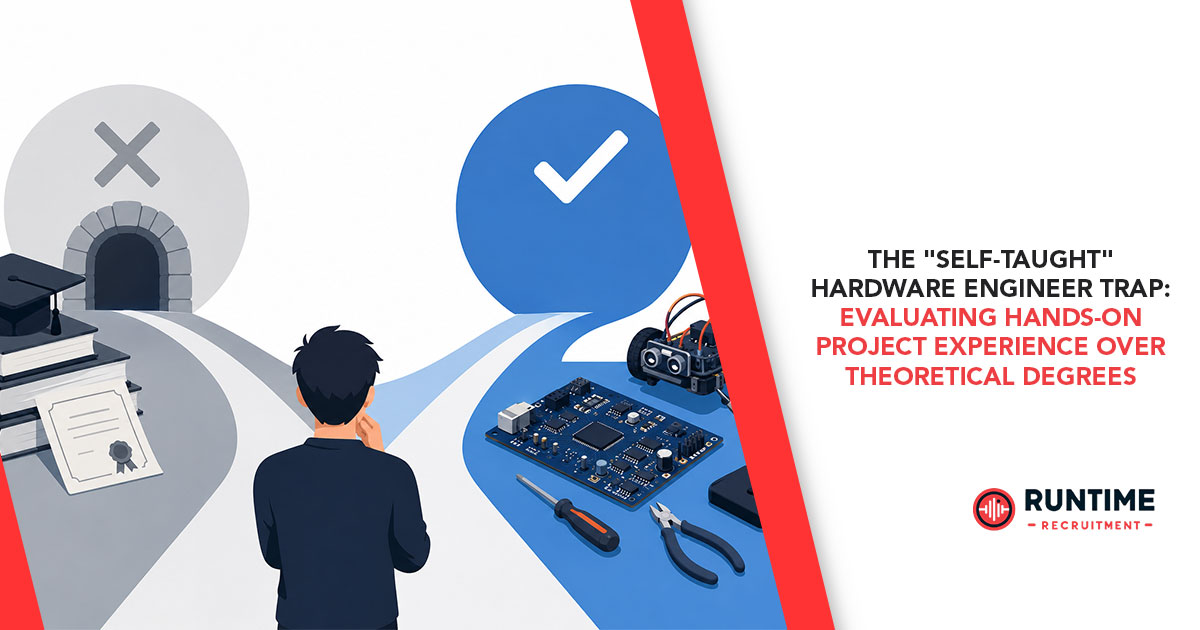
The software development world has spent the last two decades celebrating the rise of the self-taught developer. Bootcamps, open-source repositories, and interactive tutorials proved that you do not need a four-year Computer Science degree to ship scalable web applications, write clean APIs, or build responsive user interfaces.
Inspired by this democratization, a growing cohort of aspiring embedded systems and hardware engineers have taken a similar path. Armed with modern prototyping platforms like ESP32s, STM32 discovery kits, accessible EDA tools like KiCad, and low-cost desktop oscilloscopes, self-taught practitioners are building intricate hardware projects from home workshops. On paper, their portfolios look stunning: custom four-layer printed circuit boards (PCBs), wireless sensor nodes, home automation hubs, and motor controllers.
However, when engineering leaders and hiring managers attempt to transpose the "self-taught success model" directly into hardware and embedded systems, they frequently hit a wall.
While hands-on project experience is invaluable, there is a subtle, high-stakes phenomenon emerging across tech hiring: The "Self-Taught" Hardware Engineer Trap.
Evaluating hardware candidates strictly by their visible project output while dismissing formal theoretical foundations—or conversely, assuming a theoretical Electrical Engineering (EE) degree automatically guarantees hardware proficiency—creates significant hiring blind spots.
Why does the self-taught approach face unique hurdles in hardware compared to software? How can technical leaders evaluate talent beyond surface-level portfolios?
1. Why Hardware Is Not Web Development
In pure software, the abstraction layers are deep, forgiving, and elastic. If a web developer writes memory-inefficient code, cloud infrastructure scales elastically to absorb the impact. If a syntax error makes it past local testing, continuous integration and deployment (CI/CD) pipelines can revert or hotfix the change within minutes without physical damage.
Hardware and low-level firmware operate under fundamentally different physical constraints:
Physical Consequences: Software crashes result in log entries. Hardware failures can result in thermal runaways, component destruction, board fires, regulatory non-compliance fines, or bodily harm in safety-critical applications.
No "Over-the-Air" Fix for Physical Layouts: A trace routed too close to a high-speed switching line creates electromagnetic interference (EMI) that cannot be patched via a software update. If your decoupling capacitors are placed too far from IC power pins, voltage dips will cause transient reset loops that no firmware workaround can cleanly fix.
Non-Deterministic Physics: Embedded hardware interacts directly with analog realities—signal attenuation, cross-talk, parasitic capacitance, thermal dissipation, ground bounce, and component tolerances across temperature ranges (e.g., −40∘C to +85∘C).
Software Abstraciton:
[Code] ──> [Framework] ──> [OS] ──> [Virtual Cloud Machine]
Hardware Reality:
[Firmware] ──> [Silicon Registers] ──> [PCB Traces] ──> [Physics & Thermodynamics]
When self-taught software engineers transition to hardware, they often carry over a rapid prototyping mindset where success is measured by a binary outcome: Does it turn on and work right now on my desk?
In professional hardware engineering, "it works on my bench" is not the end of the project—it is barely the baseline prototype.
2. Anatomy of the Trap: What the "Works on My Bench" Portfolio Hides
The core of the "Self-Taught Trap" is not that self-taught engineers lack capability or passion. In fact, self-taught hardware builders often exhibit exceptional self-reliance, creative problem-solving, and drive. The trap lies in the invisible gap between maker-level execution and production-grade engineering.
When evaluating a portfolio containing custom PCBs and micro-controller code, hiring managers often see polished end-products. However, without a deep grounding in theoretical fundamentals, several critical blind spots tend to hide beneath the surface:
A. The "You Don't Know What You Don't Know" Problem
In formal electrical and computer engineering programs, students spend years studying circuit theory, linear systems, electromagnetics, signal processing, semiconductor physics, and discrete math. While these courses can feel abstract, they build a mental model of why physical systems behave the way they do.
A self-taught candidate relying solely on tutorial-driven learning may successfully implement an I2C sensor bus using pre-built libraries. But what happens when the bus length increases, parasitic capacitance distorts signal rise times, and communication intermittently drops?
An engineer grounded in signal theory understands pull-up resistor calculation, bus capacitance limits (400 pF per I2C spec), transmission line effects, and logic threshold margins.
A self-taught builder lacking that foundation may spend days engaged in trial-and-error—swapping microcontrollers, tweaking code delays, or blaming faulty chips—because they lack the theoretical framework to diagnose signal integrity issues with an oscilloscope.
B. Over-Reliance on High-Level Hardware Abstractions
The proliferation of platforms like Arduino, ESP-IDF, and Python-driven microcontrollers has lowered the barrier to entry significantly. While excellent for prototyping, these ecosystems abstract away critical low-level concepts:
Interrupt Service Routine (ISR) latency and reentrancy.
Direct Memory Access (DMA) channel configuration and memory-mapped register manipulation.
Cache coherence in multi-core microcontrollers.
Real-Time Operating System (RTOS) priority inversion, race conditions, and deadlocks.
A candidate may showcase an impressive IoT edge device built using high-level framework wrappers. However, if deployed in a commercial environment requiring microsecond-level deterministic timing or microamp power optimization during deep sleep, abstraction layers break down. Without foundational knowledge of MCU architecture, the engineer cannot optimize or debug at the register level.
C. Ignoring DFM, DFT, and Regulatory Compliance
Building one functional board on a desk is vastly different from designing a board that can be manufactured reliably by the thousands:

"In hobby projects, failure is a temporary nuisance you bypass with a power cycle. In commercial hardware, unaddressed failure modes become warranty claims, product recalls, and safety liabilities."
3. The Other Side of the Coin: The "Theoretical-Only" Degree Trap
To avoid the self-taught trap, some companies swing to the opposite extreme: imposing rigid educational filters that require a Master’s or Bachelor’s degree from top-tier engineering universities, while discounting practical project experience.
This approach carries its own set of failure modes.
Traditional academic curricula can lag behind modern hardware development practices:
Outdated Toolchains: Many university programs teach embedded systems using legacy 8-bit microcontrollers or outdated IDEs, failing to expose students to modern tools like Zephyr RTOS, CMake build systems, Git-based hardware workflows, or low-power ARM Cortex-M/RISC-V architectures.
Lack of Practical Bring-Up Experience: A fresh graduate with a stellar GPA in electromagnetic theory may have spent four years solving differential equations on paper without ever hand-soldering a 0402 surface-mount passive, debugging an SPI bus collision with a logic analyzer, or layout-routing a high-speed differential pair.
Fear of the Hardware Workbench: Theoretical graduates can sometimes hesitate when faced with unscripted physical debugging. When a board fails to boot, they may lean heavily on theoretical assumptions rather than rolling up their sleeves to systematically measure voltage rails, check crystal oscillators, and trace signal lines.
4. Rethinking Evaluation: How to Benchmark Embedded Talent Accurately
If neither a flashy self-taught portfolio nor a theoretical engineering degree is a standalone guarantee of competence, how should technical leads, engineering managers, and recruitment specialists evaluate hardware and embedded talent?
The key lies in evaluating how a candidate bridge theory and execution, rather than focusing exclusively on where they acquired their knowledge.
1. Evaluate Debugging Methodology, Not Just Completed Code
Anyone can follow a step-by-step tutorial to get a sensor reading displayed on an OLED screen. True embedded competence shows when things go wrong.
During technical interviews, present candidates with a broken system scenario:
"Our custom PCB intermittently hangs during heavy radio transmission. Walk us through your step-by-step diagnostic methodology."
"An SPI flash chip returns corrupted data every few hundred read operations under low temperature. How do you isolate whether this is a firmware timing issue, a voltage sag, or a trace impedance mismatch?"
Listen for systematic isolation methods: Do they check power supply stability with an oscilloscope? Do they verify signal rise/fall times? Do they check timing diagrams against datasheet specifications? A strong candidate—whether self-taught or university-educated—focuses on root-cause verification rather than random trial-and-error guessing.
2. Inspect Code & Design Formality (The "Beyond the Tutorial" Standard)
When reviewing a candidate's GitHub or hardware portfolio, look past the initial demonstration video and examine the underlying assets:
Firmware Structure: Is the code organized with modular drivers, clean HAL abstraction, static analysis considerations, and error handling? Or is it a single 2,000-line main.c file filled with blocking delay calls and global variables?
Schematic Readability: Are schematics laid out logically with clear functional blocks, net labels, power flags, and decoupling capacitor assignments? Or are they tangled "spaghetti wires" connecting pre-made breakout boards?
PCB Layout Rigor: Does the board layout show intentional ground plane distribution, minimal loop areas for high-frequency paths, and proper thermal relief?
Hobbyist Approach:
[Breakout Board A] ──Jumper Wires──> [Breakout Board B]
Professional Approach:
[Custom Schematic] ──> [Calculated Impedance & PDN] ──> [Monitored Gerber Output]
3. Test Knowledge of Constraints and Failure Modes
Ask questions that explore physical constraints and edge-case behavior:
"What happens to your firmware memory allocation if a sensor disconnected mid-operation?"
"How do you prevent flash corruption during a sudden power outage during a firmware update?"
"How do you select decoupling capacitors for an MCU with high-speed switching IOs?"
A candidate trapped in the self-taught hobbyist mindset will often struggle here, as hobby projects rarely mandate long-term reliability under adversarial conditions. A candidate with strong practical maturity will discuss watchdog timers, non-volatile storage journaling, brown-out detection, and noise filtering.
5. Bridging the Gap: Advice for Engineers and Employers
For Self-Taught Hardware Engineers
If you came into hardware through a non-traditional path, your self-motivation and practical building skills are major assets. To elevate your career and avoid the self-taught trap:
Invest in Core Theory: Do not skip the math and physics. Study university textbooks on linear circuit analysis, signal integrity, and computer architecture.
Move Beyond Arduino Frameworks: Write bare-metal drivers directly from datasheets and reference manuals using C/C++. Learn RTOS internals (FreeRTOS, Zephyr) and register manipulation.
Design for Reliability: In your personal projects, focus on robustness over feature count. Document how your board handles thermal dissipation, power cycling, noise injection, and fault recovery.
For Degree-Holding Engineers
If you hold a traditional EE or CE degree, your theoretical foundation is a powerful launchpad. To stand out in the job market:
Build Real Physical Hardware: Move beyond simulation software (SPICE, MATLAB). Design, order, assemble, and bring up your own custom PCBs.
Master Modern Toolchains: Familiarize yourself with commercial Git workflows, CI/CD for embedded systems, automated hardware testing, and modern scripting for build environments.
Embrace Hands-On Workbench Skills: Get comfortable using high-speed oscilloscopes, logic analyzers, spectrum analyzers, and SMD soldering tools.
For Hiring Managers & Technical Leaders
To build resilient engineering teams, move beyond arbitrary credential filters and superficial portfolio reviews:
Combine Evaluation Metrics: Pair portfolio reviews with deep-dive technical discussions that test theoretical understanding.
Look for "T-Shaped" Competence: Target candidates who possess broad practical building experience combined with deep domain knowledge in fundamental engineering principles.
Pair Complementary Strengths: A team composed of both deep-theory academics and highly agile self-taught builders creates a strong dynamic—where theoretical precision meets practical execution.
Conclusion
Hands-on project experience and theoretical engineering degrees are not mutually exclusive opposites—they are two halves of a complete hardware engineer.
The "Self-Taught" Hardware Trap occurs only when we mistake the ability to assemble functional prototypes for the complex discipline of production hardware engineering. By evaluating candidates through a balanced lens that values both physical execution and fundamental engineering rigor, organizations can build technical teams capable of shipping reliable, high-performance hardware products.
Partner with RunTime Recruitment
Navigating the nuances of embedded engineering talent requires industry-specific recruitment expertise. Whether you are building an elite hardware team or looking for your next engineering role, RunTime Recruitment connects premier engineering talent with industry-leading technology companies. Connect with RunTime Recruitment today to streamline your engineering talent search.