
AI for Custom Tooling: Building Specialized Dev Tools Rather Than Relying on Copied Firmware Code
9 September 2026 · Lance Harvie
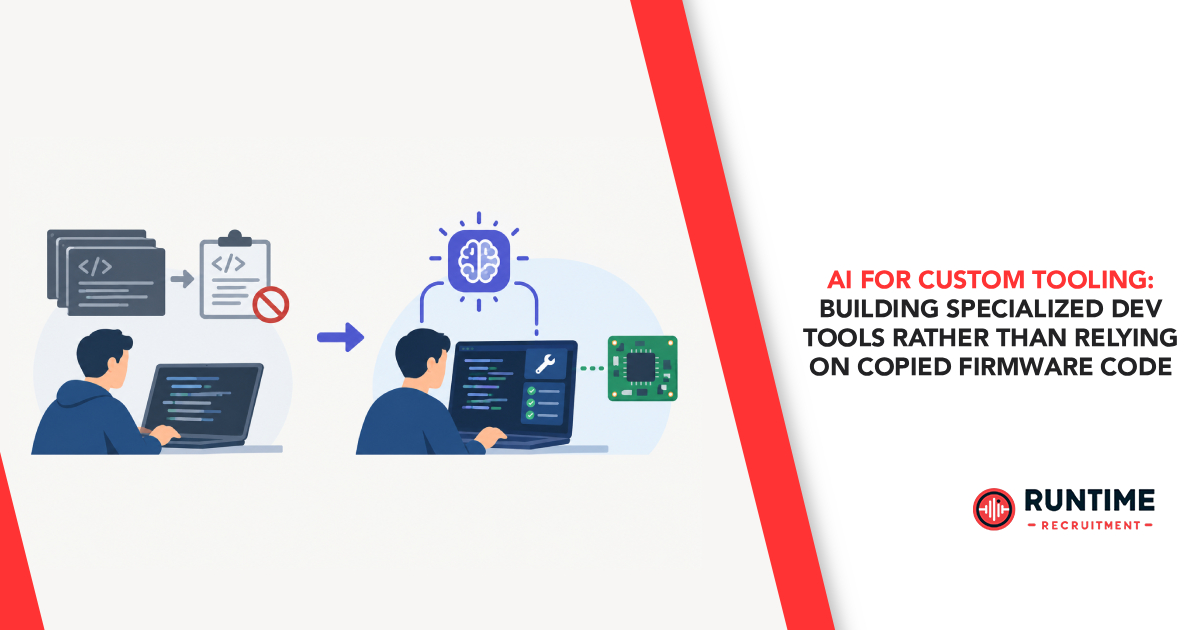
The generative AI boom has fundamentally transformed application software engineering. Web and cloud developers routinely lean on tools like GitHub Copilot and ChatGPT to draft boilerplate C#, TypeScript, or Python code. In those high-level domains, an unhandled exception or missing null check usually manifests as a caught runtime error, a logged stack trace, or a restarted microservice container.
In embedded systems engineering, however, the physics of the environment are unforgiving. Firmware runs directly on bare-metal silicon or real-time operating systems (RTOS) with hard deterministic deadlines, strict memory constraints, volatile memory-mapped registers, and precise clock configurations. Asking a large language model (LLM) to generate C, C++, or Rust firmware directly—and copy-pasting that output straight into a target microcontroller's flash memory—is a high-risk strategy.
An LLM running in a remote cloud data center lacks physical awareness of your hardware target. It does not understand your specific silicon revision, board layout trace impedances, peripheral errata, memory-mapped register states, or interrupt handler priorities. Dropping raw, AI-generated code onto a target device routinely introduces subtle timing glitches, priority inversions, unhandled edge cases, and memory corruption that can take days or weeks to diagnose with an oscilloscope, logic analyzer, or JTAG debugger.
Does this mean generative AI has no place in low-level firmware engineering? Far from it. The real force multiplier for embedded engineering teams lies in a fundamental paradigm shift: using AI to build specialized, host-side custom developer tooling rather than relying on copied firmware code.
By shifting AI from an unreliable "firmware typist" on the embedded target to an agile "toolsmith" on the host workstation, embedded teams can drastically accelerate their development velocity. This approach keeps target firmware 100% human-verified, deterministic, and certified, while leveraging AI to eliminate the tedious scripting and tooling friction that traditionally slows hardware bring-up.
The Hidden Risks of Copy-Pasting AI-Generated Firmware Code
Understanding why direct code generation fails in firmware requires examining the fundamental gap between statistical language modeling and low-level system design.
Context Blindness to Hardware Constraints
Generative AI models operate on statistical probabilities derived from vast training datasets. While an LLM might know the general syntax for an ARM Cortex-M I2C driver, it cannot infer your board's physical realities. It does not know that your I2C bus requires a specific bus-clear bit-banging sequence upon power-up, or that a vendor-specific silicon bug requires a dummy register read before clearing a DMA interrupt flag. Copied AI code lacks this hardware-specific context, leading to intermittent lockups that only manifest under specific physical conditions.
Hallucinations in Safety-Critical and Real-Time Contexts
In application software, a minor code hallucination might cause a minor UI bug. In embedded firmware, a hallucinated pointer assignment, a missing volatile keyword on a register pointer, or an unhandled interrupt service routine (ISR) flag can lead to catastrophic hardware behavior, thermal runaways, or system deadlocks. Furthermore, LLMs regularly struggle with deterministic RTOS concurrency semantics, often generating code with hidden race conditions, stack overflow vulnerabilities, or non-reentrant function calls inside interrupt contexts.
Compliance and Regulatory Liabilities
Industries utilizing embedded systems—such as medical devices (ISO 13485), automotive (ISO 26262), industrial automation (IEC 61508), and aerospace (DO-178C)—mandate rigorous code quality and traceability standards. Static analysis tools routinely enforce MISRA C:2023 or CERT C rules, which forbid dynamic memory allocation (malloc), require explicit type casting, and ban unconstrained pointer arithmetic. AI models frequently emit non-compliant code constructs that fail static analysis checks, requiring manual refactoring that negates any initial time saved.
Loss of Architecture Ownership
When engineers write firmware line-by-line, they construct an internal mental model of the system's state space, timing budgets, and execution paths. When developers rely on copy-pasting AI-generated blocks, that mental model dissolves. When hardware bring-up stalls or an intermittent bug emerges during environmental testing, the team faces the daunting task of debugging unvetted code they did not design.
The Shift to AI as a Toolsmith
Every senior embedded engineer knows that high-performing engineering teams are defined by the quality of their internal tools. Custom Python scripts, register map parsers, build system generators, trace log decoders, and hardware-in-the-loop (HIL) automation harnesses are the secret weapons that allow top teams to ship reliable products faster.
Historically, however, building custom developer tooling was a luxury. When deadlines loomed, firmware engineers rarely had spare time to write a dedicated 1,000-line Python script to parse custom binary telemetry or build a domain-specific register generator. Internal tools were often cobbled together as fragile, undocumented bash scripts or omitted entirely in favor of manual, error-prone workflows.
This is precisely where Generative AI excels.
LLMs are extraordinarily effective at host-side text manipulation, domain-specific language (DSL) translation, parser generation, CLI utility creation, and data format conversion (e.g., JSON, YAML, SVD, XML, CSV).
The Host vs. Target Guardrail
When you use AI to write host-side tooling rather than target firmware, the failure modes change completely:
Zero Target Risk: Flaws in a host-side tool do not contaminate target flash memory or cause hardware damage.
Immediate Feedback Loops: Host-side tools run on modern operating systems (Linux, macOS, Windows) where host compilers, linters, static analyzers, and unit test frameworks instantly catch bugs.
Coding CraftsHigh ROI: Writing a custom tool manually might take two days of engineering effort. Generating that same tool with an LLM, reviewing it, and running it takes thirty minutes.
Instead of asking AI to write a driver, you ask AI to write a tool that generates or validates that driver deterministically. The AI operates on your PC or inside your CI/CD build runner, leaving your embedded target pristine.
Four High-Impact Custom Tools You Can Build with AI
To put this paradigm into practice, consider four practical domain use cases where embedded teams can leverage AI to build specialized internal tooling.
1. Custom Register Map and Datasheet Code Generators
Vendor-provided Hardware Abstraction Layers (HALs) are often bloated, inefficient, or non-compliant with internal coding standards. Manual register header creation from 500-page silicon datasheets, on the other hand, is tedious and error-prone.
The AI Tool Solution: Build an AI-assisted Python utility that ingests System View Description (SVD) XML files or raw register specification tables extracted from datasheets. The Python tool validates register field offsets, checks for overlapping bitmasks, and outputs clean, MISRA-compliant C header files or Rust Peripheral Access Crates (PACs).
Why it works: The LLM writes the Python parsing script once. The script then executes deterministically across hundreds of peripherals, ensuring bit-exact register definitions without human copy-paste errors or AI hallucinations in the final header file.
2. Specialized Trace Log Decoders and Telemetry Visualizers
Debugging wireless IoT nodes or high-speed motor controllers often requires streaming raw data over UART, SPI, SEGGER Real-Time Transfer (RTT), or Single Wire Output (SWO). To minimize target bandwidth and memory footprint, firmware typically dumps tightly packed binary packets rather than ASCII strings.
The AI Tool Solution: Instead of manually reading hex dumps or hand-crafting a parser, use AI to generate a dedicated host-side telemetry parser in Python or Rust. By feeding the AI your firmware's binary frame structures (packet headers, payload bitfields, endianness, and CRC polynomial), the AI can build a CLI tool or local web dashboard that unpacks raw hex streams in real-time, displays graphical telemetry charts, and flags anomalous state transitions.
3. Domain-Specific Language (DSL) and State Machine Compilers
Complex application logic—such as battery management system (BMS) charging sequences, Bluetooth LE pairing flows, or motor control safety states—becomes unmaintainable when written as giant nested switch-case statements in C.
The AI Tool Solution: Use AI to build a lightweight DSL compiler. Engineers define state machine states, events, guards, and transitions in a clear, human-readable YAML or JSON specification. The AI-built host tool parses this specification, verifies that all state transitions are fully defined (preventing unhandled deadlock states), and generates provably complete C state machine execution functions complete with transition logging hooks.
4. Automated HAL Mocks and Unit Test Harnesses
Running unit tests directly on target hardware is slow and hard to automate in continuous integration pipelines. Effective firmware testing relies on executing business logic on the host machine using test frameworks like Ceedling, Unity, or GoogleTest, which requires mocking low-level hardware abstraction interfaces.
The AI Tool Solution: Prompt the LLM to analyze your C/C++ HAL header files and automatically generate corresponding mock implementations, error-injection utilities, and synthetic sensor data generators. When the underlying HAL interface changes, the tool regenerates updated mocks in seconds, enabling continuous test-driven development (TDD) on the host PC.
Architectural Blueprints and Safety Guardrails for AI Tooling
To ensure AI-built tooling remains reliable and maintainable across long project lifecycles, embedded development teams should enforce four structural guardrails.
Enforce Schema and Format Constraints: Never accept unvalidated text from an LLM. Use structured data validation libraries like Pydantic in Python or JSON Schema to enforce rigid constraints on the input and output data structures handled by your custom tools.
Integrate Host Compiler and Static Analysis Checks: Any code generated by your custom tools (such as generated state machine files or register headers) must pass through strict host compiler checks (-Wall -Wextra -Werror), formatting tools (clang-format), and static analysis rules (cppcheck or clang-tidy) as part of your automated build system.
Version Control Prompts and Tooling Source Code: Treat the source code of your AI-generated tools with the same rigor as your target firmware repository. Store custom tool scripts, configuration schemas, and generation prompts in version control (Git). This ensures reproducible firmware builds across the entire development team and CI runners.
Maintain Human-in-the-Loop Verification: While AI builds the tool, human engineers must remain the ultimate authority. Review generated tool code before committing it to main branches, run unit tests on the tools themselves, and verify generated firmware artifacts against physical silicon behavior during hardware bring-up.
Building Better Firmware Through Better Tools
Generative AI offers tremendous opportunities for embedded systems development, but only when applied with domain-specific wisdom. Copying AI-generated code directly into firmware flash introduces unpredictable behavior, safety risks, and debugging nightmares. By shifting AI to host-side custom tooling, embedded teams eliminate target risks while building powerful, deterministic engineering infrastructure. Custom register generators, trace parsers, DSL compilers, and test mocks empower senior firmware engineers to focus on what matters most: low-level architecture, timing closure, and hardware optimization.
Connect with RunTime Recruitment
Looking to scale your embedded engineering team with top-tier talent? RunTime Recruitment connects leading engineering businesses with elite firmware architects, embedded systems specialists, and hardware engineers. Whether you need specialized contract expertise or permanent engineering leads, we deliver verified technical talent to drive your projects forward. Connect with RunTime Recruitment today to discuss your hiring needs.