
Secure by Default, Not by Patch: Moving Threat Modeling to the Very Beginning of the Embedded Lifecycle
10 August 2026 · Lance Harvie
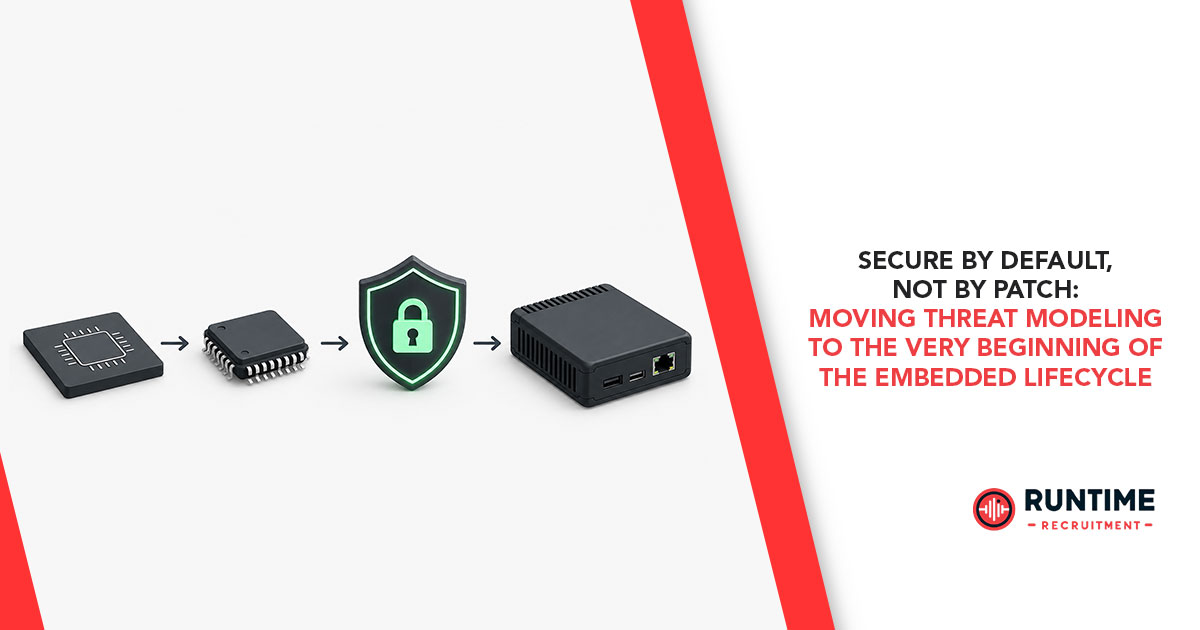
You know the feeling. You’ve just spent six months meticulously shaving milliseconds off a real-time operating system (RTOS) interrupt handler. You’ve optimized the memory footprint to fit perfectly within a highly constrained microcontroller. The PCB layout is finalized, the first prototypes are on your desk, and you are ready to ship.
Then, the security audit happens.
The penetration testing team discovers that your debug port is wide open, your firmware update mechanism accepts unsigned binaries, and your AES keys are hardcoded in plain text. Fixing these vulnerabilities post-design doesn’t just mean rewriting code; it means ripping up the architecture, delaying the launch, and potentially respinning the board.
For years, the technology industry has leaned on a "move fast and break things" philosophy, treating security as a bolt-on feature handled via post-release patches. While web developers can afford to push a hotfix to a cloud server in ten minutes, embedded engineers operate in the physical world. In our domain, pushing a faulty Over-The-Air (OTA) update to a fleet of agricultural tractors over a spotty 2G connection can brick the entire fleet.
The era of "patching it later" is over. Regulatory frameworks and the sheer physics of connected devices are forcing a paradigm shift. To build truly resilient products, we must adopt a Secure by Default methodology. And that begins with moving Threat Modeling to the very beginning of the embedded lifecycle—Phase Zero.
The "Patch It Later" Fallacy and the Regulatory Reckoning
Treating security as an afterthought is a systemic failure in the embedded space. Unlike traditional IT software, embedded systems suffer from unique constraints: hard real-time requirements, severe limitations on compute and power, and lifecycles that can span decades. When security is shoehorned in at the end, it usually manifests as a frantic scramble to implement cryptographic libraries on hardware that lacks the necessary acceleration, resulting in depleted batteries and missed timing deadlines.
Furthermore, relying on OTA updates as your primary security strategy is a dangerous game. OTA is a safety net, not a foundational defense. If the OTA implementation itself hasn't been threat-modeled, attackers can hijack the update mechanism to deliver malicious payloads, turning your fleet into a coordinated botnet.
Beyond the engineering headaches, the legal landscape is aggressively shifting. The European Union's Cyber Resilience Act (CRA) is redefining the baseline for device security. By September 11, 2026, the 24-hour vulnerability reporting obligation becomes active, and by December 11, 2027, the CRA's strict requirements become fully binding for any product with digital elements sold in the EU.
The Compliance Reality: Under the EU CRA, manufacturers face penalties of up to €15 million or 2.5% of their global turnover for non-compliance. The CRA mandates security by design, a continuous Software Bill of Materials (SBOM), and a minimum support horizon of five years.
Frameworks like IEC 62443 for industrial control systems and ISO/SAE 21434 for automotive engineering echo these sentiments. The message is clear: if you are not proving that your system was secure by design, you are legally and financially exposed.
What is Embedded Threat Modeling?
Threat modeling is a structured, repeatable process for identifying, evaluating, and mitigating security risks before a single line of C, C++, or Rust is written, and before the PCB schematic is drawn.
It forces the engineering team to shift their mindset from "How do we make this work?" to "How can an attacker make this fail?"
In the context of the software development lifecycle (SDLC), threat modeling sits squarely in the Requirements and Design phase. It involves four fundamental steps:
Decompose the Architecture: Mapping out data flows, hardware interfaces, trust boundaries, and state machines.
Identify the Threats: Systematically finding what can go wrong.
Determine Mitigations: Deciding how to counter the identified threats (e.g., adding hardware security modules, implementing encryption).
Validate: Ensuring the mitigations work and don't violate system constraints.
Applying STRIDE to the Embedded World
To identify threats systematically, the STRIDE framework—developed by Microsoft—is widely regarded as the gold standard. However, applying STRIDE to embedded systems requires a hardware-aware translation. Here is how you evaluate an embedded design through the STRIDE lens at the very beginning of your lifecycle.
1. Spoofing (Identity Context)
Can a malicious device pretend to be a legitimate component?
Embedded Scenario: An attacker splices into an I2C bus and spoofs a temperature sensor, feeding artificially low readings to an HVAC controller to force an industrial chiller to overheat.
Early Mitigation: Designing cryptographic authentication between the MCU and external peripherals, rather than blindly trusting data on the bus.
2. Tampering (Integrity Context)
Can an attacker modify data in transit or at rest?
Embedded Scenario: A bad actor uses voltage glitching (fault injection) to skip the password verification loop in the bootloader, or directly modifies the external SPI flash memory.
Early Mitigation: Utilizing internal flash for critical boot code, implementing secure boot, and physically routing sensitive traces on internal PCB layers to prevent easy probing.
3. Repudiation (Non-repudiability Context)
Can a user perform a malicious action without a trace?
Embedded Scenario: An edge gateway sends a command to open a physical access gate, but there is no secure audit log to verify which node authorized the command.
Early Mitigation: Designing secure, append-only logging mechanisms that utilize a Trusted Platform Module (TPM) to sign log entries.
4. Information Disclosure (Confidentiality Context)
Is sensitive data exposed to unauthorized parties?
Embedded Scenario: Sniffing unencrypted Bluetooth Low Energy (BLE) pairing keys over the air, or extracting hardcoded AWS IoT credentials directly from a raw firmware bin dump via an unprotected JTAG port.
Early Mitigation: Fusing JTAG interfaces during manufacturing (or enforcing cryptographic unlocking) and utilizing a Secure Enclave to handle cryptographic secrets so they are never exposed to the main application core.
5. Denial of Service (Availability Context)
Can an attacker render the system inoperable?
Embedded Scenario: A classic network flood (like an MQTT SYN flood) crashes the lightweight TCP/IP stack. Alternatively, a "Sleep Deprivation Attack" wakes a battery-powered IoT node repeatedly, draining a 10-year battery in three days.
Early Mitigation: Designing hardware watchdogs, implementing rate-limiting in the network stack, and separating network processing into a segregated RTOS task with strict memory and CPU quotas.
6. Elevation of Privilege (Authorization Context)
Can an unprivileged entity gain administrative control?
Embedded Scenario: A buffer overflow in a third-party Over-The-Air update library allows an attacker to jump out of user space and execute arbitrary code with root RTOS privileges.
Early Mitigation: Enforcing memory protection units (MPU) in the hardware selection phase and isolating critical tasks to prevent lateral movement.
Quantifying the Threat: The Math of Embedded Security
Identifying threats is only half the battle; prioritizing them is where engineering judgment comes into play. You cannot mitigate every conceivable threat without making the device too expensive or too power-hungry to function.
During the threat modeling phase, we formalize our risk assessment to prioritize engineering efforts. The foundational risk formula can be expressed as:

However, in embedded systems, we must also model the mitigation overhead. If we denote the severity of a vulnerability as vi, the criticality of the targeted asset as ci, and the probability of exploit as Pi, the total system risk exposure Esys can be modeled as:

When selecting mitigations, hardware constraints are mathematically unforgiving. Let's look at the implementation of Secure Boot. The bootloader must verify the firmware image F by checking a digital signature S generated by the manufacturer's private key Kpriv. The embedded device uses the public key Kpub to compute:

If you wait until the end of the lifecycle to implement this, you might realize your chosen microcontroller lacks hardware cryptographic acceleration. Calculating the SHA-256 hash H(F) and performing Elliptic Curve Digital Signature Algorithm (ECDSA) verification purely in software could take several seconds.
For an industrial safety valve that must boot and actuate within 500 milliseconds, a software-only cryptographic delay is catastrophic. By threat modeling at Phase Zero, you identify the need for Secure Boot before hardware selection, allowing you to source a microcontroller with a hardware cryptography engine that computes Verify() in under 40 milliseconds.
The Hardware-Software Symbiosis
One of the greatest benefits of early threat modeling is that it forces hardware and software teams out of their silos. True embedded security cannot be achieved by software alone.
If your threat model identifies physical tampering as a high-risk vector, the software team cannot solve that by writing better C code. The mitigation relies on the hardware team designing anti-tamper meshes, utilizing tamper pins to wipe volatile keys upon chassis opening, and provisioning a Hardware Security Module (HSM) or a discrete Secure Element (SE).
By collaborating during the design phase, the teams establish a Root of Trust (RoT). The RoT is the foundational hardware component that is inherently trusted, providing secure boot, secure key storage, and secure cryptographic operations. Moving threat modeling to the beginning ensures that the hardware architecture actively supports the software’s security requirements, rather than fighting against them.
Comparing the Paradigms
To illustrate the stark difference between the old way and the new way, consider the following comparison:

The Payoff: Engineering Sanity and Business Resilience
Shifting left to integrate threat modeling at the start of your embedded lifecycle requires an upfront investment of time. However, the return on investment is massive.
First, it drastically reduces the overall cost of development. According to industry studies, fixing a vulnerability in production can cost up to 100 times more than fixing it during the design phase. Discovering that your architecture allows privilege escalation on a whiteboard costs nothing to fix; discovering it after you have shipped 50,000 smart meters is an existential crisis for the business.
Second, it aligns your product with the aggressive new regulatory mandates. When the EU CRA requires you to demonstrate that you have handled vulnerabilities actively throughout your lifecycle, a documented, version-controlled threat model is your absolute best defense. It provides the verifiable proof that your team engineered the product with security as a foundational principle.
Finally, it protects the sanity of the engineering team. There is a profound peace of mind that comes from knowing your system's attack surface has been mapped, mitigated, and measured. Instead of waking up at 3:00 AM in a cold sweat over a zero-day vulnerability in your unencrypted bootloader, you can sleep soundly knowing your hardware Root of Trust has your back.
Conclusion
Embedded engineering is inherently complex, bridging the unforgiving laws of physics with the rigid logic of software. As our devices become more deeply integrated into critical infrastructure, healthcare, and our daily lives, the consequences of security failures rise exponentially.
"Secure by Default" is not a marketing slogan. It is a rigorous, deeply technical commitment to treating security as a fundamental engineering constraint, right alongside power consumption, memory, and cost. By moving threat modeling to the very beginning of the embedded lifecycle, we stop reacting to attackers and start engineering them out of the equation entirely.
Ready to build the next generation of secure embedded systems? Whether you are looking for your next career challenge or need top-tier engineering talent to fortify your designs, connect with RunTime Recruitment. Let's build a secure future, by default.