
The Multi-Modal Sync Crisis: Handling Video, Audio, and Telemetry Fusion on Constrained Edge NPUs
23 July 2026 · Lance Harvie
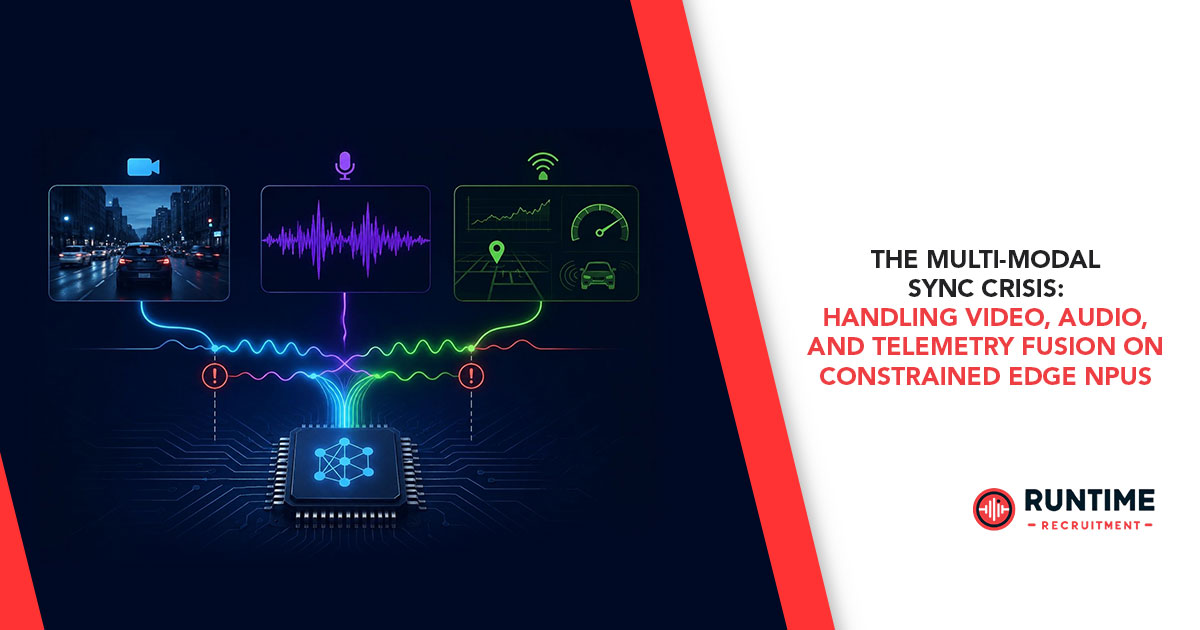
The embedded engineering landscape is undergoing a radical paradigm shift. We have moved past the era of single-sensor intelligence. Today’s edge devices—ranging from autonomous drones and industrial robotics to advanced wearable health monitors—are expected to understand their environment by simultaneously ingesting high-definition video, multi-channel audio, and high-frequency telemetry data. We are demanding that deeply embedded systems perceive the world much like humans do: in a continuous, synchronized, multi-modal stream.
However, beneath the marketing promises of "Edge AI," a significant engineering hurdle remains largely unaddressed: the multi-modal synchronization crisis.
When you strip away the abstraction layers and look closely at the silicon, fusing disparate data streams on constrained Neural Processing Units (NPUs) is a logistical nightmare. Edge NPUs are highly specialized execution engines designed for massive parallel MAC (Multiply-Accumulate) operations. They are fundamentally not designed for the erratic, asynchronous, and heterogeneous data pipelines required by multi-modal sensor fusion.
This article explores the root causes of the sync crisis, the hardware and software bottlenecks involved, and the architectural strategies embedded engineers can employ to build resilient multi-modal systems on constrained edge devices.
The Anatomy of the Multi-Modal Sync Crisis
To understand why synchronization is failing at the edge, we must first look at the nature of the data being ingested. Multi-modal systems inherently rely on sensors with vastly different physical characteristics, sampling rates, and processing requirements.
1. The Vision Pipeline: Video is a bandwidth-heavy, block-oriented data stream. A standard camera operating at 30 frames per second (FPS) produces discrete, massive chunks of data at relatively low frequencies (every ~33.3 milliseconds). Processing a single frame requires heavy convolutional neural network (CNN) workloads, pushing the NPU to its thermal and memory limits for a burst of time, followed by a period of idle waiting.
2. The Audio Pipeline: Audio is a continuous, time-series data stream. Sampled anywhere from 16kHz to 48kHz, audio data requires constant, low-latency attention. Before it even reaches the NPU, audio typically undergoes DSP (Digital Signal Processing) transformations—such as generating Mel-frequency cepstral coefficients (MFCCs) or spectrograms. The cadence is entirely different from video, often requiring recurrent neural network (RNN) or 1D-CNN architectures.
3. The Telemetry/IMU Pipeline: Telemetry data, such as inputs from Inertial Measurement Units (IMUs), LiDAR, temperature sensors, or motor encoders, operates on yet another axis. An IMU might stream at 500Hz to 1kHz, demanding near-instantaneous processing to maintain spatial awareness or stability control. The data payload is minuscule (a few bytes per reading), but the required latency is ultra-strict.
The "crisis" occurs when the system attempts to align these three disparate realities. If a robotic arm needs to identify an object (video), listen for a specific acoustic anomaly (audio), and track its own arm position (telemetry) to make a unified decision, the data must be temporally aligned. If the NPU processes a video frame that is 50 milliseconds old alongside IMU data that is 1 millisecond old, the resulting fused inference will be fundamentally flawed. In high-stakes environments, this temporal misalignment—often called "sensor jitter" or "phase drift"—leads to catastrophic machine learning model failures.
The Hardware Bottlenecks on Constrained NPUs
Why is this so difficult to handle at the edge? The answer lies in the architectural constraints of the hardware. Cloud-based sensor fusion relies on massive DDR memory bandwidth, powerful CPUs to handle context switching, and virtually unlimited power budgets. Edge architectures, conversely, are defined by their limitations.
Memory Bandwidth and SRAM Limits Constrained edge SoCs (System on Chips) typically feature a primary microcontroller (like an ARM Cortex-M or RISC-V core), a DSP, and a specialized NPU. The NPU relies heavily on localized, on-chip SRAM to achieve its performance-per-watt efficiency. SRAM is expensive and physically large, meaning edge NPUs usually only have a few megabytes available.
Multi-modal fusion requires holding the context of multiple data streams simultaneously. When an NPU is halfway through executing a heavy vision model, and a high-priority IMU fusion interrupt occurs, the system must perform a context switch. Because the SRAM cannot hold both models simultaneously, the vision model's intermediate activations must be flushed to slower, off-chip DRAM (or Flash), and the IMU model weights loaded. This memory thrashing introduces massive latency spikes, entirely defeating the purpose of real-time edge processing.
The Cost of Heterogeneous Compute orchestration Orchestrating traffic between the NPU, DSP, and MCU creates a severe bottleneck. The NPU is a coprocessor; it cannot fetch its own data. The MCU or a DMA (Direct Memory Access) controller must feed it. When dealing with video, audio, and telemetry, the MCU spends a disproportionate amount of its clock cycles simply moving data around, aligning buffers, and formatting inputs for the NPU, leaving little overhead for actual application logic.
Thermal Throttling Traps Operating multiple distinct models (vision, audio, telemetry) in a time-sliced manner on a single NPU causes continuous, high-utilization hardware states. This sustained workload rapidly increases the die temperature. Once the SoC hits its thermal ceiling, dynamic voltage and frequency scaling (DVFS) aggressively throttles the clock speed. A multi-modal sync strategy tuned for a 500MHz NPU clock will instantly fail when thermal throttling reduces the clock to 200MHz, causing immediate desynchronization of the data streams.
Engineering Solutions: Timestamping and Clock Synchronization
Solving the multi-modal sync crisis begins long before the data reaches the neural network. It requires a robust temporal foundation at the very edge of the hardware layer.
Hardware-Level Timestamping Software-based polling or RTOS (Real-Time Operating System) tick-based timestamping is insufficiently precise for complex fusion. The jitter introduced by interrupt latency and RTOS thread scheduling can easily exceed several milliseconds.
Instead, systems must utilize hardware-level timestamping. This involves tying the data ready (DRDY) pins of the camera, microphone I2S interface, and IMU SPI bus to a synchronized hardware timer or a dedicated precise event timer (PET) peripheral. The moment the physical sensor captures the analog signal, the DMA controller tags the memory buffer with a sub-microsecond hardware timestamp. This ensures that the downstream algorithms have an absolute source of truth regarding when the data was born, regardless of how long it spent sitting in a queue.
Global Timebases and PTP In distributed edge environments (e.g., a drone with multiple independent sensor boards), maintaining a global timebase is critical. Implementing a lightweight version of the Precision Time Protocol (PTP, IEEE 1588) allows disparate microcontrollers to synchronize their local hardware timers. Without a unified timebase, the independent clock drift of different oscillators will inevitably cause multi-modal data to drift out of phase over prolonged operation.
Advanced Buffering and Memory Architecture
Once the data is accurately timestamped, it must be staged for the NPU. Traditional linear buffering is entirely inadequate for multi-modal systems.
Circular Ring Buffers with Temporal Indices Because telemetry arrives continuously and video arrives in chunks, the software stack must utilize sophisticated circular ring buffers equipped with temporal indices. When a video frame arrives, the system does not simply take the latest IMU reading. Instead, it queries the IMU ring buffer for the specific subset of readings that match the precise timestamp of the video frame's exposure window.
Zero-Copy Architectures To mitigate the memory bandwidth bottleneck, engineers must implement strict zero-copy architectures. Data should be written directly by the sensor peripherals via DMA into regions of memory that are directly accessible by the NPU. Every time the CPU copies a video frame from one memory location to another to "format" it, crucial bus bandwidth and power are wasted. The NPU drivers must be configured to accept inputs directly from these shared, pre-allocated DMA buffers.
Algorithmic Fusion Strategies: Early vs. Late Fusion
The final piece of the puzzle lies in how the neural networks are structured to accept the data. The chosen fusion architecture heavily dictates the synchronization requirements.
Early Fusion (Data-Level Fusion) Early fusion attempts to combine raw or minimally processed data streams into a single input tensor before it enters the NPU. For example, stacking an audio spectrogram and a video frame as separate channels of a single multi-dimensional array.
The Catch: Early fusion requires absolute, pixel-perfect synchronization. If the audio data is shifted by even a few milliseconds relative to the video data, the spatial-temporal relationship is destroyed, and the model will fail to learn or infer correctly. On constrained edge devices, guaranteeing this level of strict alignment across heterogeneous sensors is nearly impossible due to unpredictable processing latencies.
Late Fusion (Decision-Level Fusion) For constrained Edge NPUs, Late Fusion is almost always the superior architectural choice. In a late fusion model, the vision, audio, and telemetry data are processed by separate, independent neural network branches. The vision model outputs a feature vector (e.g., object probabilities); the audio model outputs an acoustic feature vector; the telemetry model outputs physical state predictions.
These independent outputs are then fed into a final, lightweight fusion layer (often a simple multi-layer perceptron or even a non-ML heuristic algorithm running on the CPU) to make the final decision.
The Advantage: Late fusion is highly tolerant of synchronization jitter. Because each branch extracts high-level semantic features, exact millisecond alignment is less critical. Furthermore, late fusion allows for asynchronous processing. The fast-running IMU model can update its output 500 times a second, while the slow-running vision model updates its output 30 times a second. The final fusion layer simply looks at the most recent high-level outputs of each branch, drastically reducing the temporal complexity required by the software stack.
Managing RTOS Scheduling and Heterogeneous Compute
Even with late fusion, scheduling the execution of these independent models on a single NPU is a significant RTOS challenge. Embedded engineers must move away from simple round-robin scheduling and adopt priority-based, preemptive execution models for AI workloads.
Model Slicing and Preemption If a heavy CNN takes 30ms to execute, it will completely block the IMU model from running, causing a catastrophic telemetry backlog. To solve this, the NPU workload must be sliceable. Modern edge AI frameworks (like optimized versions of TensorFlow Lite for Microcontrollers, combined with vendor-specific NPU toolchains) allow large models to be split into sub-graphs.
By executing a model layer-by-layer, the RTOS can yield the NPU to higher-priority, low-latency tasks (like telemetry inference) in between the heavy vision layers. This requires intimate knowledge of the NPU's compiler and the RTOS scheduler, ensuring that context switching overhead (saving and restoring NPU registers and SRAM state) does not consume more time than the inference itself.
The Impact of Quantization on Fusion Stability
When discussing constrained NPUs, we must address quantization. Typically, Edge AI models are quantized to INT8 or even INT4 to fit within memory constraints. While the impact of quantization on a single vision model is well-documented, its impact on multi-modal fusion is often overlooked.
Different sensor modalities respond differently to quantization. A vision model might handle INT8 quantization with a negligible 1% drop in accuracy. However, a highly sensitive IMU telemetry model, relying on precise floating-point variations in accelerometer data, might suffer catastrophic precision loss when forced into INT8.
When fusing these quantized models, the variance in precision loss can destabilize the final fusion layer. The fusion layer expects inputs of a certain magnitude and distribution. If the telemetry branch is suffering from extreme quantization noise while the vision branch is stable, the fusion network will struggle to weigh the inputs correctly. Engineers must employ Mixed-Precision Quantization—keeping highly sensitive telemetry layers in INT16 or FP16 (if supported by the NPU), while aggressively quantizing the vision layers to INT8. This balances accuracy with memory constraints but requires a highly flexible hardware abstraction layer.
Real-World Application: The Autonomous Edge
Consider an automated guided vehicle (AGV) navigating a dynamic factory floor. It utilizes LiDAR (telemetry) for obstacle mapping, a camera (vision) for reading floor barcodes, and an acoustic sensor (audio) to detect the specific frequency of a failing bearing on nearby machinery.
If the sync crisis is not mitigated, the AGV's NPU might process the visual barcode data from position A, fuse it with LiDAR data recorded at position B, while reacting to a sound that occurred at position C. The resulting inference is chaotic, leading to navigational errors or missed maintenance alerts.
By implementing hardware timestamping at the DMA level, utilizing asynchronous late-fusion neural architectures, and utilizing model preemption within the RTOS, the AGV can maintain temporal coherence. The LiDAR pipeline can run at high frequency, interrupting the heavier barcode vision model only when necessary, while the audio pipeline constantly extracts background acoustic features—all sharing the same constrained edge NPU without stalling or overheating the silicon.
Navigating the Future of Embedded Systems
The multi-modal sync crisis is not an insurmountable roadblock, but it fundamentally redefines the role of the embedded engineer. We are no longer just writing firmware to read sensor registers; we are architects of complex, heterogeneous temporal pipelines. As Edge NPUs become more capable, the software abstraction layers will eventually catch up, offering better native support for synchronized, multi-modal workloads.
Until then, success at the edge requires a deep, uncompromising understanding of both the physical realities of sensor hardware and the intricate scheduling limits of constrained silicon. It requires moving away from the black-box mentality of cloud AI and embracing the rugged, cycle-accurate world of embedded development.
Building the next generation of multi-modal edge devices requires top-tier engineering talent—professionals who understand the intricate dance between RTOS scheduling, NPU constraints, and complex sensor fusion. Finding engineers with this rare blend of hardware and software expertise can be a significant bottleneck for your project timeline.
If your company is looking to build high-performance embedded systems and needs the specialized talent to make it a reality, connect with RunTime Recruitment today. We specialize in sourcing elite engineering professionals tailored to the unique demands of the embedded and edge AI industry. Let us help you find the future-proof hires necessary to turn your toughest technical challenges into market-leading products. Reach out to RunTime Recruitment and accelerate your engineering success.