
Neuromorphic Edge Silicon: Processing Spiking Neural Networks (SNNs) on Sub-Milliwatt Hardware
10 September 2026 · Lance Harvie
Edge AI system design is constrained by the energy cost of data movement. Traditional microcontrollers (MCUs) with vector extensions, micro-NPUs, and conventional Digital Signal Processors (DSPs) rely on the von Neumann architecture. They process continuous data streams — from micro-electromechanical systems (MEMS) accelerometers, acoustic microphones, or image sensors — by repeatedly sampling signals at fixed clock intervals, buffering frame tensors in SRAM or DRAM, and performing dense Multiply-Accumulate (MAC) matrix operations across hundreds of thousands of weight parameters.
Even on modern 22nm Ultra-Low Power (ULP) or Fully-Depleted Silicon-On-Insulator (FD-SOI) processes, running a dense Convolutional Neural Network (CNN) or continuous Recurrent Neural Network (RNN) consumes anywhere from tens to hundreds of milliwatts (10 mW— 500mW). For battery-powered edge devices, energy-harvesting IoT nodes, implantable medical electronics, and always-on smart sensors, a multi-milliwatt power profile is unsustainable. A standard 220mAh CR2032 coin cell battery drained continuously at 20mW will deplete in under two days.
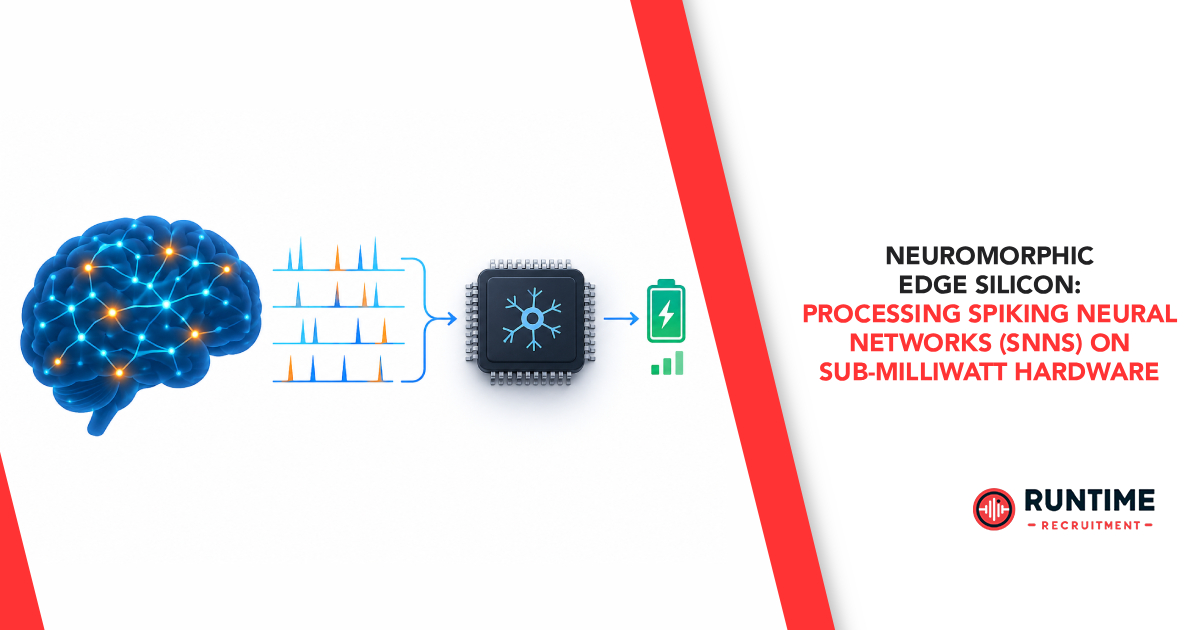
To break past this floor and achieve true sub-milliwatt (< 1 mW) or micro-watt processing, embedded engineers are moving away from frame-based, clock-driven numerical evaluation. Neuromorphic edge silicon and Spiking Neural Networks (SNNs) tackle this challenge directly. By mimicking the event-driven, temporally sparse, and asynchronous nature of biological nervous systems, neuromorphic processors process information only when significant state changes occur, cutting energy consumption per inference operation by 100x to 500x compared to conventional deep learning accelerators.
The Core Mechanics of Spiking Neural Networks
Unlike standard Artificial Neural Networks (ANNs), which transmit continuous floating-point activations synchronously across layers, Spiking Neural Networks communicate via discrete, binary event pulses called spikes over continuous time.
The Leaky Integrate-and-Fire (LIF) Primitive
The primary operational model implemented in neuromorphic hardware is the Leaky Integrate-and-Fire (LIF) neuron. Instead of constantly calculating continuous matrix multiplication, an LIF neuron functions like a tiny, electrical capacitor with a leak:
Integrate: Incoming spikes push charge into the neuron, accumulating electrical potential over time.
Leak: If no new spikes arrive, the stored potential naturally decays back toward a resting baseline state.
Fire: Once accumulated energy crosses a strict voltage threshold, the neuron instantly outputs a single binary spike, resets its internal state to zero, and briefly pauses before accepting new input.
Temporal and Spatial Sparsity
From a silicon perspective, this event-driven behavior unlocks two major efficiency vectors:
Elimination of Multiplication Operations: Because spikes are binary (present or absent), a synaptic operation no longer requires an 8-bit or 16-bit floating-point multiplication. Instead, when a spike arrives, the hardware simply adds the associated weight value directly into the target neuron’s state register. Multiplication is completely removed from the inner execution loop.
Event-Driven Execution (Spatial & Temporal Sparsity): If sensor data remains unchanged, zero spikes are generated. The underlying neuron circuits remain totally silent, consuming only minimal static leakage current. Unlike traditional NPUs that process zero-valued input matrices across active clock cycles regardless of content, neuromorphic silicon operates with native, clockless power efficiency.
Silicon Architecture: Building Sub-Milliwatt Hardware
Achieving continuous execution under 1 mW requires structural modifications to standard digital circuit design. Neuromorphic edge chips implement three core architectural strategies:
Asynchronous Logic and Network-on-Chip (NoC)
Standard digital SoCs use a global clock distribution tree that can account for 30% to 50% of total dynamic power dissipation. Ultra-low-power neuromorphic processors frequently employ asynchronous digital logic or handshaking protocol networks, such as Address-Event Representation (AER). Information is routed across the chip as spike packets only when a neuron fires, eliminating global clock toggling.
In-Memory Computing and Near-Memory Processing
Fetching weights from off-chip DRAM or distant SRAM blocks over bus lines consumes roughly 1–10 pJ per memory read, dwarfing the energy required for basic arithmetic compute. Neuromorphic chips co-locate memory directly alongside the neuron update circuits.
Weights reside inside local crossbar arrays. When an incoming spike line triggers a row, the crossbar updates values directly, minimizing interconnect capacitance and wire routing length.
Mixed-Signal vs. Asynchronous Digital Implementations
Engineers designing neuromorphic chips diverge into two hardware approaches:
Analog/Mixed-Signal (AMS): Employs physical transistors operating in the sub-threshold region to emulate membrane capacitance and leakage currents using analog continuous-time circuits. While yielding high energy efficiency < 100 fJ per spike operation, AMS faces challenges with thermal drift, process variation, and limited programmable precision.
Asynchronous Fully Digital: Uses customized low-leakage digital CMOS logic to calculate digitized state updates. While consuming slightly more energy 1–5 pJ per spike, fully digital SNN processors provide complete determinism, easy toolchain mapping, and straightforward scalability across foundry process nodes.
Commercial Sub-Milliwatt Silicon Overview
The neuromorphic edge market has moved beyond university research labs into production-ready silicon SoCs targeting embedded system integration.
Innatera Spiking Neural Processor (SNP T1)
Innatera’s architecture combines an analog-mixed-signal neuromorphic processing engine with an integrated RISC-V co-processor. Designed specifically for always-on sensor edge applications (such as radar micro-Doppler, audio classification, and IMU bio-signals), the SNP T1 operates within an energy envelope under 1 mW. Its analog spiking core processes raw temporal sensor signals natively, consuming less than 200 fJ per spike event and delivering latency under 1 ms.
SynSense Speck and Xylo
SynSense’s Speck SoC is a fully integrated, event-driven smart vision processor. It combines a $128 x 128$ Dynamic Vision Sensor (DVS) matrix directly with an asynchronous digital SNN core on a single silicon die. The SoC delivers real-time gesture control, face detection, and presence sensing at a total continuous system power budget of under 1 mW. The companion Xylo chip targets sub-milliwatt audio processing and low-dimensional time-series signal classification.

Front-End Sensor Integration: Converting Physical Signals to Spikes
A neuromorphic chip cannot reach sub-milliwatt performance if the front-end sensor requires traditional high-rate sampling buffers and analog-to-digital converters (ADCs). The entire signal chain must be optimized for temporal event generation.
Dynamic Vision Sensors (DVS)
Traditional image sensors capture full frames at fixed frequencies (e.g., 30 FPS or 60 FPS), outputting megabytes of redundant pixel data even when the scene is static. Event cameras, or Dynamic Vision Sensors (DVS), contain independent, autonomous pixels. Each pixel monitors its local illumination intensity individually. When the light change on a pixel crosses a defined threshold, that pixel immediately outputs an asynchronous event packet containing its coordinates, timestamp, and brightness direction (brighter or darker). If nothing moves, zero data is transmitted.
Time-Series Signal Encoding (IMU, Audio, ECG)
For one-dimensional signals like accelerometer data, acoustic waveforms, or biological signals, embedded engineers use dedicated spike-encoding algorithms implemented in hardware or low-power DSP front-ends:
Level-Crossing Delta Modulation (LCDM): A spike is emitted whenever the continuous voltage strays past a upper or lower boundary step relative to its last reported baseline.
Resonate-and-Fire Filterbanks: For acoustic analysis, audio is routed through a series of hardware bandpass filters, converting continuous frequency sub-bands directly into temporal spike rates, bypassing expensive short-time Fourier transforms (STFTs).
Latency Coding (Phase Coding): Information is encoded in the exact timing of the first spike relative to a trigger event. Stronger inputs fire earlier, enabling classification within the first few milliseconds of signal arrival.
Software Toolchains and Algorithmic Workflows
Training SNNs presents unique challenges because binary spikes create non-smooth mathematical functions that cannot be processed using traditional neural network optimization methods. Modern SNN development pipelines leverage two major engineering solutions:
1. ANN-to-SNN Conversion
In this approach, an engineer trains a traditional CNN or RNN using PyTorch or TensorFlow with standard activation functions. The trained floating-point weights are subsequently normalized and mapped to rate-coded SNN parameters using automated tools. While straightforward, conversion often results in higher overall spike rates (increasing dynamic power) and loses the temporal nuances of SNNs.
2. Direct SNN Training via Surrogate Gradients
To unlock full spatio-temporal efficiency, engineers train SNNs directly using Backpropagation Through Time (BPTT) combined with surrogate gradients. During forward pass training, the network uses true binary spikes. During the optimization step, software tools substitute a continuous approximation curve in place of the sharp threshold boundary to update weights smoothly.
Common open-source frameworks for direct SNN training include:
snntorch: A PyTorch-based library designed for deep spiking neural networks.
Sinabs / Rockpool: SynSense’s modeling SDKs for compiling PyTorch networks directly onto Speck and Xylo hardware targets.
Lava SDK: Intel’s open-source framework for event-driven neuromorphic computing, establishing a unified interface across diverse hardware backends.
NIR (Neuromorphic Intermediate Representation): A standardized graph representation developed by the neuromorphic research community that allows compilation across different SNN frameworks and neuromorphic targets.
Real-World Embedded Integration Considerations
Integrating sub-milliwatt SNN processors into real-world embedded designs requires managing several practical engineering trade-offs:
Memory Density vs. On-Chip State
SNN neurons maintain internal memory states over time. Every active neuron requires local register storage or dedicated SRAM bitcells to retain its accumulated energy across time steps. High neuron counts increase silicon area footprint. Embedded developers must tune model sizing — selecting minimal neuron counts that meet target classification accuracy without overwhelming available on-chip SRAM.
Temperature Drift and Mixed-Signal Calibration
For mixed-signal neuromorphic chips, physical sub-threshold currents vary non-linearly with temperature changes. Hardware designs must incorporate automatic calibration loops or temperature-compensated bias generators to preserve consistent firing thresholds across industrial operating ranges .
Interfacing Asynchronous Chips with Standard MCUs
Connecting an asynchronous event-driven chip to a traditional, clock-driven host MCU (such as an ARM Cortex-M4 or RISC-V core) requires efficient interface design. Standard SPI, I2C, or UART buses can easily become latency bottlenecks if flooded with unformatted spike events. System designs typically employ DMA-driven SPI buses or custom event buffers paired with GPIO interrupts that trigger the main MCU only when the SNN chip yields a high-confidence classification event.
The Road Ahead for Neuromorphic System Engineers
Neuromorphic edge silicon represents a functional shift for low-power embedded intelligence. By moving from frame-buffered tensor crunching to asynchronous, event-driven temporal computing, hardware design engineers can execute real-time keyword spotting, gesture tracking, vibration anomaly detection, and biomedical monitoring within sub-milliwatt power envelopes.
As toolchains like snntorch and Neuromorphic Intermediate Representation (NIR) mature, the engineering friction of deploying SNNs continues to drop. Deploying brain-inspired silicon that listens, watches, and acts only when needed opens up possibilities for true always-on intelligence at the extreme edge.
Connect with RunTime Recruitment
Looking to scale your engineering team or land your next role in embedded systems, hardware design, or edge AI development? Connect with the technical recruiting specialists at RunTime Recruitment today to find top talent and technical engineering opportunities.