The landscape of embedded systems is undergoing tectonic shifts, driven by a singular, relentless force: the migration of artificial intelligence from the cloud to the furthest reaches of the network edge. We are no longer simply building devices that sense, process, and actuate based on deterministic rules. We are building devices that perceive, infer, and adapt based on probabilistic models.
This transition from purely “embedded” to “AI-enabled embedded” is not merely a feature update; it is a fundamental restructuring of the engineering requirements stack. It has birthed a critical challenge that is stifling innovation agendas across industries: the desperate search for the “Hybrid Engineer.”
For engineering leaders and hiring managers, the dilemma is acute. You cannot build next-generation smart sensor hubs, autonomous robotics, or predictive medical wearables with yesteryear’s team structures. Yet, trying to hire for this new paradigm using traditional methods is resulting in gridlock. The talent market is screaming that the perfect intersection of deep hardware knowledge and modern data science is a vanishingly small target.
To navigate this, we must move beyond simplistic job descriptions that mash up “RTOS expert” with “TensorFlow guru.” We need to dissect the anatomy of this skills schism, redefine what a viable candidate profile looks like, and adopt more sophisticated strategies for building the teams capable of delivering the intelligent edge.
The Anatomy of the Schism: Why Oil and Water rarely Mix
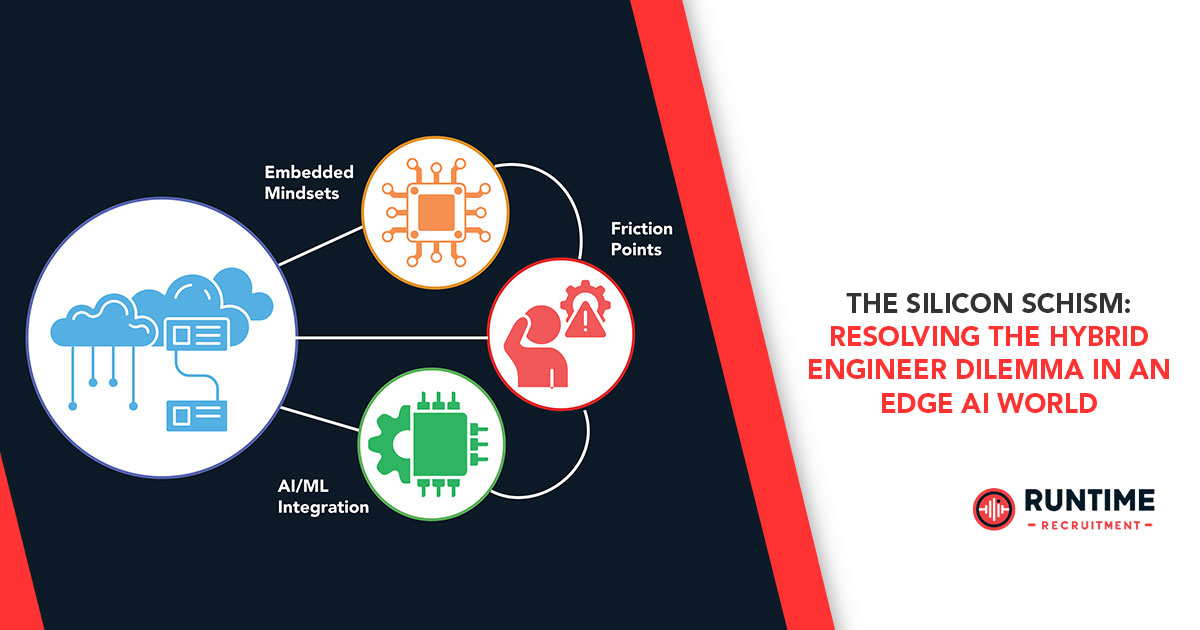
To understand why hiring the Hybrid Engineer is so difficult, one must appreciate that traditional embedded engineering and modern machine learning (ML) development are disciplines separated not just by tooling, but by philosophy. They attract different personality types and demand fundamentally opposing mindsets towards system design.
The Embedded Mindset: The Cult of Determinism The veteran embedded engineer lives in a world dominated by constraints. Their church is the datasheet, and their scripture is the instruction set architecture. They obsess over clock cycles, stack usage, and deterministic behavior. A system that behaves differently on Tuesday than it did on Monday is not “adaptive”; it is broken.
Their toolbox—C, C++, Assembly, RTOS primitives, oscilloscopes, and logic analyzers—is designed for absolute control and visibility closer to the metal. Their greatest fears are race conditions, priority inversions, and memory leaks that crash a mission-critical pacemaker or automotive braking controller. Reliability is paramount, and complexity is viewed with deep suspicion because complexity hides bugs.
The AI/ML Mindset: The probabilistic Sandbox Conversely, the Data Scientist or ML Engineer thrives in abstraction. They work in environments with virtually unlimited compute (relative to a microcontroller) and massive memory pools. Their focus is not on how the processor executes an instruction, but on the statistical validity of a model derived from terabytes of noisy data.
Their world is probabilistic. An accuracy rate of 95% is a triumph, whereas to an embedded engineer, a 5% failure rate in a control loop is catastrophic. They utilize high-level frameworks like PyTorch and TensorFlow, largely agnostic to the underlying hardware until deployment becomes an issue. Their development cycle involves rapid experimentation, hyperparameter tuning, and acceptance of “black box” operations where why the model works is less important than that it works.
The Friction Point The dilemma arises when these two worlds collide on a Cortex-M4 or a RISC-V core with 256KB of RAM.
Suddenly, the ML engineer’s model is too large, too slow, or too power-hungry. They don’t understand why they can’t just “spin up a container” on the device. Meanwhile, the embedded engineer is horrified by the non-deterministic execution times of the inference engine wreaking havoc on their real-time interrupt servicing guarantees.
The Hybrid Engineer is the mythological figure supposed to mediate this. They are expected to optimize C++ drivers in the morning, prune and quantize a neural network at lunch, and debug a power rail issue in the afternoon. It is a massive cognitive load that requires fluency in two deeply technical, rapidly evolving languages.
The “Unicorn Hunt”: How Standard Hiring Practices Fail
The current hiring landscape for edge AI roles is characterized by a massive disconnect between expectation and reality. Companies are writing job descriptions (JDs) that are essentially wish lists for an entire R&D department packed into a single role.
The Impossible Job Description We have all seen them. The JD asks for:
- 10+ years of embedded C/C++ and RTOS experience.
- Deep knowledge of schematics, PCB layout, and hardware debugging.
- 5+ years of experience with Python, TensorFlow, and deploying models to the edge.
- Bonus points for cloud backend experience (AWS/Azure IoT).
This is not a job description for a human being; it is a description of a unicorn. Even if such a person exists, they are likely already employed as a Principal Engineer or CTO and are not browsing standard job boards. By filtering for this impossible combination, hiring managers automatically discard excellent engineers who possess 80% of the requirements and the aptitude to learn the remaining 20%.
The Salary and Culture Disconnect Compounding the issue is a significant divergence in compensation expectations. A highly skilled ML engineer, even one interested in edge deployment, often commands a salary benchmarked against SaaS and FAANG data science roles. Traditional hardware and manufacturing companies often struggle to match these compensation packages, leading to immediate offer rejections.
Furthermore, the interview process often reveals cultural chasms. An embedded team interviewing an ML-focused candidate might grill them on pointer arithmetic and volatile keywords, missing their potential value in model optimization. Conversely, a data science team interviewing an embedded engineer might focus on arcane statistical theory, overlooking the candidate’s crucial ability to actually make the hardware run the code reliably.
Redefining the Target: The T-Shaped Archetypes
If the pure 50/50 hybrid engineer is a unicorn, we need to stop hunting them and start hiring for realistic, high-value profiles. The goal is not to find one person who knows everything, but to assemble a team with overlapping “T-shaped” skills.
A T-shaped individual has deep expertise in one core discipline (the vertical bar) and a working knowledge and functional empathy for adjacent disciplines ( the horizontal bar). In the context of Edge AI, we should look for three distinct profiles:
Profile A: The “ML-Aware” Embedded Veteran
- The Core: Deep expertise in C/C++, computer architecture, RTOS, and hardware interfacing. They understand constraints instinctively.
- The Bridge: They have taken the time to understand the fundamentals of ML pipelines. They may not be able to design a novel transformer architecture from scratch, but they understand what a tensor is, they grasp the concepts of quantization and pruning, and they can speak intelligibly about model input/output requirements.
- The Value: They ensure the hardware platform is stable, performant, and that the inference engine is integrated safely without compromising real-time guarantees. They are the gatekeepers of reliability.
Profile B: The “Hardware-Aware” ML Practitioner
- The Core: Strong background in Python, data science, model training, and framework usage. They know how to extract signal from noise.
- The Bridge: They have moved beyond the “unlimited cloud compute” mindset. They understand that memory is finite and that floating-point operations are expensive on certain architectures. They have likely tinkered with Raspberry Pis or Jetson Nanos and understand the basic pain of cross-compilation.
- The Value: They design models with deployment in mind from day one. They are the experts in model compression and selecting the right architecture for the specific problem, knowing it must eventually fit in a shoebox, not a server rack.
Profile C: The ML Systems Integrator (The true Hybrid) This is the rarest profile, closer to the unicorn, but occasionally found in those with 5-8 years of experience who have intentionally pivoted their careers.
- The Profile: Often someone with an Electrical Engineering degree who migrated into software, or a Computer Scientist who always loved soldering. They are fluent in the tooling of the overlap—frameworks like TensorFlow Lite for Microcontrollers (TFLM), TVM, or proprietary vendor AI SDKs (ST’s Cube.AI, NXP’s eIQ).
- The Value: They act as the translator and the glue. They can take a Python model from the data scientist, wrestle with the toolchain to convert it into optimize C++ code, and work with the embedded engineer to integrate it into the main application loop.
Strategic Hiring: Building the Factory, Not Just Buying the Parts
To solve the dilemma, engineering leaders must shift from a passive “post and pray” hiring approach to an active strategy of ecosystem building.
1. Rethink the JD: Focus on Aptitude over Acronyms Stop using keyword scanners as the primary filter. Instead of demanding ten years of experience in technologies that are five years old, structure job descriptions around outcomes.
- Bad: “Must have 5 years experience with TFLM.”
- Better: “Demonstrated ability to take a trained ML model and successfully deploy it onto a resource-constrained microcontroller target.”
In interviews, prioritize probing for engineering fundamentals and learning agility. An engineer who truly understands memory management in C can learn the specifics of an inference engine’s memory allocator. An engineer who understands linear algebra can grasp neural network operations. You are hiring for the ability to navigate the unknown intersection of these fields.
2. Build, Don’t Just Buy: The Internal Upskilling Imperative The most reliable source of hybrid talent is often your existing team. It is generally easier to teach a seasoned embedded engineer the basics of ML inference than it is to teach a data scientist how to debug a hardware interrupt vector with an oscilloscope.
Invest heavily in cross-training. Sponsor your best embedded staff to take comprehensive Coursera or Udacity specializations in TinyML. Conversely, force your ML team to spend a week trying to blink an LED and read a sensor on an STM32 board using nothing but C and datasheets. The goal isn’t to make them experts in the other field, but to build empathy for the constraints and challenges their counterparts face. This shared vocabulary is essential for collaboration.
3. Architecting Pods: The Cross-Functional Solution Stop siloing these functions. The traditional “throw it over the wall” approach—where data science builds a model and hands it to the embedded team to “make it fit”—is doomed to failure in Edge AI.
Create cross-functional “tiger teams” or pods centered around specific product features. A pod should contain a Profile A, a Profile B, and ideally a Systems Integrator. By co-locating them (physically or virtually) and sharing OKRs, you force immediate feedback loops. The embedded engineer can flag a memory constraint to the ML engineer before weeks are wasted training an oversized model. The ML engineer can explain the latency requirements of their model to the embedded engineer early in the RTOS selection process.
4. Cultivate an “Architectural Runway” Don’t force every ML initiative to reinvent the wheel. Your senior embedded staff should focus on building a stable, reusable hardware/software platform—an architectural runway—that abstracts away some of the hardest hardware complexities. By providing a stable BSP (Board Support Package), standardized sensor interfaces, and pre-integrated ML runtime environments, you lower the barrier to entry for ML-focused engineers to contribute to the edge product.
Conclusion: The Future is Convergent
The era of the siloed embedded engineer is drawing to a close. While deep specialization will always be required at the extremes—in chip design or pure algorithmic research—the vast middle ground of product engineering now demands hybridization.
The “Hybrid Engineer Dilemma” is not a temporary staffing shortage; it is a symptom of a permanent paradigm shift in how we build physical products. The companies that succeed in this new world will not be the ones holding out for unicorns. They will be the ones who recognize that hybridity is a spectrum, who pragmatically hire for overlapping T-shaped skills, and who foster internal cultures where hardware rigor and software intelligence can coexist and cross-pollinate. The path forward isn’t just about finding better candidates; it’s about becoming a better organization.
Are you struggling to find the right talent to bridge the gap between hardware and AI?
The challenge of hiring for embedded systems in an AI-dominated world is real, but you don’t have to navigate it alone. At RunTime Recruitment, we specialize in understanding the nuances of this convergence. We don’t just match keywords; we evaluate the technical depth, the architectural mindset, and the cross-disciplinary potential of candidates to find the T-shaped professionals who can actually deliver on your intelligent edge strategy.
Stop searching for unicorns and start building high-performance hybrid teams. Connect with RunTime Recruitment today to discuss your specific engineering challenges and let us help you architect your future workforce.