
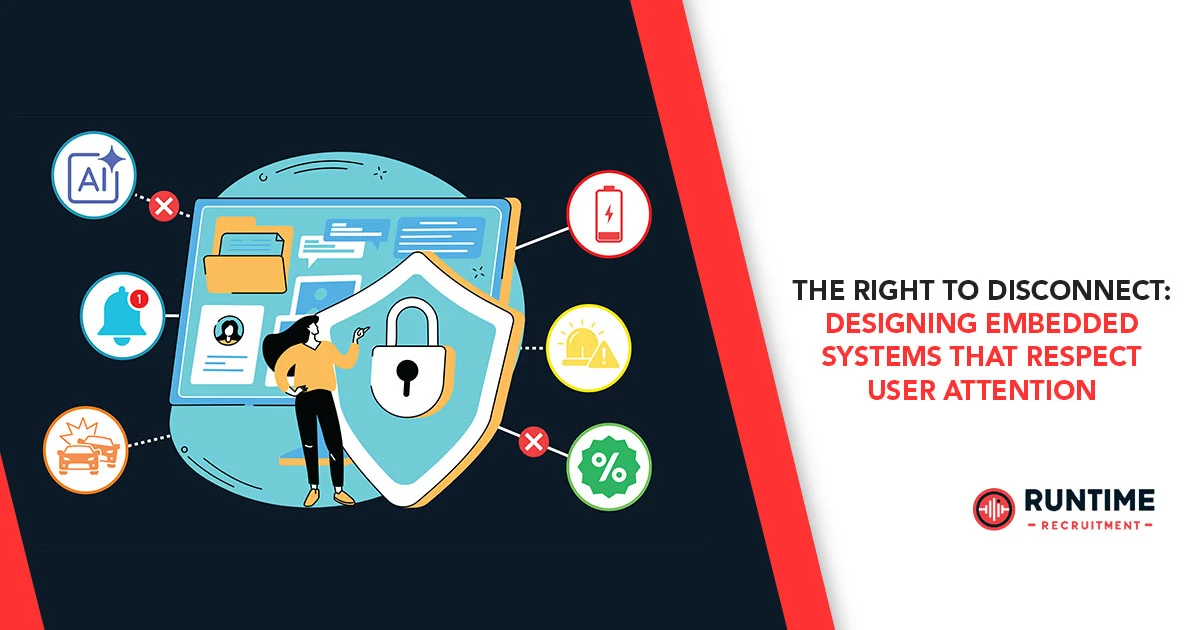
In the world of connected devices, from industrial controllers to consumer wearables, the fundamental responsibility of an embedded engineer is to ensure reliability and functionality. However, a new ethical imperative is emerging: respecting the user’s right to disconnect. This isn’t just about turning off a device; it’s about designing systems that are not manipulative, that defer to the user’s focus, and that recognize the psychological cost of constant, low-latency interruptions. For the embedded engineering community—the architects of the physical-digital interface—this represents a critical shift from optimizing for throughput and latency to prioritizing cognitive load and human well-being.
This article will delve into the ethical and technical challenges of building “attentive” embedded systems. We will move beyond the basic concept of interrupt handling to explore advanced techniques for notification throttling, context-aware scheduling, and minimal-latency-maximal-value interface design. The goal is to establish a new paradigm: embedded systems that are not merely fast, but that are also thoughtful.
I. The Ethical Core: Why the “Right to Disconnect” Matters for Embedded Systems
Embedded systems are the invisible infrastructure of the modern world. They are in our cars, our homes, our factories, and on our bodies. Unlike traditional desktop applications, which require a user to actively launch them, embedded systems are always on and often always demanding. This omnipresence is the root of the “attention crisis” for which embedded engineers must now assume a significant portion of the responsibility.
The “Right to Disconnect,” a concept enshrined in labor laws across several countries, is typically framed as a boundary between an employee and their work communications. However, for a user interacting with technology, the principle is broader: the right to control one’s own attention. When a device interrupts a user—with a flashing LED, a screen alert, or a haptic buzz—it imposes a non-trivial cognitive cost.
The Psychological Cost of Interruptions: Attention Residue
The science of attention identifies a phenomenon known as attention residue. When a task is interrupted, a portion of the user’s cognitive resources remains focused on the original task, even as they transition to the new one. This residue significantly lowers performance on the interruption task and makes returning to the original task difficult and error-prone. In the context of an embedded system, this can be disastrous:
- In Automotive HMI: An unnecessary “low washer fluid” warning that appears with the same visual urgency as a critical “imminent collision” alert forces the driver to divide focus, potentially degrading reaction time. The time lost due to attention residue can be measured in critical milliseconds.
- In Medical Devices: Alert fatigue is a well-documented crisis. Overly sensitive patient monitors that generate frequent, non-critical alarms cause nurses to desensitize, leading to missed life-threatening events. One study cited in the Journal of Clinical Monitoring and Computing found that up to 99% of alarms in an ICU setting were non-actionable, yet each one required a fraction of a second of human attention and verification. The SNR (Signal-to-Noise Ratio) of the alerts is too low.
- In Industrial Control: A deluge of status logs and system check notifications can bury the one critical message—a bearing approaching thermal failure, for example—making the system actively less safe.
As embedded engineers, our primary design metrics have historically revolved around real-time constraints: meeting deadlines, minimizing jitter, and achieving ultra-low power consumption. Now, we must add a new, human-centric metric: minimizing unnecessary cognitive load (CCL). The CCL introduced by an event is often inversely proportional to the information’s criticality, leading to systems that are constantly “crying wolf.”
The Business Case for Calm Technology
Designing for attention is not merely an ethical exercise; it is a competitive advantage. When a system is noisy, demanding, and overwhelming, it increases user frustration, which leads to two major problems:
- System Abandonment (“Shelfware”): Consumers quickly stop using smart home devices, wearables, or even non-essential industrial tools that are overly demanding. The system may be technically perfect (zero CPU exceptions, sub-millisecond response), but its usability lifetime is cut short.
- Decreased Trust and Reliance: In mission-critical environments, a system that “cries wolf” forfeits the trust of its operators. When the real crisis arrives, the operator’s first reaction will be skepticism or delay, costing valuable time. Trust is a function of the reliability and relevance of the system’s output.
A thoughtful embedded system, one that respects the user’s time and attention, fosters trust, retention, and a superior user experience. It’s the difference between a high-tech tool that feels like a demanding toddler and one that feels like a quiet, reliable partner. Our engineering must move from a simple measure of efficiency (how fast can I process this interrupt?) to a measure of efficacy (does this interruption make the user’s task better or worse?).
II. The Core Technical Challenge: From Interrupt Handling to Cognitive Throttling
The bedrock of embedded systems is the interrupt. A hardware event signals the CPU, forcing an immediate context switch to an ISR. This mechanism is a perfect metaphor for the problem we’re discussing: a non-negotiable demand for attention. Our firmware is explicitly designed to maximize the responsiveness of the machine, often at the expense of the user’s own focus.
The challenge is to evolve our thinking from machine urgency to human criticality.
The Traditional View vs. The Attentional Scheduler Paradigm
| Metric | Traditional Embedded Design | Attentive Embedded Design (New Paradigm) |
| Primary Goal | Low Latency (Minimize time from event to processing) | Low Cognitive Load (CCL) (Minimize user mental effort) |
| Interrupt Model | Hard Real-Time Priority (Higher IRQ always preempts) | Context-Aware Priority (System state and user activity modify IRQ presentation) |
| HMI Default State | Active/Ready (Screens on, pulsing LEDs, constant feedback) | Silent/Ambient (Information is deferred, state is conveyed subtly) |
| Design Metric | CPU Utilization, ISR Jitter | User Task Completion Rate, Attention Residue Index |
Export to Sheets
In a traditional Real-Time Operating System (RTOS), a high-priority task preempts a low-priority task because the scheduler is only concerned with its own internal deadlines. For an attentive system, we need an attentional scheduler that is concerned with the user’s deadlines.
The Attentional Scheduler is not a new kernel; it is a design philosophy implemented in the application layer that sits on top of the RTOS. Its core principle is deference: the system should assume the user is busy and only interrupt if the value of the information outweighs the cost of the interruption.
This requires the embedded system to possess and process three crucial streams of context data before triggering a user alert:
- System State (Machine Context): Is the device in a stable operating mode, in a diagnostic self-test, or in an error state? A sensor reporting A/D saturation during a power-on POST is expected and should not trigger a user alert; the same saturation event during active operation is critical.
- User State (Human Context): This is the most challenging metric to capture. Is the user currently interacting with the device (high attention), or is the device in standby mode next to the user (low attention)?
- Proximal Sensors: Using ToF (Time-of-Flight) or capacitive sensing to detect user proximity.
- Input State: Is the touch screen active? Are buttons being pressed? An alert during active input is highly disruptive, while an alert during idle time is merely annoying.
- Environmental State (Ambient Context): What is the environment telling us? Is it noisy (suggesting visual alerts are better)? Is it dark (suggesting low-brightness, non-flashing indicators)? Is the device moving (suggesting high vibration alerts are useless)?
Interrupt Coalescing for Human Interfaces
In networking, interrupt coalescing is a standard technique where multiple low-priority network events are batched together and processed with a single ISR to reduce CPU overhead. We must apply this principle to human interfaces.
Instead of:
Event1→Alert1
Event2→Alert2
Event3→Alert3
We must implement a Time-Criticality Window (TCW):
Event1,Event2,Event3 (if non-critical)→Wait for TCW timeout→Single Consolidated Alert
The TCW is a dynamically sized buffer that accumulates non-critical status changes (e.g., “Sensor A value low,” “Wi-Fi signal dropped by 10%”). Only when the buffer overflows due to a hard-fault event, or when the user initiates interaction with the device (indicating available attention), should the consolidated alert be presented. This shifts the HMI from reactive, high-frequency pulsing to proactive, scheduled summaries.
III. Design Principles for Attentive Embedded Systems
Building on the foundation of the Attentional Scheduler, we can formalize a set of design principles that guide firmware and hardware choices.
1. Context-Aware Notification Scheduling
The goal is to move from state-based alerting (alert when X=5) to context-based advising (advise the user about X=5 when they are ready).
- Priority Matrix: Notifications must be classified not just by technical severity (e.g., Level 1 error) but by Actionability (does the user need to intervene right now?) and Irreversibility (will the system suffer permanent harm if the user waits 5 minutes?). Only high-actionability, high-irreversibility events justify an immediate interruption.
- The Opportunistic Moment: For non-critical updates (e.g., “Firmware Update Available”), the system should wait for an “opportunistic moment.” This could be:
- Device Interaction: The user lifts the device or wakes the screen.
- Scheduled Downtime: A predefined maintenance window (e.g., 3 AM).
- Ambient Change: The device detects it has been placed on a charging dock.
2. The “Minimal Latency, Maximal Value” Rule
Every interaction must be highly information-dense. If a system must interrupt, the interruption should deliver the complete context required for a decision, not just a cryptic code.
- Avoid Abstraction Layers: On a simple embedded display, avoid the common anti-pattern of displaying “Error Code 401 – See Manual.” The firmware should be smart enough to display: “Pressure Transducer P3 Reading Out of Range. Automatic Recalibration Attempt Failed. Action: Check P3 Cable.”
- Haptic Signature Coding: Instead of a generic buzz, use haptic patterns that are linked to criticality. A single, sharp haptic pulse for a critical alarm; a slow, repeating “heartbeat” pattern for a low-priority notification. This allows the user to classify the interruption without visual attention. This requires fine-grained control over the LRA (Linear Resonant Actuator) or ERM (Eccentric Rotating Mass) motor, driven directly from the firmware with minimal OS latency.
3. Asymmetric Interface Design
The user interface should be designed to convey information without requiring an interaction, but to request interaction only when truly necessary.
- Ambient Display: Use low-power, ambient visual cues (e.g., e-Ink displays, dim LEDs) to show the system’s “OK” state or a non-critical status (e.g., battery life). The absence of a visual cue (black screen, LED off) can signify “status normal and sleeping.”
- The Feedback Loop: Ensure that once a user does interact (e.g., silencing an alarm), the system immediately confirms that the attention has been registered and the interruption is terminated. A silent ACK is critical for relieving cognitive load.
IV. Implementation in Firmware and Hardware
The principles above must translate directly into code and hardware selection.
RTOS and Scheduler Optimization
The application layer must abstract the notion of a ‘User Interrupt’ from a ‘System Interrupt’.
- Message Queues for HMI: All HMI update events (e.g., screen refresh, LED blink, haptic buzz) should be placed into a low-priority message queue rather than directly triggering a high-priority task. A single, dedicated HMI task consumes this queue.
- Non-Preemptive HMI Task: The HMI task should be scheduled as non-preemptive where possible. This ensures that a critical sensor reading loop or control PID loop is never interrupted simply to flash an LED.
- Dynamic Priority Promotion/Demotion: Implement an RTOS hook that can dynamically promote the priority of an HMI message from “Log” to “Alert” only if the TCW timeout is exceeded and the system context is critical. For instance, a temperature warning is promoted from low to high priority only if the temperature rate-of-change (dtdT) exceeds a hard-coded danger threshold.
PriorityHMI=BasePriority×f(Actionability,Irreversibility,User_Context)
Hardware and Low-Power Modes
The hardware should facilitate the right to disconnect, not resist it.
- Dedicated Low-Power HMI: Implement a small, ultra-low power microcontroller (MCU) dedicated solely to handling ambient feedback (e.g., monitoring a single LED and the power button) while the main, powerful MCU is in deep sleep. The main MCU should only be woken for high-priority, irreversible events.
- Tactile and Non-Visual Input: Prioritize input methods that don’t require visual attention. Large, easy-to-find physical buttons for silencing alarms are essential. For wearables, relying on gyroscope and accelerometer data (e.g., a twist gesture to dismiss a non-critical alert) is less disruptive than requiring a screen tap.
V. Case Studies in Thoughtful Design (Industrial, Medical, Consumer)
Industrial IoT: The Self-Healing Edge Node
In a factory setting, a vibration sensor on a motor bearing might report an anomalous reading every 10 seconds. A non-attentive system would generate 6 notifications per minute, leading to alert fatigue for the maintenance team.
An attentive industrial IoT node is designed with a localized, multi-stage TCW:
- Stage 1: Local Logging and Self-Correction (10 minutes): The node detects the anomaly but only logs it locally. It initiates a low-power control sequence (e.g., slightly reducing motor speed) to see if the issue self-corrects. No user alert.
- Stage 2: Remote Advisory (30 minutes): If the anomaly persists but is within safe limits, the node sends a scheduled advisory to the remote server, marked as low priority. The maintenance manager sees this in a daily digest. No immediate interruption.
- Stage 3: Critical Alert (Hard Threshold): If the bearing temperature or vibration exceeds a RED line, or if the dT/dt accelerates rapidly, the system bypasses the TCW and issues an immediate, high-priority, multi-modal alert (loud audible alarm, flashing LED, immediate SMS to the on-call engineer).
This system reduces user interruptions by over 95% while increasing the relevance of the remaining 5%.
Medical Devices: Distinguishing Alarms from Status
For infusion pumps or vital sign monitors, the ethical mandate is to save lives, but the engineering challenge is to do so without generating paralyzing alert fatigue.
- The Four-Tier Alarming Structure: Modern attentive medical devices use a tiered system that maps to human action:
- CRITICAL (Immediate Action): Life-threatening. Requires loud, continuous, unique sound profile. Cannot be easily silenced.
- WARNING (Prompt Action): Potentially worsening condition. Requires distinct, less abrasive sound. Silenceable, but re-alerts after a short period.
- CAUTION (Scheduled Attention): Status change, but not immediately threatening. Visual LED change only, non-audio, deferred to the nurse’s next scheduled check-in.
- STATUS (Information Only): Battery charging, connection stable. No visual or audio change, only logged.
- Smart Snooze: The system only allows “snoozing” an alarm based on a pre-defined maximum safe time (Tmax_safe). If a condition is worsening (e.g., patient SpO2 continues to fall), the snooze function is dynamically disabled, and the alarm escalates to the next tier, ensuring the system respects attention only when it is safe to do so.
VI. Conclusion: The Future is Thoughtful
The embedded world is moving into an era of ubiquitous computing, where devices are not just tools, but persistent agents in our lives. Our technical mastery—our ability to minimize latency and maximize throughput—must now be tempered by an ethical responsibility to protect the user’s finite resource: their attention.
Designing for the Right to Disconnect is not about adding a new feature; it is about fundamentally rethinking system architecture. It is about applying the same rigorous RTOS and low-power principles we use for silicon to the human mind. The most elegant embedded solution of the future will not be the one that is the fastest, but the one that is the quietest and the most judicious with its demands.
This paradigm shift demands engineers who are technically brilliant but also contextually aware—engineers who understand that a few lines of code in an ISR can drastically impact human well-being.
Connect with RunTime Recruitment
Are you an embedded engineer ready to build the next generation of thoughtful, human-centric systems? Do you specialize in RTOS optimization, context-aware sensor fusion, or low-power HMI design?
RunTime Recruitment connects visionary engineers with companies pioneering the next wave of ethical, attentive embedded technology. If your expertise lies in designing systems that respect the right to disconnect, we want to hear from you.
Connect with RunTime Recruitment today to explore opportunities where your technical skills can shape a better, less interrupted world.