For decades, the standard architectural approach in embedded systems engineering has mirrored traditional corporate hierarchies: a powerful, centralized processing unit dictates the actions of numerous “dumb” peripherals. In this model, a central Microcontroller Unit (MCU) or Microprocessor Unit (MPU) constantly polls sensors, ingests raw data, runs the core algorithms, and explicitly commands actuators.
While this centralized approach is straightforward to conceptualize and debug, it is rapidly hitting its physical and theoretical limits. As modern engineering demands increasingly complex robotic systems, autonomous vehicles, and expansive Industrial Internet of Things (IIoT) networks, the traditional centralized architecture creates severe data bottlenecks, unmanageable latency spikes, and inefficient power profiles.
To solve this, modern embedded engineers are looking toward evolutionary biology—specifically, the cephalopod. The octopus possesses a highly advanced nervous system, but unlike humans, its intelligence is not strictly confined to its central brain. An estimated two-thirds of an octopus’s 500 million neurons are distributed throughout its arms. These arms can independently taste, touch, and execute complex motor functions—like opening a jar or evading a predator—without requiring direct, step-by-step instructions from the central brain.
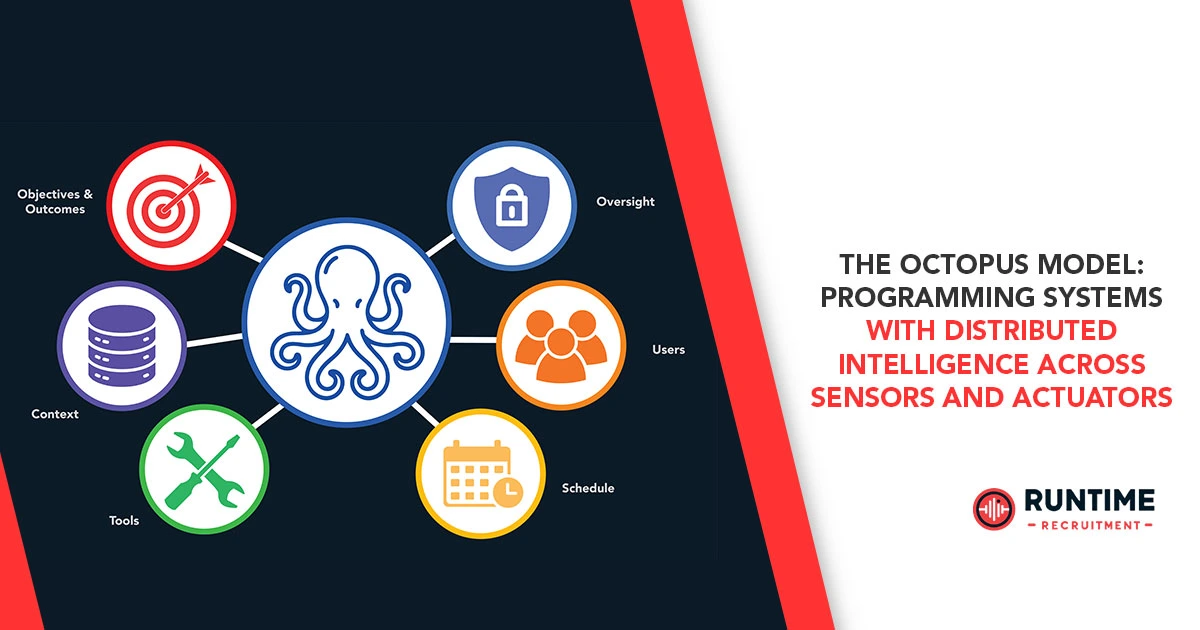
In embedded systems, we call this paradigm the Octopus Model: an architecture defined by distributed intelligence, where sensors and actuators possess localized processing power to execute autonomous edge-level decisions, relying on the central processor only for high-level strategic coordination.
This article explores the technical mechanics, hardware requirements, and communication protocols necessary to implement the Octopus Model, while analyzing how this shift impacts modern engineering teams, RTOS development, and sustainable hardware design.
The Bottleneck of Centralized Compute
To understand the necessity of distributed intelligence, we must first analyze the failure points of the traditional centralized architecture when scaled.
Consider a modern six-axis industrial robotic arm equipped with high-resolution encoders, load cells, thermal sensors, and vision systems. If every piece of raw data must be routed back to a single central processor via an I2C or SPI bus, the system immediately encounters the Von Neumann bottleneck. The central processing unit spends a disproportionate amount of its clock cycles simply moving data in and out of memory, managing Direct Memory Access (DMA) controllers, and servicing an overwhelming barrage of hardware interrupts.
This results in three critical failure points:
- Latency Instability: In hard real-time systems, predictability is more important than raw speed. When a central RTOS has to context-switch between hundreds of sensor interrupts, deterministic execution degrades. A motor control loop that requires a strict 100-microsecond update rate will fail if the CPU is momentarily locked up processing a burst of data from a LIDAR sensor.
- Bandwidth Saturation: Moving massive amounts of raw data (e.g., high-speed ADC sampling for vibration analysis) across system buses saturates bandwidth. This leaves little room for the actual transmission of actionable control commands.
- Power Inefficiency: Transmitting raw, unfiltered data across a physical medium or RF interface is highly energy-intensive. For battery-powered IoT devices, continuous data transmission drastically reduces operational lifespans.
Deconstructing the Octopus Architecture
The Octopus Model solves these bottlenecks by physically migrating the processing power to the extreme edge of the network—right at the point of data acquisition (the sensor) and physical interaction (the actuator).
The Central Brain: Strategic Oversight
In a distributed model, the central processor (often a high-performance MPU running an RTOS or embedded Linux) is stripped of low-level micromanagement duties. It no longer calculates PID control loops or runs Fast Fourier Transforms (FFTs) on raw vibration data.
Instead, the central node acts as the strategic commander. It handles complex sensor fusion, global state machines, high-level AI inference, user interfaces, and external network communications. It sends broad directives rather than granular commands. For example, instead of telling a motor driver exactly how much current to apply every millisecond, the central node simply sends the command: “Accelerate to 3000 RPM over 2 seconds, maintaining a maximum torque of 5 Nm.”
The Neural Arms: Autonomous Edge Nodes
The “arms” of the system are smart sensors and smart actuators. These nodes are equipped with their own localized processing capabilities—ranging from ultra-low-power Cortex-M0+ microcontrollers to localized Field Programmable Gate Arrays (FPGAs) or specialized Edge AI accelerators.
- Smart Sensors: Instead of sending continuous analog voltages or raw digital streams, a smart sensor processes data locally. A smart vibration sensor on an industrial motor might sample data at 20 kHz, perform a local FFT, and apply an embedded machine learning model (TinyML) to detect anomalous bearing wear. It only wakes the central brain to send an asynchronous message: “Bearing fault detected; confidence 92%.”
- Smart Actuators: A smart motor controller receives the high-level “Accelerate to 3000 RPM” command and takes over the entire execution. It handles the localized closed-loop control, monitoring its own current draw, thermal limits, and encoder feedback autonomously, adjusting the Pulse Width Modulation (PWM) dynamically without bothering the central processor.
Engineering the Distributed Network: Protocols and Synchronization
Replacing a centralized system with a decentralized web of intelligent nodes introduces a new engineering challenge: communication. The Octopus Model relies heavily on robust, deterministic, and fault-tolerant communication protocols. Simple master-slave buses like standard I2C are insufficient for complex distributed intelligence.
Advanced Communication Protocols
To facilitate true distributed control, engineers must utilize protocols designed for asynchronous, multi-master environments:
- CAN FD (Controller Area Network Flexible Data-Rate): An evolution of classical CAN, CAN FD increases the payload size and transmission speed. Its arbitration mechanism makes it ideal for distributed systems where different “arms” need to broadcast high-priority messages (e.g., an emergency stop signal from a smart proximity sensor) without waiting to be polled by the master.
- EtherCAT and Time-Sensitive Networking (TSN): For systems requiring extreme precision, industrial Ethernet protocols provide deterministic communication. Ethernet TSN allows different types of data (critical real-time control traffic vs. bulk diagnostic data) to share the same physical network without interfering with each other.
- DDS (Data Distribution Service): At the software layer, DDS provides a decentralized, publish-subscribe architecture. Smart sensors “publish” their processed insights to a topic, and any node that needs that data (including the central brain or other smart actuators) can “subscribe” to it. This decouples the network and eliminates single points of failure.
The Challenge of Distributed Time
If the “arms” are acting independently, how do we ensure they act in unison when required? In a centralized system, there is one master clock. In a distributed system, clock synchronization is paramount. Protocols like the Precision Time Protocol (PTP – IEEE 1588) are essential. PTP allows distributed edge nodes to synchronize their internal clocks to within sub-microsecond accuracy, ensuring that a coordinated movement involving multiple autonomous smart actuators happens in perfect harmony.
Sustainable Hardware and the Carbon Cost of Code
For modern engineering teams—particularly Gen Z and Millennial leaders who heavily prioritize sustainability and corporate responsibility—the Octopus Model offers distinct advantages in the realm of environmental impact. The intersection of embedded engineering and sustainability is no longer a fringe topic; it is a core design requirement.
Centralized systems are inherently inefficient from an energy perspective. Continuously streaming raw data requires significant power, and maintaining a high-frequency, high-performance central processor to handle every minor interrupt leads to wasted energy.
By pushing processing to the edge, engineers can engage in carbon-conscious coding. We can express the dynamic power consumption of a CMOS circuit using the formula:
P=αCV2f
Where P is power, α is the activity factor, C is capacitance, V is voltage, and f is the switching frequency.
In a distributed model, a massive, power-hungry central MPU (high V, high f) can be put into a deep sleep state for extended periods, reducing the activity factor (α) drastically. Meanwhile, localized, application-specific integrated circuits (ASICs) or ultra-low-power microcontrollers at the sensor level operate at significantly lower voltages and frequencies.
Furthermore, this modularity deeply impacts the lifecycle of embedded hardware, directly addressing the growing crisis of e-waste. In a monolithic centralized system, if the processing requirements increase, the entire mainboard often needs to be scrapped and replaced. In an Octopus architecture, hardware is modular by design. If a system requires a more advanced vision processing capability, only the specific smart camera node needs to be upgraded, drastically reducing the volume of discarded silicon and rare earth metals.
Implementation Challenges for Modern Teams
While the benefits are profound, transitioning to distributed intelligence requires a paradigm shift in how engineering teams structure their development lifecycles. Engineering managers must prepare for several distinct hurdles:
1. Distributed State Machines and Debugging
Debugging a central monolithic RTOS is relatively straightforward; you halt the processor and inspect the memory. Debugging a system with five different microcontrollers executing simultaneous, autonomous state machines is incredibly complex. Engineers must implement comprehensive distributed tracing protocols. Every edge node must log timestamped events that can be reconstructed later to understand the precise sequence of failures.
2. Over-The-Air (OTA) Updates across Heterogeneous Nodes
Managing firmware updates becomes exponentially more difficult. A system might contain a central Linux processor, multiple ARM Cortex-M4 motor controllers, and FPGA-based smart sensors. An OTA update system must be capable of securely delivering, verifying, and flashing different compiled binaries to diverse hardware architectures simultaneously, with mechanisms to roll back the entire distributed system if a single node fails its update.
3. Increased Security Attack Vectors
A centralized system has a relatively small surface area for cyberattacks. The Octopus Model, by nature, creates multiple intelligent endpoints, each representing a potential point of entry. As regulatory frameworks like the European Union’s Cyber Resilience Act (CRA) mandate stricter security standards, engineers must implement localized hardware security modules (HSMs), secure boot processes, and encrypted communication on every smart node, not just the central gateway.
The Future is Distributed
The transition toward the Octopus Model represents a fundamental maturation of embedded engineering. Just as the software industry moved from monolithic applications to microservices, hardware architecture is shifting from centralized bottlenecks to decentralized, autonomous intelligence.
By embracing FPGAs, intelligent RTOS scheduling at the edge, and robust asynchronous protocols, engineers can build systems that are infinitely more scalable, responsive, and power-efficient. For engineering teams looking to build the next generation of robotics, edge AI devices, and sustainable industrial infrastructure, the path forward is clear: let the brain strategize, and let the arms do the work.
Ready to build the next generation of embedded systems?
Connect with RunTime Recruitment to find the top-tier engineering talent you need to bring your distributed architectures to life.