
The paradigm of industrial and consumer product maintenance is undergoing a profound shift, driven by a convergence of capabilities that places sophisticated intelligence directly at the point of action. For decades, the standard operating procedure has oscillated between reactive “run-to-failure”, a costly strategy guaranteeing unscheduled downtime, and preventive maintenance, a time-based approach that frequently results in replacing perfectly functional components unnecessarily. Neither approach is sustainable in an era defined by supply chain volatility, intense cost pressures, and an urgent need to reduce electronic waste.
For the embedded engineer, the solution lies in a radical architectural evolution: moving away from centralized, cloud-dependent data crunching and toward autonomous, edge-based intelligence. This is the domain of predictive maintenance (PdM) powered by embedded analytics. It is the transition from devices that merely sense their environment to devices that understand their own state of health. By integrating inferencing capabilities directly onto microcontrollers (MCUs) and applications processors, we are not just building smarter products; we are engineering more resilient systems, extending product lifespans, and fundamentally altering the lifecycle economy of electronics.
The Imperative for Local Intelligence
Traditionally, implementing predictive maintenance meant streaming vast quantities of raw sensor telemetry to a cloud server for analysis. While effective for high-value, stationary assets with reliable backhaul connectivity, this model fractures under the constraints of modern embedded applications.
Bandwidth costs become prohibitive when scaling to thousands of endpoints. Latency makes real-time intervention impossible in safety-critical scenarios. Perhaps most importantly, the sheer volume of data generated by high-frequency sensors—such as multi-axis accelerometers sampling at tens of kilohertz for vibration analysis—overwhelms standard IoT protocols. Furthermore, relying on continuous cloud connectivity introduces an unacceptable single point of failure for autonomous systems operating in remote or RF-denied environments.
Embedded analytics inverts this model. Instead of asking, “How do we get all this data to the cloud?” the embedded engineer asks, “How much intelligence can we pack onto this Cortex-M7?” By processing data locally and transmitting only high-value insights (e.g., “Bearing Stage 2 fault detected, 85% confidence” rather than gigabytes of raw vibration logs), we reduce bandwidth usage by orders of magnitude, lower power consumption associated with radio transmission, and ensure deterministic, real-time responses to emerging faults.
The Technical Stack: From Sensor to Insight
Implementing effective PdM via embedded analytics requires a holistic re-evaluation of the embedded stack, from the physical layer up to the application logic. It is a multidisciplinary challenge blending signal processing, data science, and firmware engineering.
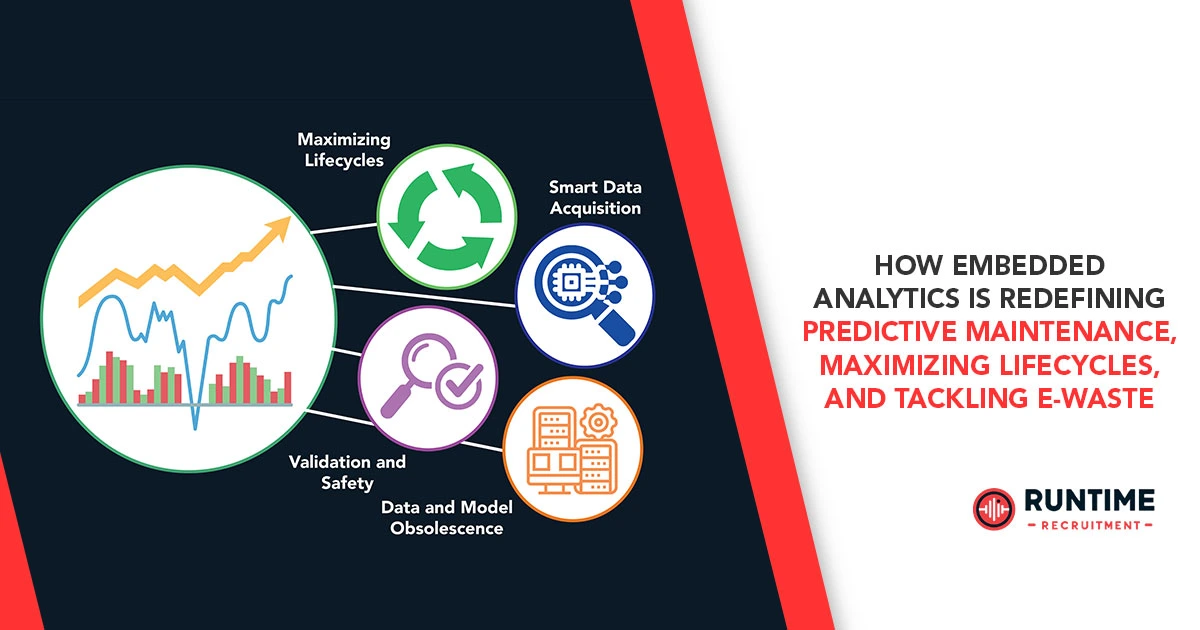
1. Smart Data Acquisition and Signal Conditioning
The quality of the prediction is irrevocably tied to the quality of the input data. In embedded PdM, this often involves monitoring subtle changes in physical parameters: vibration, acoustics, temperature, current consumption, and magnetic fields.
The challenge here is rarely just reading an ADC. It involves understanding the physics of failure. For example, detecting early-stage pitting in a ball bearing requires analyzing high-frequency vibration signatures that are easily masked by noise. The embedded engineer must design robust analog front-ends (AFEs) with appropriate anti-aliasing filters before the signal even reaches the microcontroller.
Furthermore, smart sensors with integrated MEMS processing cores are increasingly offloading the initial burden. An accelerometer that can autonomously calculate RMS velocity or kurtosis and only wake the main MCU when a threshold is breached is a critical power-saving architecture for battery-operated PdM nodes.
2. The Rise of TinyML and Edge AI
The engine of embedded analytics is TinyML—the field dedicated to running machine learning workloads on highly constrained hardware, often with under a megabyte of SRAM and flash. This is where the embedded engineer’s constraint-optimization skillset shines.
We are moving beyond simple algorithmic thresholding (e.g., “if temperature > 70°C, sound alarm”). While necessary for safety guardrails, simple thresholds are poor predictors of complex failure modes. Embedded analytics utilizes two primary classes of models:
- Anomaly Detection (Unsupervised Learning): This is often the starting point because healthy data is abundant, but failure data is scarce and expensive to generate. By training a model (such as an autoencoder or a One-Class Support Vector Machine) on “normal” operating parameters, the device establishes a baseline. During operation, incoming sensor data that deviates statistically from this baseline is flagged as an anomaly. The output is an “anomaly score,” indicating how far the current state is from known healthy behavior.
- Remaining Useful Life (RUL) Estimation (Supervised Learning): If historical failure data exists, regression models can be trained to predict the time until functional failure. While complex deep learning models like LSTMs (Long Short-Term Memory networks) are often too heavy for standard MCUs, simpler structures like optimized random forests or shallow neural networks, when combined with strong feature engineering, can provide surprisingly accurate RUL estimates on the edge.
3. Feature Engineering at the Edge
A raw time-series vibration signal is often useless to a tiny neural network. The critical intermediate step is feature engineering—transforming raw data into meaningful descriptors.
On an MCU, this is a computational bottleneck. The embedded firmware must efficiently perform operations like Fast Fourier Transforms (FFTs) to convert time-domain vibration data into the frequency domain, revealing spectral peaks corresponding to specific mechanical faults (e.g., inner race vs. outer race defects). Other features might include crest factor, skewness, or spectral entropy. The efficient implementation of these DSP functions using hardware accelerators (like the SIMD instructions on ARM Cortex-M processers) is vital to keep CPU utilization and power consumption in check.
4. The Silicon Enablers: Hardware Convergence
The feasibility of this entire approach rests on recent advancements in microcontroller architecture. We are seeing a rapid convergence of traditional MCU control capabilities with DSP and entry-level AI acceleration.
Modern MCUs aimed at industrial IoT now routinely feature high clock speeds (upwards of 400MHz-1GHz), larger on-chip SRAM capabilities (crucial for storing model weights and activation buffers during inference), and double-precision floating-point units. Even more significant is the integration of dedicated Neural Processing Units (NPUs) or AI-accelerator blocks directly alongside the CPU core. These specialized hardware blocks can execute matrix multiplications—the fundamental operation of neural networks—dozens of times faster and more energy-efficiently than a general-purpose CPU. This silicon evolution allows engineers to run increasingly complex models without blowing the power budget or requiring an external applications processor.
The Engineering Challenges: Reality Check
While the promise of embedded PdM is immense, the implementation path is fraught with challenges unique to the embedded domain.
The Power vs. Performance Trade-off: In battery-powered applications, running an inference engine is expensive. The system cannot infer continuously. The engineer must design sophisticated duty-cycling regimes: sleep deep, wake up periodically, acquire data rapidly, perform a quick, optimized inference, transmit a tiny status packet, and return to sleep. Every clock cycle spent calculating a neuron activation must be justified against battery life. Model quantization—converting 32-bit floating-point weights to 8-bit integers—is almost always necessary, trading a fractional amount of accuracy for massive gains in execution speed and memory footprint.
Data Drift and Model Obsolescence: A model trained in a climate-controlled lab may fail miserably on a humid factory floor. Furthermore, as mechanical machinery ages, its “normal” baseline vibration signature naturally changes. A static model burned into ROM will eventually start throwing false positives. Embedded PdM systems need robust mechanisms for lifecycle management. This includes detecting model drift and, ideally, supporting Over-the-Air (OTA) updates to deploy retrained model weights without requiring physical access to the device.
Validation and Safety: How do you validate a probabilistic system in a deterministic environment? If a safety-critical embedded system relies on an ML output to make a decision, how do we guarantee worst-case execution times or prove that the model won’t hallucinate under edge-case conditions? Integrating stochastic ML components into traditional V-model engineering workflows and safety standards (like IEC 61508) remains an area of intense research and developing best practices.
Beyond ROI: The Sustainability and E-Waste Impact
The conversation around predictive maintenance is often dominated by Return on Investment (ROI) measured in reduced downtime and optimized spare parts inventory. While these are critical drivers, they obscure a more profound impact of embedded analytics: sustainability.
We are facing a global e-waste crisis, generating over 50 million metric tonnes of electronic waste annually. A significant portion of this waste comes from premature disposal of electronics or the industrial machinery they control. When a complex system fails unexpectedly, the default response is often to replace entire subsystems or the whole unit because diagnosing the specific component failure is too difficult or time-consuming.
Embedded analytics changes this dynamic by providing granular, component-level visibility into health.
- Life Extension: By identifying issues like bearing wear, lubrication breakdown, or thermal stress early, minor interventions can prevent catastrophic failures, significantly extending the usable life of the capital equipment.
- Circular Economy Enablement: When a product does reach the end of its first life, embedded analytics data provides a “digital passport” of its usage history and stress accumulation. This allows refurbishers to accurately assess whether components can be harvested for reuse, remanufactured, or must be recycled, moving us away from a linear “take-make-dispose” economy.
- Optimized Design Loops: The insights gathered from edge devices returning real-world wear data can be fed back to design engineering teams. If a specific capacitor in a power supply is consistently showing premature signs of aging across a fleet of devices, future iterations can be engineered with better thermal management or higher-spec components, reducing future waste at the source.
Conclusion: The Engineer’s New Role
The adoption of predictive maintenance via embedded analytics is more than just a new feature set; it is a fundamental re-imagining of the relationship between physical hardware and digital intelligence. It requires embedded engineers to broaden their horizons, stepping outside the comfort zone of deterministic C code and ISRs to embrace the probabilistic world of data science and machine learning.
The engineers who master this convergence—who can figure out how to squeeze a vibration analysis neural network onto a Cortex-M4 while sipping microamps of current—are not just optimizing maintenance schedules. They are building the nervous systems of the future infrastructure, creating products that are more reliable, longer-lasting, and deeply aligned with the urgent necessity of a sustainable industrial future. The tools, silicon, and software are finally mature enough to make this reality. The challenge now rests in the implementation.
Is your engineering team ready to lead the charge in embedded intelligence and predictive maintenance?
The demand for engineers skilled in the convergence of embedded systems, TinyML, and edge analytics is exploding. Finding the right talent—or finding the right role that utilizes your specialized skills—can be the biggest bottleneck in realizing these innovations.
RunTime Recruitment specializes exclusively in connecting premier embedded engineering talent with the innovative companies that are defining the future of the industry. Whether you are an engineer looking for your next challenge in edge AI, or a hiring manager desperate for expertise in signal processing and low-power design, we speak your language. Don’t let your ambitions stall due to the talent gap. Contact RunTime Recruitment today and let’s build the future of reliable embedded systems together.