
In the world of embedded systems, the microcontroller (MCU) has become the ubiquitous answer, the default solution to nearly every design problem. Need to blink an LED? MCU. Monitor a sensor? MCU. Implement complex motor control? Definitely an MCU. Their power, flexibility, and ever-decreasing cost have turned them into the Swiss Army knife of electronics.
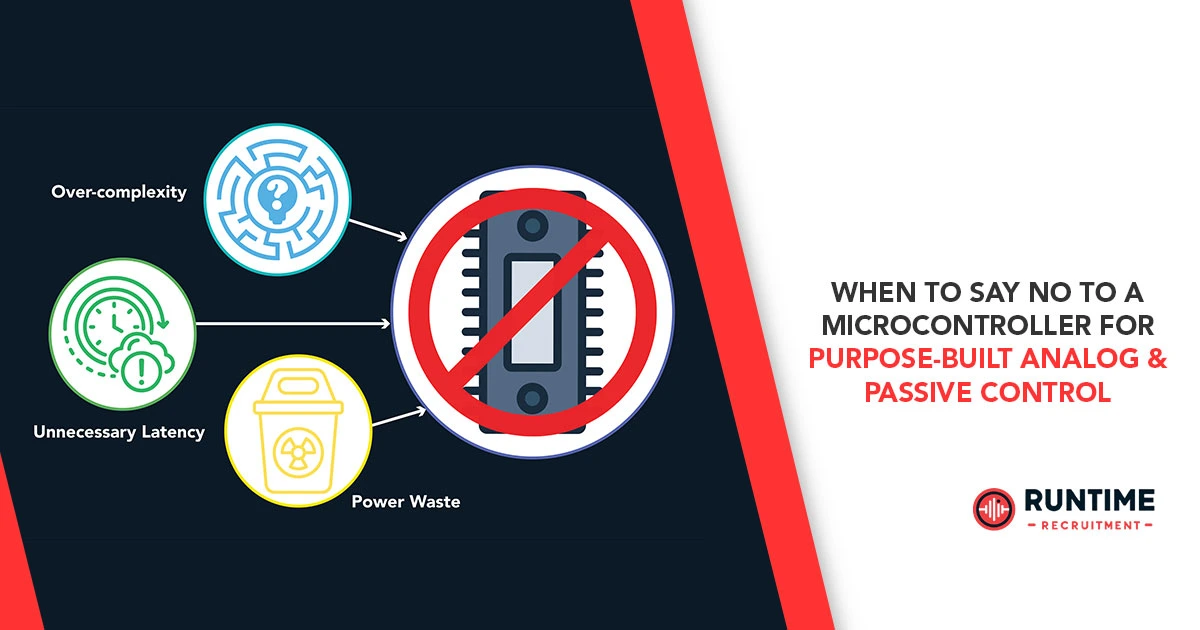
But for the seasoned embedded engineer, this “MCU-first” mentality often leads to over-engineering, power waste, increased complexity, and unnecessary latency in the most critical of applications. This article is not a dismissal of the MCU, it is a necessary intervention. It’s an in-depth exploration into the compelling, often superior, and always more elegant alternative: purpose-built analog and passive control circuits.
We’re making the case for a return to fundamental electronics, demonstrating when the most sophisticated solution is often the one that involves no code at all.
The Siren Song of the MCU: Why We Over-rely
Before we dismantle the MCU’s dominance, let’s acknowledge why it’s so appealing.
- Software Flexibility: The primary draw. Any function can be changed, debugged, or updated simply by flashing new firmware. This seems to eliminate hardware risks.
- Integration: Modern MCUs pack ADCs, DACs, PWM generators, timers, and communication peripherals (SPI, I2C, CAN, USB) all onto a single chip, consolidating the BOM.
- Development Speed: High-level languages, IDEs, and established libraries drastically speed up initial prototyping.
- The “Digital” Mindset: As firmware engineers, we are trained to think digitally, using states, loops, and conditional logic. The MCU is our native tongue.
This convenience, however, comes at a hidden cost, particularly in systems where response time, power efficiency, noise immunity, and long-term reliability are paramount.
The Critical Comparison: MCU vs. Purpose-Built Analog
The decision to use a purpose-built circuit over an MCU hinges on a few key, non-negotiable design criteria.
1. The Need for Speed: Latency and Determinism
The most critical argument against the MCU in high-speed control is latency and non-determinism.
The MCU’s Bottleneck: The Execution Cycle
An MCU’s response to an event is inherently delayed by several factors:
- Interrupt Latency: The time it takes for a peripheral signal to generate an interrupt, the CPU to halt its current execution, and vector to the Interrupt Service Routine (ISR).
- Instruction Cycle Time: The time required to execute the necessary logic within the ISR (reading registers, performing calculations, writing to an output).
- Context Switching: The overhead of saving and restoring the CPU state.
- Peripheral Configuration: The time to set up and clock the internal peripherals (e.g., ADCs).
Even on a high-speed, dedicated RTOS, this process takes time, often in the order of microseconds (μs), or even tens of microseconds. While this sounds fast, it is insufficient for applications like:
- High-Frequency Power Supply Feedback Loops: Where loop bandwidths can be in the hundreds of kilohertz (kHz). A μs-level delay is a significant phase shift, destabilizing the system.
- Laser Diode Current Control: Where nanosecond-level (ns) transient response is necessary to prevent component damage.
- Pulse-Width-Modulation (PWM) Shutoff: In a motor driver or inverter, a catastrophic overcurrent must be shut down within ns to protect the power stage (MOSFETs or IGBTs).
The Analog Advantage: Near-Zero Latency
Purpose-built analog circuits, built from Op-Amps, Comparators, Passive Components (R, C, L), and Analog Switches, operate based on the physics of current flow and electromagnetic fields, offering a response time limited only by the propagation delay of the active components, often nanoseconds (ns) or picoseconds (ps).
- Feedback Loops: A classical Op-Amp-based Proportional-Integral-Derivative (PID) controller is continuous-time. The feedback correction is instantaneous, limited only by the Op-Amp’s Gain-Bandwidth Product (GBWP).
- Over-Current Protection: A Comparator monitoring a shunt resistor can trip a latching circuit (like an SCR or TVS Diode) to shut down a power stage in a few nanoseconds, orders of magnitude faster than any MCU-based protection. This is often called a hardware fail-safe.
2. The Power Equation: Efficiency at the Edges
In battery-powered and energy-harvesting devices, power consumption is the defining constraint. The MCU, despite modern low-power modes, carries an inherent energy tax.
The MCU’s Power Overhead
- Always-On Peripherals: Even when the core sleeps, the Real-Time Clock (RTC), Brown-Out Detectors (BOD), and a fraction of the flash/RAM must remain powered.
- Wake-Up Energy: Waking an MCU from its deep sleep state consumes a surge of energy, the time to restore its state, clock the PLLs, and execute the startup code. If the system needs to wake and sleep frequently, this overhead dominates the power budget.
- Operating Current: The core and its peripherals (especially ADCs/DACs/Comms) draw significant current when active. A typical low-power MCU might draw ∼20 to 50 mA when fully active.
The Analog Efficiency
Passive and low-power analog circuits offer dramatically lower power consumption for simple, continuous monitoring tasks.
- Passive Detection: Simple passive voltage dividers, or a Zener Diode with a resistor, can create a continuous, extremely low-power voltage reference.
- Nano-Power Comparators: Specialized comparators designed for battery-powered applications can have a quiescent current (Iq) in the range of nano-amperes (nA). A circuit monitoring a battery voltage could run continuously for years on a single coin cell, drawing a total current far below the μA-level leakage of a deeply sleeping MCU.
- Switched/Latched Control: A simple bistable latch (using two discrete transistors or a specialized chip) can maintain a state (e.g., ON or OFF) with virtually zero current draw until an external event forces a change.
If the task is purely to monitor a threshold or maintain a binary state (e.g., “Is the battery dead?” or “Is the fan over-revving?”), the power drawn by the MCU’s necessary infrastructure is disproportionately high compared to an analog solution.
3. Noise Immunity and Reliability: A Matter of Physics
Digital systems are masters of logic, but they are surprisingly fragile when faced with high electromagnetic interference (EMI), ESD events, or temperature extremes.
MCU Vulnerabilities
- Susceptibility to EMI: High-speed digital signals and clocking generate noise and are also susceptible to external noise, leading to Single Event Upsets (SEUs), corrupted memory or state. This requires complex filtering and shielding.
- Watchdog Dependencies: To ensure reliability, all MCUs rely on watchdog timers to recover from software or hardware failures, acknowledging the inherent possibility of a crash.
- Temperature Drift: While MCUs are specified for industrial temps, their timing stability and ADC accuracy can drift, and their high power density can lead to self-heating.
The Analog Robustness
Purpose-built analog circuits, especially those using passive components, are inherently more robust and reliable.
- Natural Filtering: The very nature of RC filters and LC tanks provides passive filtering of noise, operating continuously in the frequency domain.
- Extreme Environments: Passive components like resistors and capacitors, and specialized industrial-grade Op-Amps, can be rated for extreme temperatures (>150∘C) and radiation that would instantly shut down a general-purpose MCU.
- Code-Free Reliability: The circuit’s function is defined by physics, not by code or memory state. If a hardware circuit works once, it will work millions of times under the same conditions without a risk of a firmware bug or memory leak.
🛠️ The Purpose-Built Arsenal: When to Deploy the Analog Giants
Here are three common embedded scenarios where saying ‘No’ to the MCU yields a superior design.
Scenario 1: Reset and Power-Up Sequencing
The simplest, most fundamental task: ensuring components power up in the correct order.
- MCU Solution: An MCU would monitor voltage rails via ADCs and use GPIOs to control power-enabling MOSFETs, requiring a pre-programmed, reliable boot-up sequence.
- Problem: The MCU itself needs a stable power supply and clock before it can execute the code to enable the other supplies. This introduces a dangerous dependency.
- Analog/Passive Solution: A Power-On Reset (POR) supervisor IC combined with a sequencing delay circuit (RC network and comparator).
- Superiority: The POR IC ensures the MCU doesn’t start until the primary voltage is stable. The RC delay circuit generates the necessary hold-off signals entirely in the analog domain, ensuring an unconditional, hardware-guaranteed power-up sequence that is independent of any software state.
Scenario 2: Simple Hysteresis and Threshold Detection
Many embedded tasks boil down to comparing a sensor input to a threshold.
- MCU Solution: An Analog-to-Digital Converter (ADC) reads the sensor, and the firmware executes a simple if (reading > threshold) { action(); } loop.
- Problem: Without software hysteresis, the output will chatter near the threshold, causing unnecessary CPU cycles. Implementing software hysteresis adds code complexity, latency, and power consumption (since the ADC must run continuously).
- Analog Solution: A Schmitt Trigger Comparator Circuit.
- Superiority: This circuit implements hysteresis (a wider ‘ON’ threshold and a narrower ‘OFF’ threshold) in the hardware itself, using positive feedback. The output is a clean digital signal that changes state with zero latency and requires no code, no clock, and draws nA of current. The output can directly drive a downstream circuit (like an optocoupler or power gate).
Scenario 3: Continuous Filtering and Signal Conditioning
Sensors rarely output clean, linear voltages. They require conditioning before a digital system can meaningfully process them.
- MCU Solution: The raw signal is fed directly into the MCU’s ADC. Digital signal processing (DSP) routines (e.g., FIR/IIR filters) are implemented in firmware to clean the signal.
- Problem: DSP consumes significant CPU bandwidth and energy. Aliasing and noise can still corrupt the signal before it’s digitized, necessitating a physical anti-aliasing filter anyway.
- Analog Solution: A dedicated Op-Amp-based active filter (e.g., a Sallen-Key filter or a second-order Butterworth filter).
- Superiority: The analog filter performs the filtering continuously in the time domain, often more cleanly and with less phase distortion than its digital counterpart. By cleaning the signal before the ADC, it allows for a less demanding ADC (fewer bits, lower sample rate) and significantly reduces the processing load on the MCU, or eliminates the need for the MCU entirely if the conditioned signal is simply driving a meter or a warning light. It’s always better to stop noise from entering the digital domain than to try and remove it after the fact.
🧠 The Engineer’s Mindset: Rebalancing the Trade-Off
Choosing an analog solution is a conscious design decision that requires a different approach from the firmware engineer:
| Design Consideration | MCU-Based Approach | Analog/Passive Approach |
| Flexibility | High (firmware update) | Low (BOM change) |
| NRE (Non-Recurring Eng.) | Lower initial dev cost | Higher initial design time, PCB spins |
| Determinism/Latency | Microsecond (μs); non-deterministic | Nanosecond (ns); deterministic |
| Power Efficiency | Poor for simple, continuous tasks | Excellent; nA quiescent current |
| Reliability | Relies on Watchdog Timer, software state | Inherently robust; physics-defined |
| Component Count | Low MCU count, high peripheral complexity | Higher component count (Op-Amps, R, C) |
Export to Sheets
The Analog Imperative: If a function can be cleanly and reliably implemented in analog/passive components, and that function is safety-critical, high-speed, or ultra-low-power, the choice is clear: do it in hardware. Reserve the MCU for the tasks it excels at: complex decision-making, networking, user interface management, data logging, and high-level control that benefits from its inherent flexibility.
For example, use an analog comparator for the hard-limit over-current shutdown (safety-critical, high-speed) and use the MCU’s ADC for soft, data-logging current measurement and predictive power management (complex decision-making, networking). This is the Hybrid Design Strategy, the most modern and robust approach.
The embedded engineering landscape is evolving rapidly, yet the fundamentals of circuit design remain timeless. The temptation to reach for the MCU for every problem is strong, but the truly masterful embedded engineer recognizes the moment to step back, put the datasheet down, and design a solution based on pure physics.
Purpose-built analog and passive circuits offer a definitive, often mandatory, advantage in:
- Ultra-High Speed/Low-Latency Control
- Mission-Critical Safety Interlocks
- Nano-Power Continuous Monitoring
- Extreme Environment Resilience
By embracing the Anti-MCU Manifesto and leveraging these fundamental building blocks, we build systems that are faster, more efficient, and fundamentally more reliable.
Are you an embedded systems engineer who believes in elegant hardware solutions? Do you master both the C code and the Op-Amp? RunTime Recruitment specializes in connecting elite embedded hardware and firmware engineers with the most challenging, high-stakes projects in aerospace, medical devices, and high-frequency trading; roles that demand this level of nuanced expertise.
Connect with RunTime Recruitment today to find your next project where hardware determinism and code elegance are equally valued. Don’t just write code; design the physics.