
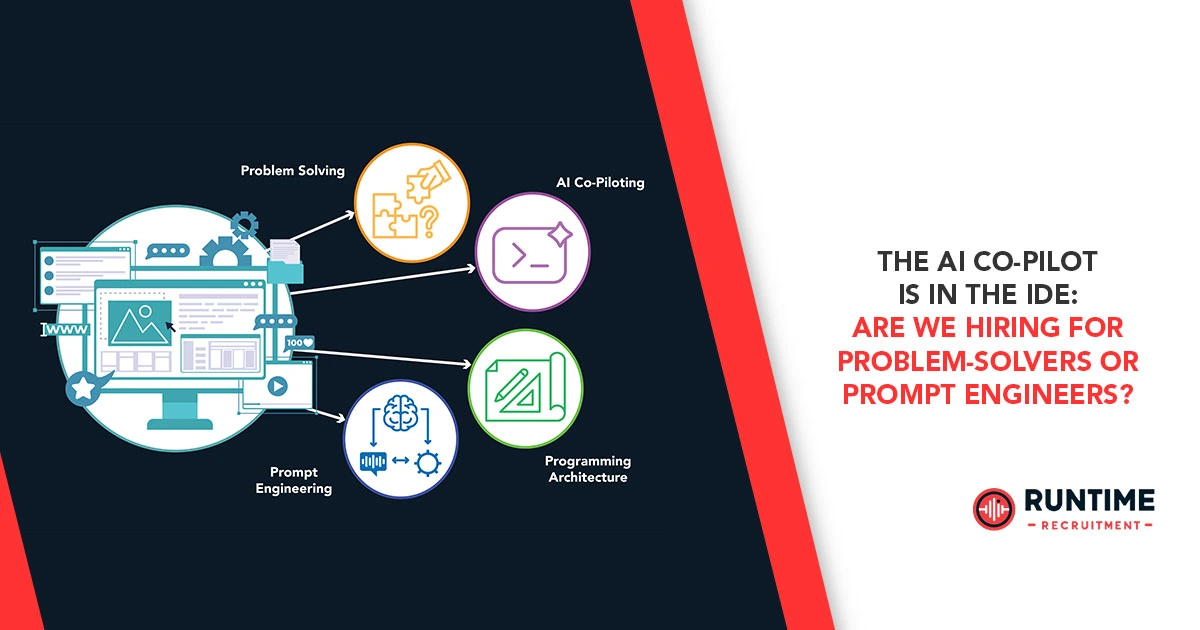
The Integrated Development Environment (IDE), long the sacred ground of the embedded engineer, has a new inhabitant: the AI Co-Pilot. Tools like GitHub Copilot, built on Large Language Models (LLMs) fine-tuned on mountains of code, are no longer a distant sci-fi concept. They are here, integrated directly into Visual Studio Code, JetBrains IDEs, and other platforms we rely on daily. For an industry steeped in low-level control, real-time constraints, and hardware-software co-design, this transformation is seismic.
This shift forces a profound existential question upon every engineering team, hiring manager, and seasoned veteran in the embedded space: What is the core value proposition of the embedded engineer in the age of the AI Co-Pilot? Are we transitioning from hiring deep-domain Problem-Solvers, the engineers who intuitively understand hardware idiosyncrasies, power consumption, and signal integrity, to merely hiring Prompt Engineers, those adept at crafting the precise natural language queries that coerce the LLM into spitting out a usable snippet of C or Rust?
The answer, as with all true transformations, is complex, but the path forward is clear: Problem-Solving will remain, and its value will be exponentially amplified, while “Prompt Engineering” will become a non-negotiable, baseline skill for the modern engineer. The true genius will lie in the synergy between human expertise and machine speed.
The Embedded Crucible: Why We’re Different
The embedded world, with its focus on microcontrollers, FPGAs, safety-critical systems, and constrained resources, has always been the rugged exception to the general software rule. A web developer’s mistake might cost a user a few seconds of frustration; an embedded engineer’s mistake can cause a medical device to fail, a car to crash, or an industrial process to seize up.
This context is crucial when evaluating the role of an AI Co-Pilot.
The Code Generation Delusion in Embedded Systems
AI Co-Pilots excel at generating boilerplate code, implementing standard algorithms, or writing functions for well-trodden paths (like a basic UART driver or a common sorting function). This capability alone offers immense productivity gains, speeding up the tedious, repetitive tasks that consume a significant portion of the development cycle.
However, the core challenges in embedded systems remain largely untouched by basic code-generation:
- Hardware Bring-up and Configuration: Getting a new custom PCB to boot, configuring intricate pin multiplexing, dealing with datasheet errata, and diagnosing signal integrity issues require an intimate, holistic understanding of the silicon and the circuit board. An AI might suggest a peripheral configuration, but it cannot troubleshoot a non-booting board with an oscilloscope and a logic analyzer.
- System-Level Constraints: Embedded systems are defined by their constraints: memory footprint (a few kilobytes of RAM/Flash), power budget (every milliampere matters), and real-time performance (deterministic execution within tight deadlines). An LLM, trained on general-purpose code, often generates verbose, non-optimal code that ignores these realities. The human engineer must still act as the final system-level validator, pruning the AI-generated code for size, optimizing for power consumption, and ensuring determinism.
- Safety and Certification: In domains like avionics (DO-178C) or automotive (ISO 26262), every line of code must be traceable, auditable, and provably correct. AI-generated code, with its opaque provenance and probabilistic nature, raises significant challenges for compliance. The engineer is the one who must impose the necessary rigor, write the meticulous unit tests, and generate the required documentation, tasks where the AI can assist, but never wholly replace.
The LLM is a phenomenal coder, but it is a poor system architect and a non-existent hardware troubleshooter.
The Evolution of the Embedded Engineer: From Coder to Architect
The arrival of the AI Co-Pilot does not make embedded engineers obsolete; it fundamentally re-calibrates what makes an embedded engineer valuable. The future belongs to those who embrace the AI as a force multiplier, shifting their focus up the abstraction stack.
The Ascendancy of Problem-Solving
The highest-value skills are those that an LLM cannot replicate. These skills are all centered around Problem-Solving in its most complex, multi-disciplinary form:
- System Architecture and Holistic Design: The ability to design the interplay between components, to segment a system into reliable, testable modules, and to anticipate future requirements. This involves choosing the right microcontroller, selecting the appropriate communication protocols (SPI vs. I2C vs. CAN), and defining the RTOS structure. The AI can write a single driver; the engineer designs the entire operating ecosystem.
- Constraint-Driven Debugging: An AI can spot a syntax error or a common bug pattern. It cannot, however, debug an intermittent crash caused by a stack overflow in an ISR, a data race in a custom mutex implementation, or an unexpected system halt due to a brown-out reset from a transient power sag. These complex, emergent behaviors require hypothesis generation, deep knowledge of the silicon’s registers, and skillful use of debugging tools, a domain reserved for the human Problem-Solver.
- Cross-Disciplinary Literacy: Embedded engineering is the convergence of electrical engineering, computer science, and domain-specific knowledge (e.g., control theory, RF design, thermodynamics). The AI can generate the code, but the human must validate if the generated Proportional-Integral-Derivative (PID) controller code correctly implements the necessary damping for the physical motor being controlled. This judgment requires expertise in the physical world.
- Requirements Elicitation and Validation: The most difficult problem in any project is knowing what to build. An LLM can’t talk to a customer, interpret a vague specification, or resolve conflicting requirements from different stakeholders. The engineer’s ability to translate ambiguous needs into precise, verifiable, and constrained technical specifications is irreplaceable.
The new metric of a top embedded engineer will be Problems Solved per Hour, not Lines of Code Written per Hour. The AI will generate the lines; the human will solve the problem behind them.
The New Baseline: Prompt Engineering as a Diagnostic Tool
If Problem-Solving is the high-value skill, then Prompt Engineering, the ability to articulate intent and constraints clearly to the LLM, is the new, mandatory baseline skill.
This isn’t just about writing a good question; it’s about computational thinking and diagnostic reasoning applied to a large language model.
Prompt Engineering is the New Google Search
A decade ago, the best developers were those who were best at Googling for solutions. Today, the best developers are learning to be the best at prompting an AI Co-Pilot. This involves:
- Clarity and Specificity: Instead of “write a timer function,” the prompt becomes: “In C, using the STM32L4 HAL library, write a function start_low_power_timer(uint32_t ms) that utilizes Timer 2 in one-shot mode, disables all interrupts upon completion except for the main loop flag, and minimizes power consumption.” The value isn’t the code; it’s the engineer’s ability to precisely define the constraints (STM32L4 HAL, one-shot, power optimization) and the intent (disable interrupts, set a flag).
- Iterative Refinement (Chain-of-Thought): When the AI’s first attempt fails (which it often will in complex, constrained scenarios), the engineer must be able to diagnose the flaw in the AI’s logic and refine the prompt. This requires the same debugging intuition, e.g., “The generated code uses HAL_Delay(), which blocks the RTOS. Refactor the code to use an interrupt-driven timer and a semaphore for non-blocking wait.” This process of recognizing a logical, architectural, or performance flaw in the AI’s output is an act of Problem-Solving in itself.
- Contextual Guardrails: The engineer must provide the AI with the necessary domain knowledge that it lacks, like the contents of a custom header file, the specifics of a proprietary RTOS API, or the exact memory map of the custom hardware. This is how the human Problem-Solver infuses the LLM’s generic knowledge with the project’s unique, hard-won expertise.
Prompt Engineering, therefore, is not a separate discipline; it is simply high-fidelity communication of a technical problem to an abstract reasoning engine. It’s the language of delegation.
Preparing the Next Generation: A Shift in Hiring Focus
The market is already signaling this shift. Companies are not just looking for engineers who can write C/C++; they are looking for engineers who can reason in C/C++ and architect reliable systems.
The New Embedded Skill Stack
Hiring managers need to re-evaluate their criteria to favor the following:
| Skill Set | Old Focus | New Focus (AI Amplified) |
| Coding | Fluency in C/C++ syntax; driver implementation. | Code Curation: Validation, optimization (speed/size), security review of AI-generated code. |
| System | Knowledge of one MCU family (e.g., PIC, AVR). | Holistic Architecture: Cross-disciplinary knowledge (EE, Mechanical, CS, ML); RTOS scheduling; bus protocols; system-level debugging. |
| Tooling | Proficiency with debugger/IDE shortcuts. | AI Collaboration: Mastery of prompt engineering, integrating AI for testing/documentation, model-based design. |
| Core Value | Writing functional code that meets requirements. | Solving Ambiguous Problems: Defining the right problem, validating AI output, troubleshooting emergent, cross-domain failures. |
The best candidate is the one who can solve a novel, un-Googleable problem on a new piece of silicon with a critical power budget. The AI Co-Pilot will make them 10x faster at the implementation, but it cannot supply the initial, critical spark of insight and ingenuity required for the solution.
The challenge for new engineers is the risk of a “cognitive shortcut”using the AI as a crutch without understanding the underlying principles. The engineering schools and hiring processes must ensure that new graduates possess the foundational knowledge (low-level memory management, interrupt vectoring, hardware registers) that allows them to validate and debug the AI’s output, not just blindly accept it.
Connect Your Expertise with Opportunity
The AI Co-Pilot is undeniably a game-changer, accelerating the work of the good engineer and forcing the less-skilled to adapt or be left behind. It’s an accelerant for the industry, raising the collective bar for competence. The transition isn’t about replacing engineers; it’s about replacing the unskilled parts of the job with automation, leaving the truly creative, high-value problem-solving for the human mind.
Are you ready to leverage the AI Co-Pilot to take on the next generation of complex embedded challenges?
The best companies are currently seeking embedded engineers who are not only masters of their craft but who also view AI tools as a critical part of their workflow, a powerful new tool in their problem-solving arsenal.
Connect with RunTime Recruitment today. We specialize in connecting top-tier embedded, firmware, and hardware engineering talent with the innovative companies building the future of physical technology. Let us help you find the role that rewards your problem-solving expertise and allows you to lead the charge in the age of the AI Co-Pilot.