
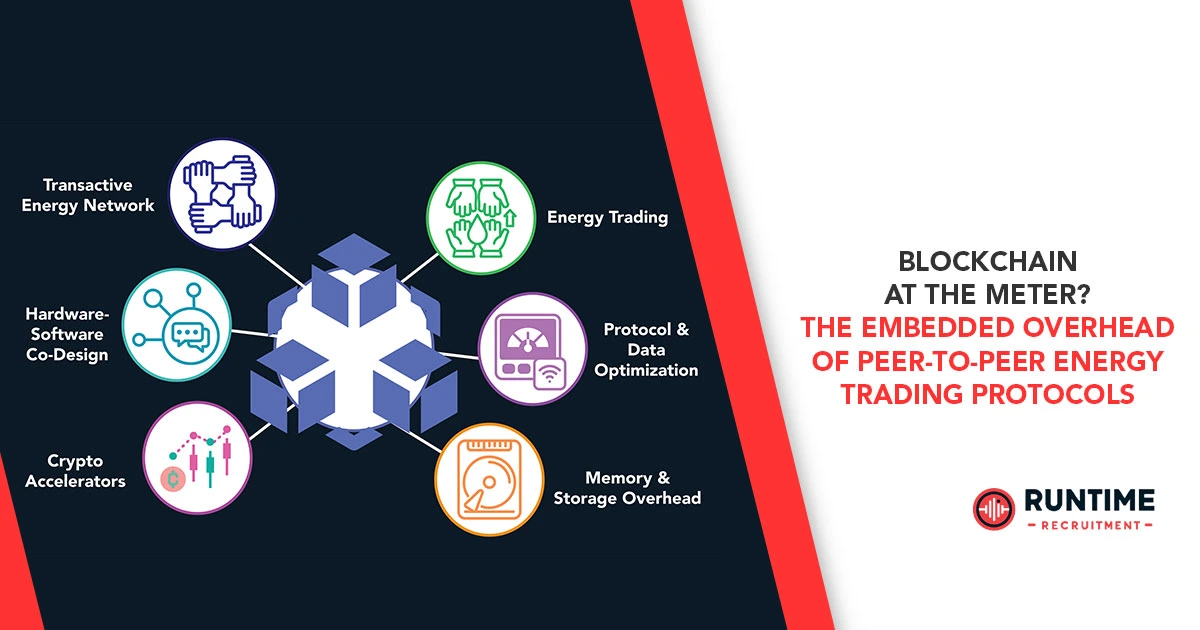
The smart grid is evolving from a centralized, unidirectional power delivery system into a dynamic, decentralized transactive energy network. At the core of this transformation lies the promise of Peer-to-Peer (P2P) energy trading, where homes with solar panels (prosumers) can directly sell surplus power to their neighbors (consumers), bypassing traditional utility intermediaries. This vision promises greater efficiency, better utilization of distributed renewable energy (DRE), and lower costs.
To facilitate P2P trading in a trustless, transparent, and immutable manner, many architects point to blockchain technology. Placing the secure ledger onto the smart meters and IoT devices at the grid’s edge, the very points of generation and consumption, is the ultimate goal of decentralized energy.
But for the embedded engineer, this utopian future presents a stark, complex challenge: overhead. The smart meter is a fundamentally resource-constrained device, a far cry from the high-powered servers running public blockchain nodes. The challenge is not if blockchain is secure, but can an ARM Cortex−M4 or similar microcontroller execute its demanding cryptographic and storage requirements without succumbing to unacceptable latency, power consumption, or memory exhaustion.
This article delves into the substantial embedded overhead of P2P energy trading protocols and explores the critical design choices required to bridge the gap between ledger security and embedded reality.
The Resource Chasm: Smart Meter vs. Blockchain Node
The modern smart meter, or an adjacent IoT gateway for DRE, is built for longevity and cost-effectiveness. Key hardware specifications are often defined by utility-level constraints: decades of operation, low-power consumption (often battery-backed or highly power-efficient), and a fixed, modest bill of materials (BOM).
In contrast, a standard blockchain node, like a full Ethereum client, demands high-speed multi-core CPUs, gigabytes of RAM, and terabytes of fast SSD storage to handle the ever-growing, full transaction history.
Mapping blockchain functions onto the typical smart meter reveals a severe resource mismatch across three primary vectors: Computational Power, Memory/Storage, and Energy Consumption.
1. Computational Overhead: The Cryptographic Tax
Every transaction in a blockchain, even a simple kWh trade, requires a complex cryptographic operation. This is the embedded engineer’s most immediate challenge.
Hashing and Integrity Check
A fundamental blockchain operation is the calculation of a secure hash (e.g., SHA-256) for transaction data and block linking. While lightweight compared to mining, repeated hashing for block verification or Merkle tree computation can significantly strain a low-power microcontroller. A simple SHA−256 calculation on a resource-constrained Cortex−M device can consume several orders of magnitude more clock cycles than a standard data processing task, leading to high processing latency and thermal concerns.
Digital Signature Verification (Authentication)
Authenticating a P2P transaction requires the prosumer’s smart meter to sign the transaction and the receiving nodes to verify that signature. The standard for lightweight, high-security authentication is Elliptic Curve Cryptography (ECC).
- ECC vs. RSA: ECC is computationally efficient compared to older standards like RSA, offering equivalent security (e.g., 256-bit ECC key is comparable to a 3072-bit RSA key) with significantly shorter key lengths. This is crucial for minimizing communication and storage overhead.
- Performance Hit: Even optimized ECC/ECDSA (Elliptic Curve Digital Signature Algorithm) verification remains a resource-intensive task. Studies of ECC verification on ARM Cortex−M4 microcontrollers show that the operation can take tens of milliseconds, which, when scaled to thousands of transactions per second (TPS) across a local microgrid, quickly becomes the system’s primary bottleneck.
- Mitigation: Hardware Acceleration: To address this, many next-generation smart meter architectures are incorporating dedicated Cryptographic Accelerators (often on-chip ASICs or peripheral modules) that offload the compute-heavy ECC/SHA operations from the main CPU, allowing the device to maintain real-time metering and control functions.
2. Memory and Storage Overhead: The Ledger Bloat
A blockchain is, by definition, an ever-growing ledger. This poses an existential storage crisis for a device with limited Flash or EEPROM.
Full Node vs. Light Client
A smart meter cannot possibly run a Full Node that stores the entire history of the blockchain. Even a consortium blockchain for a city microgrid would quickly grow too large. The only viable path is the Light Client model.
- Light Clients: These nodes only download and store the block headers, relying on Merkle tree proofs to securely verify transactions against the header root. This drastically reduces the storage footprint from gigabytes to megabytes, making it viable for a device with 128KB to 1MB of Flash memory.
- Transaction Pool & State: The meter must still maintain a local cache of pending transactions (the mempool) and a record of its current energy credit/token balance (the state). The complexity of the smart contract logic (e.g., dynamic pricing algorithms) and the underlying virtual machine (VM) also adds to the firmware’s code footprint, often pushing the device’s RAM limitations. A lightweight blockchain client implementation can still require an additional 14KB of Flash and 3KB of RAM just for the cryptographic libraries and protocol stack, according to embedded security whitepapers.
3. Energy Overhead: The Battery Trade-Off
Energy efficiency is paramount for any device on the grid edge, especially those in remote locations or relying on local batteries for backup.
Consensus Mechanisms
The type of consensus mechanism employed is the single largest factor in determining the energy overhead.
| Consensus Mechanism | Resource Demand | Latency | Viability for Smart Meter |
| Proof-of-Work (PoW) | Extremely High (Massive Hashing) | High | Impractical (Unacceptable power draw) |
| Proof-of-Stake (PoS) | High (Validator Selection/Signing) | Medium | Better, but still demanding on single nodes |
| Delegated PoS (DPoS) | Low (Only votes/transactions) | Low | Optimal (Offloads validation to high-power gateway nodes) |
| Practical Byzantine Fault Tolerance (pBFT) | Medium (High communication) | Low | Viable for small, trusted consortiums |
The embedded ecosystem is actively rejecting PoW. Lightweight P2P energy protocols leverage energy-efficient models like DPoS or simplified PoS, where the resource-intensive tasks (e.g., block validation and mining) are offloaded to more powerful edge computing gateways, utility servers, or dedicated cluster heads. The smart meter is reduced to a “signer” or “prover” of the transaction, rather than a full-fledged “validator,” dramatically reducing its energy footprint by over 50% compared to a PoW-based system.
Protocol Deep Dive: Ethereum vs. Hyperledger Fabric
The choice of underlying blockchain platform directly dictates the scale of the embedded overhead. Public, open-access chains like Ethereum offer maximum decentralization but impose the greatest constraints, while permissioned, enterprise-grade platforms are more palatable to utility models but sacrifice some P2P purity.
Ethereum (Public/Permissionless)
While not designed for embedded devices, its smart contract capabilities (Solidity/EVM) are ideal for complex P2P markets (e.g., dynamic pricing, automatic settlement).
- Overhead: The complexity of the Ethereum Virtual Machine (EVM) and the overhead of its transaction model (Gas fees, nonce management) are too heavy for most traditional smart meter microcontrollers. Devices require an intermediary gateway to handle Web3 communication and transaction broadcasting.
- Feasibility: Only a handful of highly-optimized clients (like MicroETH) or a gateway-centric architecture are feasible, where the meter only signs raw transaction data and the gateway handles the network stack and contract calls.
Hyperledger Fabric (Private/Permissioned)
This enterprise-grade, permissioned platform is a strong contender for utility-managed microgrids (Consortium Blockchain). It does not use PoW, which is a massive advantage.
- Overhead: Fabric’s model of Endorsing Peers and Ordering Service simplifies the embedded challenge. Peers (like high-end meters or local edge servers) only need to endorse transactions and maintain a snapshot of the ledger state, not mine blocks. However, the system still suffers from high communication overhead due to the multi-stage endorsement process, where transaction proposals must be routed, endorsed, ordered, and committed. This process can lead to network failure or high latency in environments with poor bandwidth or highly concurrent transaction volumes (e.g., latency of up to 6.8 seconds for transaction commitment in some test scenarios).
- Feasibility: Highly suited for the consortium model. Its architecture allows for a tiered approach: high-power edge routers can be the Endorsing Peers, while the actual low-power smart meters only interact with these trusted nodes, offloading most of the protocol-specific overhead.
Mitigating the Overhead: Engineering Solutions
The integration of blockchain at the meter requires a deliberate re-engineering of the entire embedded stack, shifting from a passive data collector to an active, secure transaction processor.
1. Hardware-Software Co-Design
Cryptographic operations are the bottleneck. The solution is to leverage dedicated hardware:
- Crypto-Accelerators: As mentioned, dedicated on-chip modules (ASIC/FPGA) for SHA−256 and ECC operations reduce the execution time from milliseconds to microseconds, freeing the main CPU for metering tasks.
- Trusted Execution Environments (TEE): Using secure enclaves (e.g., ARM TrustZone) to isolate the private key and signature process prevents firmware-level attacks, ensuring the device’s cryptographic identity (its public key on the ledger) cannot be compromised. This bolsters trust without adding significant computational overhead to the main application.
2. Protocol and Data Optimization
The embedded protocol must be a minimalist.
- State-Channel Networks: Rather than writing every single kWh trade to the main chain, transactions can occur off-chain between two parties (e.g., neighbor-to-neighbor trade) using state channels. The main blockchain is only used to open and close the channel and resolve disputes. This massively reduces the number of on-chain operations and minimizes network chatter.
- Data Aggregation and Offloading: The meter sends raw energy data to a local edge gateway, which then aggregates thousands of meter readings into a single, signed Merkle root and posts the root to the blockchain. This significantly reduces the storage and transmission overhead for the low-power meters.
3. Specialized Lightweight Blockchains
The final and most potent solution involves moving away from general-purpose blockchains to protocols built specifically for the IoT and resource-constrained environments:
- Directed Acyclic Graph (DAG) Structures: Technologies like IOTA or Nano (which use a DAG instead of a linear chain) eliminate the concept of blocks, miners, and proof-of-work. Transactions are validated by subsequent transactions, offering zero transaction fees and extremely low latency. This “Tangle” architecture is inherently more suited for the high volume, low-value micro-transactions typical of P2P energy trading, requiring only minimal computational resources for verification.
The Embedded Imperative
The promise of a truly decentralized energy grid, one where the blockchain lives at the meter, is compelling. It offers unprecedented security, transparency, and the potential for new, dynamic energy markets.
However, this future hinges on the ingenuity of the embedded engineer. The overhead of cryptographic operations (ECC, SHA), the sheer volume of ledger data, and the high-energy cost of consensus mechanisms are not trivial; they are existential threats to the smart meter’s function and longevity. The embedded industry must continue to champion permissioned consortium models (like Hyperledger Fabric), lightweight consensus algorithms (like DPoS), and hardware-accelerated cryptography to make “Blockchain at the Meter” a cost-effective and operationally stable reality. The solution is not to run a full blockchain on an MCU, but to design a secure, highly-optimized client that leverages the power of its trusted neighbors and edge gateways.
The next generation of smart meters will not be judged just on their accuracy, but on their ability to securely and efficiently participate in a transactive energy network; a task that requires a fundamental shift in embedded design philosophy.
Your Expertise is the Power
The convergence of distributed ledger technology and the smart grid is one of the most exciting and challenging areas of modern engineering. Your unique skills are in high demand to solve these critical embedded overhead challenges.
RunTime Recruitment is actively partnering with leading utilities and energy tech startups who are building the next generation of transactive energy infrastructure.
Connect with RunTime Recruitment today to explore embedded engineering roles that are literally powering the future of the decentralized grid.