
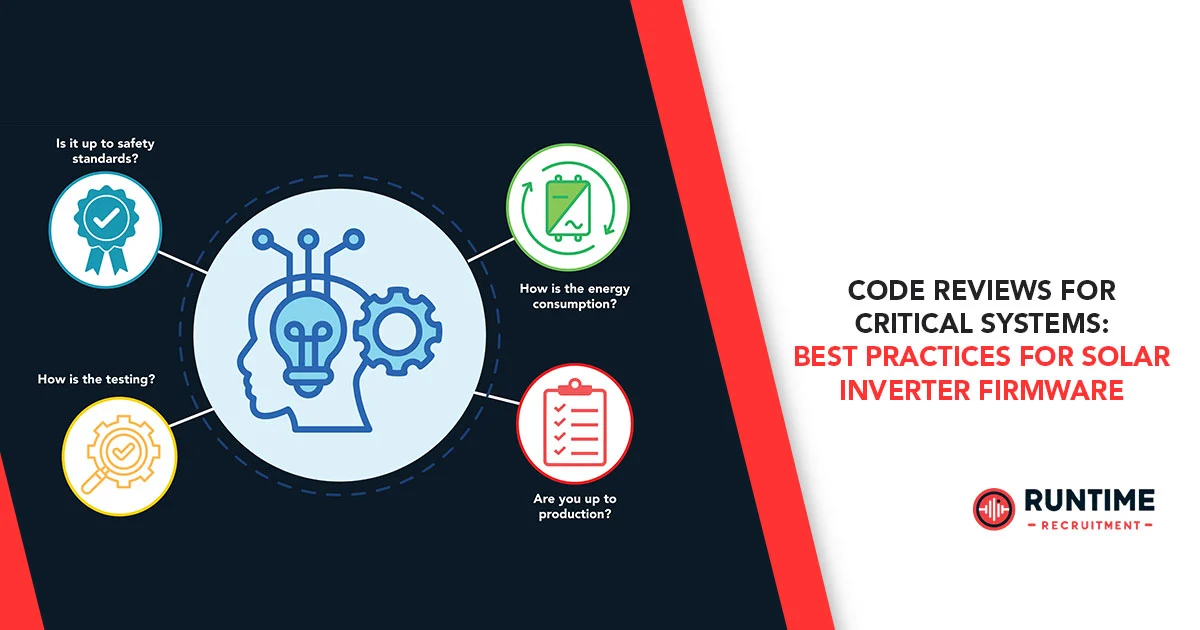
The global shift toward renewable energy has positioned the solar photovoltaic (PV) inverter at the heart of the modern power grid. Far from being a simple switch, the solar inverter is a sophisticated critical embedded system governed by complex, real-time firmware. This firmware is responsible for a demanding array of tasks: maximizing power output via Maximum Power Point Tracking (MPPT), safely inverting DC to synchronized AC, managing communications, and, most crucially, ensuring grid compliance and safety.
Given that a failure in this system can lead to fire, grid instability, catastrophic hardware damage, or significant financial loss, the quality of solar inverter firmware is non-negotiable. Code reviews, therefore, transcend mere best practice—they become a foundational pillar of functional safety and system reliability. For the embedded engineer working on this technology, a standard code review process is insufficient. It must be a rigorously specialized, multi-layered inspection tailored to the unique demands of high-voltage power electronics and real-time operations.
This in-depth article will serve as a definitive guide for embedded engineers, dissecting the specialized challenges of reviewing solar inverter firmware and laying out a comprehensive set of best practices, checklists, and tool integration strategies to ensure that every line of code upholds the highest standard of safety and performance.
The Unique Criticality of Inverter Firmware
Before diving into the review process, it’s essential to appreciate why inverter firmware is uniquely critical and what separates its code review from that of a typical enterprise application.
1. Hard Real-Time Constraints
Inverter control loops—specifically the Pulse Width Modulation (PWM) generation and current/voltage regulation—operate under microsecond-level deadlines. A slight delay or jitter in an Interrupt Service Routine (ISR) or a high-priority task can lead to:
- Harmonic Distortion: Poorly timed PWM signals distort the AC output waveform, impacting power quality and grid synchronization.
- Overcurrent/Shoot-Through: Delays in switching off an IGBT/MOSFET pair can cause a catastrophic short circuit (shoot-through), immediately destroying the power stage.
- Control Instability: Jitter or non-deterministic execution in the control loop can cause the entire system to oscillate or trip offline.
2. Safety and Grid Compliance
The firmware is the sole enforcer of safety standards like IEC 62109 and grid codes such as IEEE 1547 or local derivatives (e.g., California Rule 21). These standards mandate specific behavior for:
- Anti-Islanding: The inverter must detect when the grid is down and cease power export within milliseconds to protect utility workers.
- Voltage/Frequency Ride-Through: The inverter must remain connected and support the grid during minor voltage sags or frequency deviations.
- Ground Fault Detection: The system must immediately trip and isolate in case of a ground fault (GFDI/AFCI).
A bug in the safety logic is not a minor defect; it is a safety hazard with potentially life-threatening consequences.
3. Hardware-Software Interdependency
Inverter firmware is inextricably linked to the underlying hardware—from Analog-to-Digital Converters (ADCs) sampling current and voltage to the Digital Signal Processor (DSP) or microcontroller generating PWM signals. The firmware’s quality directly impacts the lifespan and reliability of high-cost components like IGBTs, capacitors, and magnetics.
Phase I: Pre-Review Automation and Preparation
A manual code review should never be the first line of defense. For critical systems, a comprehensive layer of automation must precede human inspection to ensure the reviewer’s time is spent on complex logic, not trivial style or common pitfalls.
1. Static Analysis with Industry Standards
The single most valuable automated step for embedded firmware is the integration of a rigorous Static Analysis Tool. These tools analyze the source code without executing it, checking compliance against industry-specific standards.
- MISRA C/C++: Mandating adherence to MISRA C (or MISRA C++) is paramount. This set of software development guidelines for C/C++ is specifically designed to enhance safety, security, portability, and reliability in critical systems. The tool must enforce rules that target:
- Undefined/Unspecified Behavior: Catching pitfalls like order of evaluation or using volatile incorrectly.
- Pointers and Memory: Ensuring safe pointer use to prevent memory corruption, a classic embedded vulnerability.
- Numeric Conversions: Preventing implicit type conversions and integer overflow/underflow, which are catastrophic in control loops.
- CERT C/C++: For security-focused firmware (especially networking stacks and communication protocols), CERT C/C++ Coding Standards must be integrated to prevent common vulnerabilities like buffer overflows, injection flaws, and insecure function usage.
- Tool Choice: Commercial tools like Coverity, Polyspace, or LDRA Testbed are often preferred for their certification support, though open-source alternatives like Clang-Tidy and Cppcheck can provide a solid baseline if properly configured.
2. Review Size and Time Boxing
Research consistently shows that human defect-finding capability sharply declines beyond 400 Lines of Code (LOC) in a single review session. This principle is even more critical for complex, math-intensive inverter code.
- Rule of Thumb: Limit Pull Requests (PRs) to a maximum of 400 LOC. If a feature requires more, the author must break it down into smaller, logically atomic commits.
- Time Management: Reviewers should time-box their sessions to a maximum of 60 minutes to maintain peak concentration. After an hour, take a mandatory break.
3. Comprehensive Testing Artifacts
A PR for critical firmware should never be reviewed until it passes a comprehensive suite of automated tests.
- Unit Test Coverage: The author must provide proof of high branch and statement coverage for the new or modified code. For control functions, test cases must include:
- Boundary Conditions: Testing the limits of variables (min/max voltage, min/max frequency).
- Negative/Fault Injection: Demonstrating correct handling of sensor failures, communication errors, and input faults.
- Hardware-in-the-Loop (HIL) Test Summary: For code touching core control loops, the PR should link to or summarize results from HIL testing, proving that the code performs as expected under simulated real-world conditions (voltage sags, load steps, etc.).
Phase II: The Specialized Code Review Checklist
The manual review is the final gate, focusing on the nuanced logic, architectural correctness, and real-time behavior that static analysis and unit tests may miss. The following checklist is specifically tailored for solar inverter firmware.
1. Real-Time & Concurrency Review (The Timing is Everything) ⏱️
This is the most critical section for inverter firmware. Deterministic execution is paramount.
| Check | Rationale for Inverter Firmware |
| ISR Execution Time | Are all Interrupt Service Routines (ISRs) demonstrably short? Long ISRs mask interrupts, introducing jitter into other high-priority tasks (e.g., the PWM generation ISR), leading to control instability or shoot-through risk. |
| Shared Data Access | Are all accesses to global or shared data structures (e.g., measured current, reference voltage) protected by semaphores, mutexes, or interrupt disabling? Race conditions on power control variables are system killers. |
| Volatile Keyword Use | Is volatile used correctly on all variables shared between an ISR and non-ISR code? Check that it’s applied only where necessary to prevent the compiler from optimizing away necessary reads/writes. |
| Blocking Calls in RTOS Tasks | Are there any infinite loops or long-duration blocking calls (e.g., I/O waits, heavy processing) in high-priority RTOS tasks? This causes priority inversion and system starvation. |
| Watchdog Management | Is the watchdog timer (WDT) refreshed only at a high-level point in the main system loop, proving that all critical tasks are running? Avoid kicking the dog inside low-level loops. |
2. Power Control & Mathematical Logic Review 📐
Inverter control is a game of high-precision mathematics and physics. Errors here directly translate to efficiency loss or hardware damage.
| Check | Rationale for Inverter Firmware |
| Fixed-Point Arithmetic | If fixed-point math is used for DSP performance, is the scaling and precision handled correctly? Look for potential overflow in intermediate calculations (e.g., squaring a 16-bit value can overflow a 16-bit accumulator). |
| PID/Control Loop Logic | Is the Proportional-Integral-Derivative (PID) controller logic correct? Specifically, check for: Integrator Windup Protection and correct anti-windup logic. Derivator Filtering to prevent noise amplification. |
| MPPT Algorithm Logic | Does the Maximum Power Point Tracking (MPPT) logic handle rapid changes (e.g., sudden shading) without overshooting or oscillation? Verify the logic for step size and direction changes. |
| Saturation & Clamping | Are all control outputs (e.g., the duty cycle command for PWM) properly clamped to their valid hardware limits? Unclamped outputs can command impossible or dangerous duty cycles. |
| Error Code Propagation | When a fault condition is detected (e.g., over-voltage, sensor failure), is the error code correctly logged and immediately propagated up the call stack to the top-level safety handler for shutdown? |
3. Hardware Interfacing & Safety Review 🛡️
The layer interacting directly with peripherals requires painstaking review to prevent incorrect hardware state or unsafe operations.
| Check | Rationale for Inverter Firmware |
| Register Access Atomicity | For microcontrollers that require multiple accesses to configure a single peripheral register (e.g., two 8-bit writes for a 16-bit register), are these accesses protected from interruption (via critical sections or interrupt disabling)? |
| Write-Only/Read-Only Register Handling | Is the code correctly using bit-banding or bit-field operations for Read-Modify-Write cycles? Ensure the code does not inadvertently write to reserved or read-only bits. |
| Safety Relay Logic | For the critical utility-tie relay (grid-connect), is the control logic fail-safe? Is the coil energized only when all grid and internal checks pass? Does the code log the time and reason for every connect/disconnect event? |
| Brownout/Reset Behavior | Does the initialization code and hardware-abstraction layer (HAL) ensure the system resets to a known-good, safe state (e.g., all PWMs disabled, all relays open) following a brownout or software reset? |
4. Communication & Security Review
Modern inverters are connected devices, often using protocols like Modbus, SunSpec, or IEEE 2030.5. The networking stack is a primary attack vector.
| Check | Rationale for Inverter Firmware |
| Input Validation | Is every single external input (e.g., received network packet, configuration file data, user command) rigorously validated, sanitized, and bounds-checked before being used internally? Look for potential buffer overflows or injection attacks. |
| Credential Storage | Are network credentials, private keys, or security certificates stored in a secure, non-volatile memory region, and are they encrypted or hashed? Never store plain-text secrets. |
| Firmware Update Integrity | For Over-The-Air (OTA) update logic, is there a robust check for image integrity (e.g., SHA-256 hash check) and authenticity (e.g., cryptographic signature verification) before flashing and executing the new code? |
| Protocol Compliance | Does the communication stack strictly adhere to the defined protocol specification (e.g., correct register addresses for Modbus, proper message format for DNP3)? Inverter interoperability relies on this. |
Phase III: Fostering a Robust Review Culture
The best checklists and tools are useless without a strong team culture that embraces code review as a collective responsibility, not a punitive process.
1. Focus on the Code, Not the Coder
Feedback must be constructive, specific, and focused solely on the code. Use phrasing that encourages shared ownership, such as: “The MPPT logic here could benefit from…” or “This function has a race condition potential because…” Avoid personalizing the feedback (“You missed…”)
2. Require the Author to Annotate
The author of the code should be required to provide a detailed, non-trivial description in the pull request. This annotation should explain:
- The “Why”: The functional requirement being met.
- The “What”: A high-level description of the change.
- The “Where”: Pointers to the most critical files or functions to review (e.g., “Pay close attention to the calc_pwm_duty_cycle() function for fixed-point overflow risk”).
This preparation forces the author to think critically about their own changes and significantly reduces the reviewer’s cognitive load.
3. Integrate Dual-Expertise Reviews
For solar inverter firmware, a single reviewer is often inadequate. The ideal review team should comprise:
- The Software Expert: Focuses on code quality, architecture, RTOS constructs, memory management, and C/C++ language nuances (e.g., a software lead).
- The Domain Expert: Focuses on the physics, control theory, electrical standards, and hardware interaction (e.g., a power electronics engineer).
This dual perspective ensures that the code is not just “clean,” but also physically correct and safe for the power stage.
4. Close the Loop with Metrics
To continuously improve the review process, the team should track and analyze a few key metrics:
- Defect Density: Bugs found per 1,000 LOC.
- Review Time/LOC: How long reviews take per line of code—a high value may indicate PRs are too large or too complex.
- Post-Release Escapes: The number of critical bugs found in production that should have been caught in the code review. This metric is the ultimate measure of review effectiveness.
Conclusion: The Mandate of Reliability
Code reviews for solar inverter firmware are a fundamental engineering safety process. They demand a level of rigor that extends far beyond general software development, requiring a deep, specialized focus on real-time behavior, power electronics safety, and compliance with stringent grid codes.
By leveraging powerful static analysis, enforcing small, well-documented changes, and applying a specialized, dual-expertise review checklist, embedded engineers can elevate their code quality from merely functional to predictably safe and reliable. The stability of the renewable grid, and the safety of the systems on it, depends on the engineering discipline applied to every reviewed line of code.
Is your embedded team ready to meet the rising demands of grid-tied and safety-critical solar firmware development?
Connect with RunTime Recruitment today to find specialist embedded engineers who live by the principles of safety, rigor, and cutting-edge firmware best practices.