
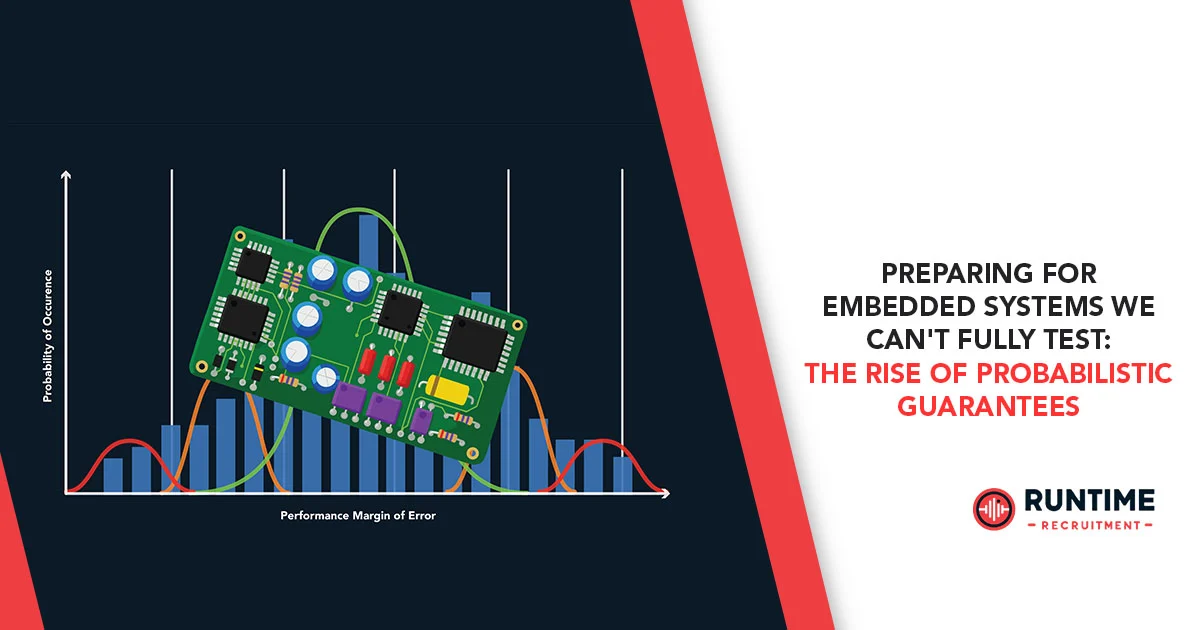
In the golden age of embedded systems, which is arguably right now, the complexity of our designs is escalating beyond the capabilities of traditional, deterministic testing. We are building systems that are profoundly interconnected, that operate in volatile, real-world environments with imperfect sensors and actuators, and that are frequently governed by real-time constraints that defy simple static analysis. The dream of 100% test coverage and absolute, verifiable correctness for the entire system is, for most modern, large-scale embedded projects, from autonomous vehicles to dense IoT networks, a comforting, yet increasingly obsolete, ideal.
This blog article is a deep dive for the seasoned embedded engineer into the paradigm shift from deterministic guarantees (a system will always behave this way) to probabilistic guarantees (a system will behave this way with a confidence of P). We will explore the forces driving this change, the mathematical and engineering concepts underpinning this new approach, and the practical steps engineers must take to navigate this complex, yet necessary, evolution in system verification.
The Death of Determinism in Complex Systems
For decades, the embedded world was ruled by the principles of hard real-time systems and safety-critical standards like DO-178C (Aerospace) and IEC 61508/ISO 26262 (Industrial/Automotive). These standards are built on a foundational promise: that a system’s behavior, particularly its timing, can be proven to be correct under all specified operating conditions. This is the world of Worst-Case Execution Time (WCET) analysis, a cornerstone of static scheduling and resource allocation.
However, the systems we build today have outgrown the practical reach of this deterministic model:
- Massively Parallel and Heterogeneous Architectures: Modern System-on-Chips (SoCs) feature complex architectures—multiple cores, GPUs, dedicated accelerators, shared caches, and advanced memory controllers. The contention and interference introduced by these shared resources make the worst-case timing path virtually impossible to determine precisely. A tiny, transient change in cache state can introduce jitter that invalidates a conservative WCET calculation.
- Environmental Volatility and Sensing: Embedded systems are no longer closed boxes. They interact with the physical world via sensors (LiDAR, cameras, radar) and communication networks (5G, Wi-Fi, CAN-FD). Sensor data is inherently noisy and incomplete. Network latency is a stochastic variable. The system’s behavior depends not only on its code but on the unpredictable physics of its environment. For an autonomous vehicle, “correctness” is a function of millions of external, non-deterministic events.
- The Integration of Machine Learning (ML): Crucially, many mission-critical embedded systems now rely on AI/ML models for perception, prediction, and control. These models are inherently statistical black boxes. You can test a neural network with a million images, but you can never exhaustively prove that it won’t classify a stop sign as a yield sign under a rare set of lighting and weather conditions. Their “correctness” is a measure of their accuracy and confidence level, which is fundamentally probabilistic.
- Combinatorial Explosion of States: For large software/hardware systems with complex concurrency, state-space exploration required for exhaustive formal verification becomes computationally infeasible. The number of possible thread interleavings, interrupt timings, and hardware states explodes into a number far exceeding the number of atoms in the universe.
In this reality, insisting on an absolute, deterministic guarantee is either prohibitively expensive, leads to crippling design conservatism, or, most dangerously, forces engineers to declare a system “proven” based on an insufficient model of its actual, complex operational environment.
The Mathematical Foundation: From ∀ to P
The shift to probabilistic guarantees is an embrace of Stochastic Modeling and Probabilistic Formal Methods. Instead of proving that a property P holds for all states (∀s,P(s)), we prove that a property P holds with a probability greater than a defined threshold pmin (P(P)≥pmin).
Probabilistic Timing Analysis (PTA)
The most tangible area where this shift is occurring is in real-time system scheduling, where Probabilistic Timing Analysis (PTA) is replacing traditional WCET analysis.
Instead of calculating a single, extremely conservative WCET value, PTA models the execution time of a task as a Random Variable and generates a Probabilistic Execution Time (PET) distribution.
The core of PTA involves two key steps:
- Modeling Micro-Architectural Effects: Using statistical methods like Extreme Value Theory (EVT) to model the timing variability (jitter) introduced by shared hardware resources (caches, buses, memory controllers). This acknowledges that while a cache miss is possible, a long sequence of consecutive worst-case events is astronomically improbable.
- Probabilistic Schedulability Analysis: This step uses the PET distributions to prove that the probability of a task missing its deadline, P(Deadline Miss), is less than the required safety threshold, ϵ (e.g., 10−9 for safety-critical systems).
This approach allows engineers to move away from overly pessimistic WCETs, leading to higher resource utilization (better performance) while still providing a rigorous, quantifiable safety argument. The guarantee is no longer “This will never happen,” but “This will happen less than once in a billion years of operation.”
Formal Verification with Probabilistic Model Checking (PMC)
While formal verification traditionally offers binary (true/false) proofs, its probabilistic extension, Probabilistic Model Checking (PMC), is the central mathematical toolkit for probabilistic guarantees.
PMC uses models like Markov Chains (Discrete-Time Markov Chains (DTMCs), Continuous-Time Markov Chains (CTMCs)) and Markov Decision Processes (MDPs) to represent the system’s states and the transitions between them, where the transitions are governed by probabilities instead of deterministic rules.
- The System Model: The embedded system (software, hardware interactions, and environment noise) is modeled as an MDP. The states can represent program counter locations, register values, and I/O status, while the transitions are assigned probabilities reflecting stochastic events (e.g., sensor noise, network packet loss, random thread scheduling).
- The Property Specification: Temporal logic is extended to the probabilistic domain, typically using Probabilistic Computational Tree Logic (PCTL) or Continuous Stochastic Logic (CSL). These logics allow the engineer to specify properties like:
- Reachability: “What is the maximum probability that the system enters a critical failure state (S_fail)?”
- Safety: “What is the probability that the system always satisfies a certain invariant (e.g., ‘brake pressure ≥100 PSI’) over a time horizon T?”
- Performance: “What is the expected average time for a task to complete?”
The PMC tool then algorithmically verifies the model against the PCTL/CSL formula to compute the precise probability of the property holding.
This is fundamentally different from simulation-based testing, which is limited by the number of test runs. PMC provides a mathematical proof over the entire defined state space of the model.
Engineering the Change: Practical Shifts in Workflow
The adoption of probabilistic guarantees is a multi-faceted organizational and technical challenge that requires new tools and a shift in the engineering mindset.
1. Rethinking Requirements and Safety Cases
The most significant change begins with requirements. Traditional requirements are binary: The system shall respond in less than X milliseconds. Probabilistic requirements are expressed as a safety goal: The probability of a system failure resulting in fatality shall be less than 10−9 per hour of operation (SIL 4 or ASIL D equivalent).
- Quantified Dependability: Engineers must learn to map abstract safety integrity levels (SIL, ASIL) into concrete probabilistic constraints on the hardware and software. This involves detailed Hazard Analysis and Risk Assessment (HARA) to assign failure rates to components and subsystems.
- Documenting the Statistical Argument: The traditional safety case, which relies on exhaustive testing and deterministic proof, must evolve into a Statistical Safety Case. This case rigorously documents the probabilistic models used (e.g., the assumptions behind the PET distribution, the confidence intervals of the ML model) and provides the mathematical evidence (P(Safety)≥1−ϵ) derived from PTA and PMC.
2. Model-Centric Design and Tooling
Probabilistic methods are fundamentally model-centric. The quality of the guarantee is entirely dependent on the fidelity of the system model.
- High-Fidelity Stochastic Modeling: Engineers need proficiency in creating mathematical models (in tools like PRISM or UPPAAL) that capture not only functional behavior but also the inherent stochastic elements: timing jitter, communication channel noise, sensor uncertainty, and random fault injection (e.g., Single Event Upsets).
- Tool Integration and Automation: The future of embedded verification lies in tools that bridge the gap between code, timing analysis, and probabilistic model checking. Automated tools are emerging that can extract system structure from C/C++ code and generate an initial probabilistic model, or that can leverage dynamic analysis results (statistical timing from testing) to refine the parameters of the PTA model.
- Hardware Abstraction and Separation: To make PTA viable, architectures must become more time-predictable. This trend is driving the adoption of Time-Triggered Architectures (TTA), specialized scratchpad memories, and predictable cache-locking mechanisms to tame the non-determinism introduced by modern hardware.
3. Validation and Refinement: Closing the Loop
A probabilistic guarantee is only as good as the probability values it uses. This requires closing the loop between theoretical analysis and real-world observation.
- Stress and Fuzz Testing for Tail Events: Since we are primarily concerned with ensuring the probability of failure ϵ is extremely small (the “tail” of the probability distribution), testing must focus on generating the extremely rare, high-stress scenarios that traditional testing misses. Probabilistic Fuzzing and Guided Randomization are used to explore the state space more effectively, seeking out low-probability concurrency bugs or timing violations.
- Statistical Runtime Monitoring: Runtime systems must move beyond simple error codes. They should continuously monitor key performance indicators (KPIs) and timing metrics, accumulating a statistical history of the system’s behavior. Bayesian techniques can be used to update the confidence in the probabilistic guarantees dynamically as more operational data is collected. If the observed failure rate starts to trend towards the maximum acceptable ϵ, it triggers an early warning.
Probabilistic Guarantees for AI-Embedded Systems
The most challenging application of this paradigm is in systems where the core decision-making logic is a trained neural network, common in robotics and autonomous systems.
Certifying Black Boxes
A trained ML model is a black box of billions of floating-point operations. The probabilistic guarantee here shifts from the code execution to the model’s output confidence.
- Confidence Scores as Guarantees: A key technique is making the ML model output an explicit confidence score alongside its classification or prediction. The system’s safety-critical logic is then designed to handle low-confidence outputs by activating a Designated Safe State or falling back to a simpler, verifiably deterministic algorithm. For example, if the confidence in an object classification drops below 95%, the autonomous system reduces speed and increases the safe following distance.
- Adversarial Testing: We must probabilistically guarantee resilience against targeted attacks. Adversarial examples are inputs specifically crafted to cause an ML model to fail (e.g., making it misclassify a stop sign). Testing now involves running massive stochastic simulations where environmental inputs are slightly perturbed to ensure the system’s failure rate remains bounded by the acceptable ϵ. This builds a probabilistic guarantee of robustness.
- Formal Verification of ML Components: Emerging research is focused on techniques to formally verify smaller, critical parts of a neural network; for instance, proving the model is monotone (increasing input always yields increasing output) or Lipschitz continuous (small change in input yields small change in output). These proofs contribute verifiable, deterministic components to the overall probabilistic safety argument.
The Engineer’s Mandate: Becoming Fluent in Stochastic Design
This shift is not simply about changing tools; it’s about changing the fundamental way we think about correctness. It is a fusion of computer science, mathematics, and statistical analysis.
For the embedded engineer, the mandate is clear:
- Embrace a Hybrid Methodology: Recognize that Formal Verification remains essential for small, critical system kernels and hardware elements, while Probabilistic Formal Methods (PMC/PTA) are the necessary tool for modeling the complex, interacting, and non-deterministic whole.
- Develop Statistical Literacy: A deep understanding of probability distributions, Extreme Value Theory, Markov models, and statistical analysis is rapidly becoming as crucial as fluency in C/C++ and assembly.
- Drive Collaboration: The boundary between the traditional “tester” and “developer” dissolves. The new role is the Verification Engineer who must be fluent in both the hardware/software stack and the probabilistic models used to argue for safety. The safety team must directly inform the system’s runtime behavior based on calculated statistical risk.
The future of embedded systems, autonomous, intelligent, and operating in the open world, depends on our ability to manage uncertainty with mathematical rigor. Probabilistic guarantees provide the only path forward to building systems of unprecedented complexity that are not only high-performing but demonstrably safe within a defined, quantifiable measure of confidence. It’s an exciting, challenging frontier, and the engineers who master this domain will be the architects of tomorrow’s most advanced technology.
Is your career ready to tackle the statistical revolution in embedded systems?
Connect with the experts at RunTime Recruitment. We specialize in placing elite embedded, firmware, and verification engineers into roles that are defining the future of high-stakes, complex systems.