
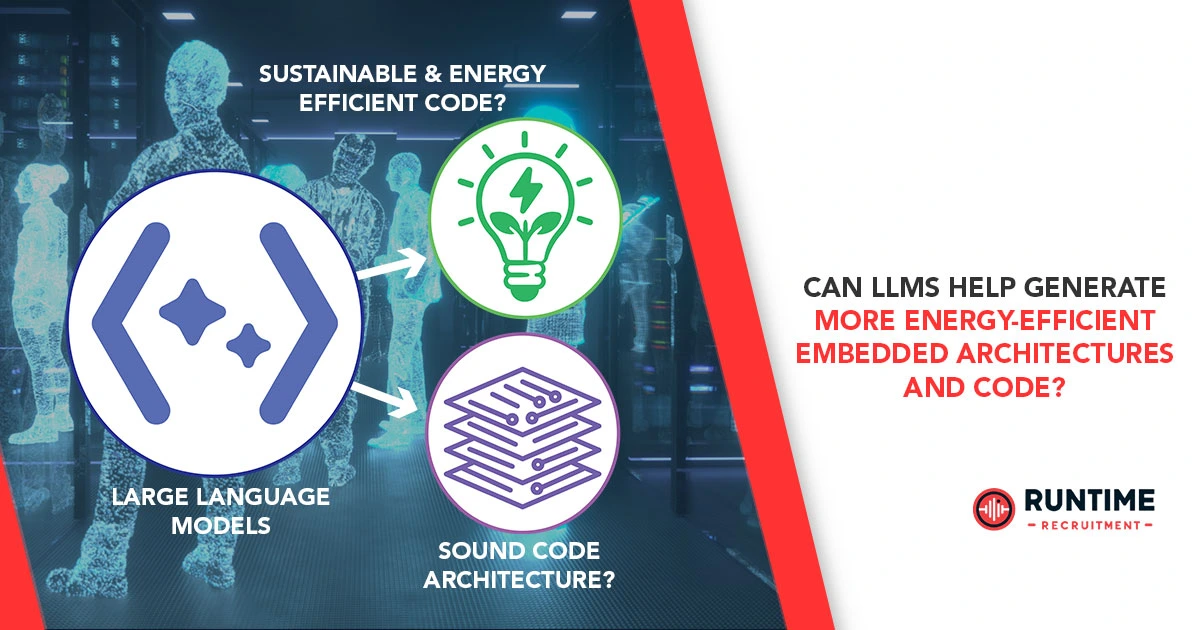
The embedded world, long driven by the relentless pursuit of smaller, faster, and cheaper, is now facing a new imperative: greener. As our connected devices proliferate, from smart home sensors to industrial IoT giants, the cumulative energy consumption of embedded systems is becoming a significant concern. The push for sustainability isn’t just an ethical one; it’s increasingly a business necessity, driven by regulatory pressures, consumer demand, and the rising cost of energy.
Enter Generative AI, specifically Large Language Models (LLMs). These powerful models have revolutionized tasks from content creation to code generation. But can they truly be a game-changer in the quest for energy-efficient embedded systems? Can LLMs move beyond generating boilerplate code to actually design for reduced power consumption, helping engineers craft more sustainable architectures and optimize code at a granular level? This article delves into the potential of LLMs to usher in a new era of “Green Design” for embedded systems, exploring their capabilities, the challenges, and the exciting future that awaits.
The Embedded Energy Conundrum: A Multifaceted Challenge
Before we explore the role of LLMs, it’s crucial to understand the complexities of energy efficiency in embedded systems. Unlike their general-purpose computing counterparts, embedded devices often operate under severe constraints:
- Limited Power Sources: Many embedded systems rely on batteries, energy harvesting, or low-power grids, making every millijoule precious.
- Real-time Constraints: Critical applications demand deterministic responses, often making aggressive power-saving techniques challenging.
- Diverse Hardware Architectures: From tiny microcontrollers to powerful edge AI processors, the spectrum of embedded hardware is vast, each with its own power characteristics.
- Software Overhead: Operating systems, communication protocols, and application logic all contribute to power consumption.
- Environmental Factors: Temperature, humidity, and vibration can influence power consumption and component lifespan.
- Design Trade-offs: Optimizing for power often means making compromises in performance, memory footprint, or development time.
Traditionally, achieving energy efficiency has been a painstaking process involving manual optimization, profiling, and expert knowledge. Engineers meticulously select components, design power management units, optimize algorithms, and hand-tune code for specific hardware. This process is time-consuming, error-prone, and heavily reliant on the experience of individual engineers. This is precisely where LLMs could offer a transformative advantage.
LLMs as Architects and Optimizers: A Vision for Green Design
The core hypothesis is this: LLMs, trained on vast datasets of code, hardware specifications, design patterns, and even scientific papers on power optimization, can learn to identify, suggest, and even generate solutions that lead to more energy-efficient embedded systems. Let’s break down how this could manifest across different stages of the embedded design lifecycle.
1. Architectural Exploration and Component Selection
The earliest design decisions have the most profound impact on energy consumption. Choosing the right microcontroller, sensor, communication module, and power management IC is critical.
- Intelligent Component Recommendation: An LLM, fed with project requirements (e.g., target power budget, processing needs, connectivity, cost), could suggest optimal component combinations. Imagine describing your smart sensor node: “I need a low-power MCU for a battery-operated device with BLE connectivity, sensing temperature and humidity, and a 5-year battery life.” The LLM could then sift through a vast database of datasheets, comparing power profiles, peripheral sets, and even known issues, to recommend specific MCUs, radio transceivers, and sensors that best meet the power constraints.
- Power-Aware Architecture Generation: Beyond individual components, LLMs could help design the overall system architecture. They could suggest optimal power modes for different operational states, design efficient power-gating strategies, and even recommend distributed processing approaches where smaller, less powerful nodes handle specific tasks, reducing the burden on a central, more power-hungry processor.
- Trade-off Analysis and Justification: LLMs could articulate the power implications of various architectural choices. “Choosing MCU A, while slightly more expensive, offers a deep sleep mode consuming only 100nA, extending battery life by 20% compared to MCU B’s 500nA deep sleep.” This ability to quantify and explain trade-offs would empower engineers to make informed, data-driven decisions for green design.
2. Code Generation and Optimization for Power Efficiency
Once the architecture is defined, the focus shifts to software. Code quality, algorithm choices, and even compilation flags significantly impact power consumption.
- Power-Optimized Code Snippets: LLMs are already adept at generating code. The next step is for them to generate power-optimized code. This means suggesting efficient algorithms for data processing, implementing interrupt-driven rather than polling-based I/O, and utilizing low-power peripherals effectively. For example, instead of a generic delay loop, an LLM might suggest using a hardware timer in a low-power mode.
- Algorithm Selection for Energy: Certain algorithms are inherently more power-hungry than others. An LLM could analyze the requirements of a task (e.g., “process sensor data, perform FFT, send over LoRaWAN”) and recommend algorithms known for their energy efficiency, perhaps even suggesting specific fixed-point implementations over floating-point for resource-constrained MCUs.
- Dynamic Power Management (DPM) Code: Implementing sophisticated DPM strategies – dynamically scaling CPU frequency, entering sleep modes, or power-gating unused peripherals – is complex. LLMs could generate the boilerplate code for these mechanisms, adapting it to the specific MCU and its power management registers. They could even suggest optimal thresholds for state transitions based on expected workload patterns.
- Compiler Flag Optimization: Compiler flags can dramatically affect both code size and execution efficiency, which in turn impacts power. An LLM, given the target hardware and desired optimization goals (e.g., “minimize power, moderate performance”), could recommend an optimal set of compiler flags, potentially even experimenting with different combinations and evaluating their impact on energy estimates.
- Identifying and Refactoring Power Hotspots: With the aid of profiling data, an LLM could analyze existing code, identify functions or loops that consume excessive power, and suggest refactoring strategies to reduce their energy footprint. This could involve recommending more efficient data structures, reducing memory accesses, or optimizing arithmetic operations.
3. Simulation, Verification, and Testing for Green Metrics
LLMs can extend their utility beyond design and code generation into the crucial stages of verification.
- Automated Test Case Generation for Power: Creating test cases to validate power consumption under various scenarios is a tedious task. LLMs could generate comprehensive test suites that simulate different workloads, power modes, and environmental conditions, helping to uncover potential power leaks or inefficiencies.
- Interpreting Power Measurement Data: When integrated with power analysis tools, an LLM could interpret raw power traces, identify anomalies, and explain their potential causes. “The sudden spike in current at T=5s suggests the WiFi module is activating unexpectedly, possibly due to a misconfigured keep-alive timer.”
- Predictive Modeling of Energy Consumption: Trained on historical data and hardware specifications, LLMs could build predictive models to estimate the energy consumption of a design even before it’s physically built. This allows for early iteration and optimization, saving costly hardware revisions.
The Training Ground: What Feeds a Green LLM?
For LLMs to achieve this vision, they need to be trained on specialized datasets that go beyond general programming knowledge. This includes:
- Datasheets and Application Notes: A vast repository of semiconductor datasheets, detailing power modes, peripheral power consumption, and recommended design practices.
- Power Profiling Data: Real-world power consumption data from various embedded systems under different workloads and operating conditions.
- Reference Implementations and Best Practices: Examples of energy-efficient code and architectural patterns.
- Scientific Papers and Research: Publications on low-power design, energy harvesting, and power management techniques.
- Hardware Abstraction Layers (HALs) and Driver Code: Understanding how to interface with specific hardware in an efficient manner.
- Compiler Internals and Optimization Strategies: Knowledge of how different compiler optimizations impact power.
- Simulation Models: Data from power simulators and emulators.
The creation and curation of such domain-specific datasets will be crucial for the success of green design LLMs.
Challenges on the Path to Green AI
While the potential is immense, several challenges need to be addressed:
- Accuracy and Hallucination: LLMs can sometimes “hallucinate” incorrect information or generate code that, while syntactically correct, is functionally flawed or, critically, not energy-efficient. Rigorous validation and testing will be paramount.
- Hardware Specificity: Embedded systems are incredibly hardware-specific. An LLM needs deep contextual understanding of different MCU architectures, their unique power registers, and peripheral idiosyncrasies. This requires highly specialized training.
- Real-time Constraints and Determinism: Generating code for real-time systems demands not just correctness but also predictability. LLMs need to be fine-tuned to understand and respect these critical constraints.
- Integration with Existing Toolchains: For widespread adoption, LLMs need to seamlessly integrate with existing IDEs, compilers, debuggers, and power analysis tools.
- Explainability and Trust: Engineers need to understand why an LLM made a particular suggestion. Black-box recommendations, especially for critical power optimizations, will be met with skepticism. The ability of an LLM to explain its reasoning will be crucial for building trust.
- Data Availability and Quality: As mentioned, gathering and curating the vast, high-quality, and diverse datasets needed for training green design LLMs is a monumental task.
- Keeping Up with Evolving Technology: The embedded landscape is constantly changing, with new MCUs, communication protocols, and power management techniques emerging rapidly. LLMs will need continuous updates and retraining to remain relevant.
The Future is Green: A Synergistic Partnership
Ultimately, LLMs are not here to replace embedded engineers. Instead, they will serve as powerful co-pilots, augmenting human ingenuity and accelerating the design process. Imagine an embedded engineer sketching out a high-level architecture, and an LLM immediately suggesting power-optimized component alternatives and providing initial estimates of battery life. Or an engineer writing a piece of critical code, and the LLM highlighting a more energy-efficient algorithmic approach.
This synergistic partnership will free engineers from repetitive, manual optimization tasks, allowing them to focus on higher-level design challenges, innovation, and creative problem-solving. It will democratize access to best practices in low-power design, making it easier for even less experienced engineers to produce energy-efficient systems.
The impact of this shift could be profound. A new generation of embedded devices, from IoT sensors to medical implants, could operate for longer on smaller batteries, reduce their carbon footprint, and contribute to a more sustainable technological future. The cumulative effect of millions, even billions, of energy-optimized embedded systems would be a significant step towards a greener planet.
Connect with RunTime
The journey towards truly energy-efficient embedded systems, powered by Generative AI, is just beginning. As an embedded engineer navigating this exciting landscape, staying at the forefront of these innovations is crucial.
If you’re an embedded engineer passionate about green design, curious about how LLMs can enhance your workflow, or simply looking to connect with a vibrant community of like-minded professionals, we invite you to connect with RunTime today! Let’s build the next generation of energy-efficient embedded systems, together. Whether it’s through our forums, webinars, or collaborative projects, your expertise and vision are invaluable. Join us in shaping a greener, more intelligent embedded future.