In the world of consumer electronics, “planned obsolescence” is often viewed as a cynical marketing ploy—a way to force a smartphone upgrade every twenty-four months. But for the embedded engineer, obsolescence isn’t a marketing strategy; it’s a relentless, creeping technical reality. We don’t build apps that live in the cloud; we build firmware that lives in the “wild”—inside industrial controllers, medical devices, automotive ECUs, and smart infrastructure.
When we ship a product, we often do so with the unspoken prayer that it will outlive our own tenure at the company. However, the intersection of Moore’s Law, the escalating cybersecurity arms race, and the finite nature of corporate resources eventually forces a difficult question: When is it ethically responsible to stop supporting a product that is still physically functioning?
This is not just a business decision regarding ROI. It is a profound ethical challenge that touches on safety, environmental stewardship, and the fundamental trust between the engineer and the end-user.
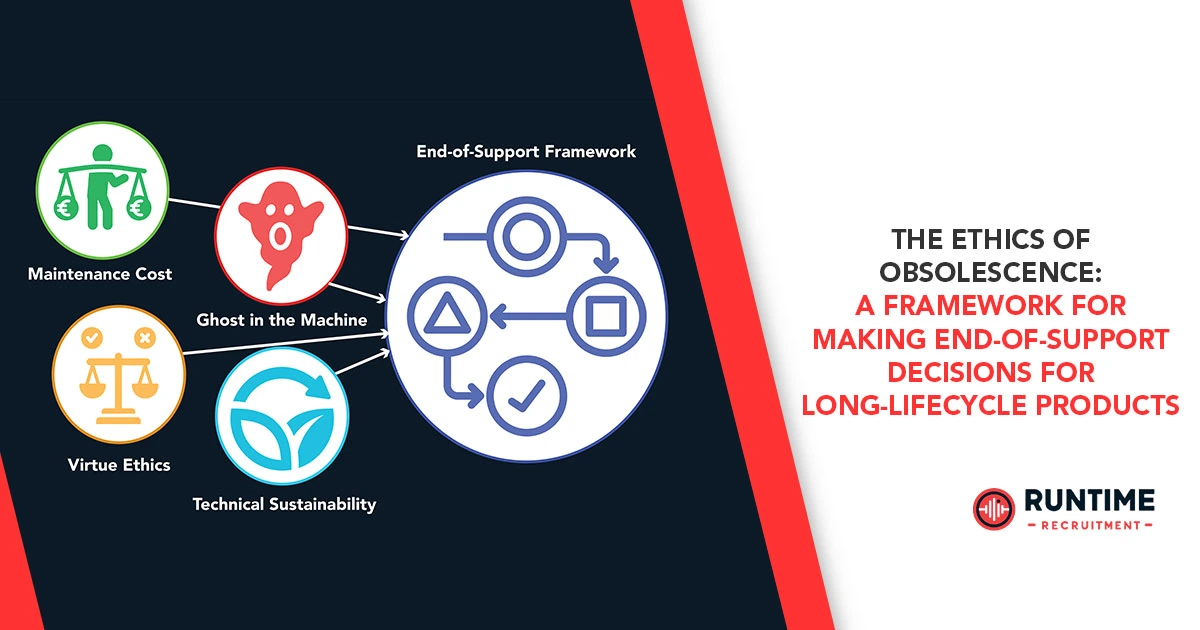
The Embedded Engineer’s Dilemma: The Ghost in the Machine
Most software developers measure “long-term support” (LTS) in years. Embedded engineers often measure it in decades. We are the architects of systems that are expected to run reliably for 15, 20, or even 30 years.
The dilemma arises when the delta between the original design environment and the modern world becomes too wide to bridge. You might find yourself maintaining a codebase written in a bespoke dialect of C, compiled with a toolchain that only runs on a Windows XP virtual machine, targeting a microcontroller that went EOL (End of Life) during the Obama administration.
The ethical tension lies between three competing forces:
- The Duty of Care: Ensuring the device remains safe and functional for the user.
- The Technical Debt: The mounting cost and complexity of maintaining “zombie” systems.
- The Security Imperative: The reality that an unpatchable device is a liability to the entire network it inhabits.
A Philosophical Framework for EoS Decisions
To make a truly ethical End-of-Support (EoS) decision, we must look beyond the balance sheet. We can apply classic ethical frameworks to the specific challenges of embedded systems.
1. Deontology: The Duty to the User
Deontological ethics suggests that we have a moral obligation to follow rules or duties. In engineering, this translates to the “Contract of Expectation.” If a manufacturer sells a smart thermostat with a 10-year warranty, they have a deontological duty to provide software support for at least that duration.
An ethical EoS framework must start with Transparency. Users shouldn’t have to guess when their device will become a “brick.” Ethical engineering requires a clear, publicly available “Software Support Lifecycle” policy provided at the point of sale.
2. Utilitarianism: The Greatest Good
Utilitarianism asks: “What action results in the best outcome for the most people?”
Sometimes, continuing to support a legacy product is actually unethical under this framework. If an engineering team spends 60% of their time backporting security fixes to a 15-year-old architecture with fundamental hardware vulnerabilities, they are neglecting the development of more secure, efficient, and sustainable new products. In this view, EoS is a tool for resource allocation—moving talent from the “past” to a “safer future.”
3. Virtue Ethics: The “Good” Engineer
Virtue ethics focuses on the character of the practitioner. A “virtuous” embedded engineer values integrity and craftsmanship. This means refusing to “silently EOL” a product. It means ensuring that when support ends, the device fails gracefully rather than catastrophically.
The Three Pillars of Ethical Obsolescence
When evaluating whether to pull the plug, engineers should assess the product across three specific dimensions.
Pillar I: The Security Integrity Threshold
This is often the primary driver for EoS. As cryptographic standards evolve, older hardware simply lacks the compute power to handle modern encryption.
- The Hardware Wall: If a device cannot support TLS 1.3 or modern SHA-256 signatures because its CPU cycles are maxed out, it is no longer a “functional” device; it is a security hazard.
- The CVE Reality: An ethical framework must determine a “Criticality Score.” If a device controls a physical actuator (a valve, a motor, a drug pump) and can no longer be patched against remote code execution (RCE) vulnerabilities, the ethical choice is often to force an EoS or disable its connectivity features.
Pillar II: Technical Sustainability and Toolchain Rot
Maintenance requires more than just the source code. It requires the environment.
- The “Bus Factor” and Institutional Knowledge: If the only engineer who understands the legacy assembly code is retired, and the build server is a 486 beige box under a desk, the product is technically unsustainable.
- Compiler and Library Dependency: Often, the libraries we relied on 10 years ago are no longer maintained. Using “abandonware” to maintain “legacy-ware” is a recipe for catastrophic, unfixable bugs.
Pillar III: Societal and Environmental Impact (E-Waste)
We cannot ignore the piles of lithium and silicon we are adding to landfills.
- The “Brick” Test: If an EoS decision turns a perfectly functional piece of hardware into a paperweight (e.g., a smart speaker that won’t boot without a defunct server), that is an ethical failure.
- The Right to Repair/Repurpose: An ethical EoS framework should include a “Parting Gift” strategy. Can you open-source the firmware? Can you provide a “Local Mode” that removes the cloud dependency?
The Framework: A Weighted Decision Matrix
When your organization is debating whether to sunset a product line, don’t rely on gut feelings. Use a structured matrix to quantify the ethical and technical risks.
| Criteria | Low Risk (Continue Support) | High Risk (Plan EoS) |
| Safety Impact | Device failure causes minor inconvenience. | Device failure causes physical harm or infrastructure loss. |
| Security Capability | Hardware can support modern crypto (ECC, AES-256). | Hardware is limited to deprecated protocols (SSLv3, WEP). |
| E-Waste Potential | Device can function offline or be repurposed. | Device becomes a “brick” without cloud connectivity. |
| Maintenance Cost | Standard toolchain; documented codebase. | Custom/obsolete toolchain; “tribal knowledge” only. |
| User Base | Large, active user base in critical sectors. | Dwindling user base; non-critical applications. |
Strategic “Sunset” Options: The Graceful Exit
The end of support shouldn’t be a cliff; it should be a ramp. Here are four ethical strategies for handling the end of a product’s lifecycle:
1. The “Final Stable” Release
Before cutting off support, release a “Long-Term Stable” firmware version. This version should strip away non-essential, high-risk features and focus purely on local, autonomous functionality.
2. Opening the Gates (The Open Source Transition)
If the company no longer finds it profitable to maintain the code, the most ethical path is often to release the HAL (Hardware Abstraction Layer) and core application logic to the community. This allows enthusiasts and specialized third-party firms to continue security maintenance.
3. The “Local-Only” Pivot
For IoT devices, the “cloud kill-switch” is the greatest ethical sin. A virtuous design includes a “Local Mode” fallback. When the servers go dark, the device should still be accessible via a local API, Bluetooth, or a physical interface.
4. The Hardware Bridge
Sometimes, the software can’t be saved because the silicon is too weak. In these cases, offering a low-cost “upgrade module” (a small PCB that replaces the logic board while keeping the expensive sensors/actuators) is a superior ethical choice over full replacement.
Communicating the End: The “Human” Aspect
Engineers often hate the “soft” side of things—the notifications and the documentation—but this is where the ethics of the decision are most visible to the public.
- Advance Warning: Provide a minimum of 12–24 months’ notice before “Sunset.”
- Clarity of Function: Be specific. Instead of saying “Support is ending,” say “Security updates will cease on Date X, and the Mobile App will stop functioning on Date Y. The physical buttons will continue to work indefinitely.”
- Incentivized Recycling: If the product must be retired due to safety risks, provide a clear path for responsible recycling, perhaps incentivized by a discount on a more secure replacement.
The Reality of “Zombie” Systems in the Field
We have to acknowledge the reality: many embedded systems will continue to run long after we stop supporting them. There are SCADA systems running on Windows 95 today. There are medical imaging machines running on prehistoric versions of VxWorks.
As engineers, our ethical duty includes Documentation for Post-Life. We should leave behind “tombstone files”—documentation that explains the known vulnerabilities and the architectural limitations to whoever is forced to maintain the system in 2045.
“The measure of a society is how it treats its weakest members. The measure of an engineer is how they treat their oldest products.”
How RunTime Helps You Manage the Lifecycle
Navigating the complexities of legacy code and long-term maintenance is one of the most grueling aspects of the embedded world. You want to innovate, but you’re tethered to the past by a thousand lines of unpatchable assembly.
RunTime specializes in bridging this gap. We provide the tools and expertise to help engineering teams modernize their development workflows, manage technical debt, and implement robust security even in resource-constrained legacy environments. Whether you are looking to extend the life of a critical system or are designing a new product with “longevity by design,” RunTime is your partner in ethical engineering.
Connect with RunTime today to learn how we can help you streamline your EoS transitions and build products that stand the test of time—without becoming a liability.
Conclusion: Engineering as a Multi-Generational Trust
The ethics of obsolescence isn’t about avoiding the end; it’s about managing it with integrity. As embedded engineers, we are the stewards of the physical world’s digital layer. When we decide to end support for a product, we aren’t just closing a Jira ticket; we are altering the lifecycle of a physical object and the safety profile of a user’s environment.
By adopting a framework that prioritizes transparency, security integrity, and environmental responsibility, we move away from the “planned obsolescence” of the disposable era and toward a model of Responsible Stewardship. We owe it to our users, our environment, and our professional legacy to ensure that when our creations finally go dark, they do so with grace.
Optimize Your Long-Lifecycle Support with RunTime
Managing the “Long Tail” of embedded devices doesn’t have to be a manual slog. At RunTime, we specialize in providing the tools and expertise embedded engineers need to manage firmware lifecycles, security patches, and hardware transitions efficiently. Whether you’re designing for the next 20 years or trying to secure a 20-year-old legacy system, we can help.
Ready to build more sustainable, maintainable embedded systems? Connect with RunTime today to learn how we can streamline your product lifecycle management.