
Security by Design: Recruiting Engineers Who Think Like Hardware Hackers
23 October 2026 · Lance Harvie
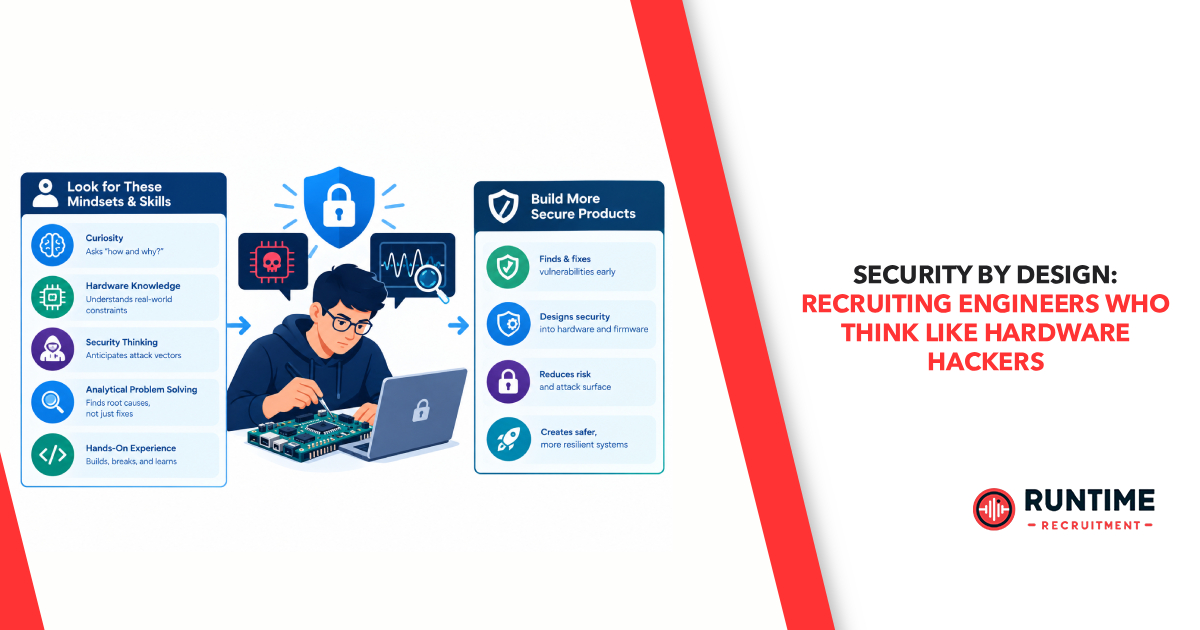
For decades, embedded software engineering treated security as a final-stage compliance exercise — a checklist applied just before flashing mass-production chips or shipping a device to customer sites. In an era dominated by isolated microcontrollers and closed air-gapped systems, that approach was often “good enough.”
Today, the landscape has fundamentally shifted. Modern embedded systems — from autonomous automotive control units and medical devices to industrial edge gateways — operate in hyper-connected, hostile environments. When devices operate on exposed physically accessible perimeters, traditional software-only security boundaries disintegrate.
Achieving true security requires moving beyond passive defense. Organizations must embrace Security by Design, which relies on building teams equipped to think like hardware hackers.
The Illusion of Software-Only Security at the Silicon Edge
Software security engineers typically build defenses around logical constructs: memory boundary checks, network encryption layers, privilege rings, and user access controls. However, a hardware attacker operates under an entirely different paradigm. They treat the underlying physical substrate not as a trusted execution context, but as an accessible attack vector.
When an adversary has physical possession of a board, software assumptions fall apart quickly:
Logical isolation fails against physical side-channels. A software routine executing a cryptographic operation may be logically sound, yet it can leak private keys through infinitesimal variations in power consumption (Differential Power Analysis) or electro-magnetic emissions.
Instruction flow control breaks under physical manipulation. A fault-injection attack using a precise voltage glitch or targeted laser pulse can skip a single branch instruction, bypassing a critical signature verification check during the boot sequence.
Debug access becomes an open door. Unprotected JTAG, SWD, or UART trace points offer raw, unmonitored access to internal registers, bypass memory protection units (MPUs), and dump memory contents directly.

When systems are built without anticipating hardware-level threats, even the most robust encryption algorithms become ineffective. To build resilient edge systems, engineering teams must incorporate the adversary’s playbook directly into the architectural design stage.
The Anvil of Hardware Security: What “Thinking Like a Hacker” Looks Like
Engineers who possess a hardware attacker’s mindset approach hardware and firmware design with constructive skepticism. They do not ask, “How is this feature supposed to work?” They ask, “How can this signal, bus, or register state be manipulated to force an unexpected execution path?”
To cultivate this approach within engineering teams, candidates should demonstrate proficiency across four technical pillars:
1. Root of Trust & Immutable Boot Chains
Hardware hackers target the execution flow from the exact millisecond power hits the board. Engineers with an offensive mindset understand that a secure system requires an unbroken chain of trust anchored in hardware. They do not rely on high-level bootloader configurations alone. Instead, they design architectures around silicon-level immutable primary boot ROMs, public key hashes burned into one-time programmable (OTP) fuses, and hardware-backed cryptographic engines (such as HSMs, TPMs, or Secure Elements).
2. Physical Interface Hardening & Signal Integrity
An engineer trained in defensive hardware design assumes every PCB trace is exposed to an oscilloscope probe or logic analyzer. They anticipate bus sniffing across external SPI or I2C flash chips holding firmware images or configuration tables. Consequently, they implement hardware-level memory encryption (such as AES-XTS on external memory buses), systematically disable or cryptographically lock debug ports (JTAG/SWD) before deployment, and route sensitive trace lines through internal PCB layers.
3. Fault Injection Resilience
Understanding how voltage, clock, or EM glitching impacts silicon registers enables engineers to write glitch-resistant firmware. Instead of relying on single boolean conditional checks for critical decisions, engineers with a hacker mindset write defensive routines using redundant state checks, randomized delay loops to break deterministic timing, and anti-glitch assembly sequences that validate execution state twice across different register sets.
4. Memory Protection and Isolation Architecture
Hardware-minded engineers design for defense-in-depth within the SoC itself. They leverage hardware features like ARM TrustZone, RISC-V Physical Memory Protection (PMP), or dedicated security co-processors to isolate cryptographically sensitive operations from general-purpose application logic. If the main runtime OS is compromised, the hardware boundaries prevent attackers from extracting master keys or altering immutable system states.
Evaluating the Hacker Mindset: Technical Candidate Screening
Identifying engineers who possess both the technical discipline to write production-ready C/C++ or Rust and the creative curiosity of a hardware hacker requires a specialized interview strategy. Standard algorithm coding questions and generic software design patterns fail to reveal how an engineer thinks when confronted with physical hardware vulnerabilities.
Below is a technical screening framework to help evaluate candidates during technical interviews:
Scenario 1: The Bootloader Verification Bypass
Interview Prompt: “Imagine you have designed a secure boot chain where the primary bootloader verifies a digital signature of the main application image stored in external SPI flash before executing it. You have tested the cryptographic math, and it is flawless. How would a hardware hacker bypass this check without cracking the RSA/ECC key, and how would you redesign the system to prevent it?”
What to Look For:
The Naïve Response: Focuses purely on software algorithms, suggesting longer key lengths or changing the hash function (e.g., SHA-256 to SHA-512).
The Hacker Mindset: Identifies physical attack vectors immediately. They will talk about glitching the CPU core power line during the signature comparison instruction to flip a branch flag (forcing a BEQ to jump as BNE), or probing the SPI bus to perform a inline payload injection after verification completes (Time-of-Check to Time-of-Use / TOCTOU).
The Defensive Fix: Proposes using inline hardware-assisted flash encryption, implementing double-check verification loops in assembly, and ensuring the verification routine runs entirely inside locked internal SRAM before execution.
Scenario 2: Debug Interface Security
Interview Prompt: “We need to leave JTAG enabled on field units for critical failure analysis on returned RMA boards, but we cannot allow customers or malicious actors to read out internal memory. How do you resolve this conflict?”
What to Look For:
The Naïve Response: Suggests relying on software passwords or obscure pin headers.
The Hacker Mindset: Recognizes that software passwords on debug ports can often be brute-forced or bypassed via power-glitching the debug state machine.
The Defensive Fix: Recommends challenge-response cryptographic authentication baked into hardware (e.g., ARM CoreSight lock mechanisms), utilizing fuse-blown debug lifecycle states (OEM Production vs. RMA state), or leveraging physical key-injection workflows during production board bring-up.
Scenario 3: Real-Time Side-Channel Leaks
Interview Prompt: “You are reviewing C code written for a crypto-accelerated firmware module running on a bare-metal microcontroller. The function compares a calculated MAC with an incoming MAC byte-by-byte using standard memcmp(). What is the security vulnerability?”
What to Look For:
The Naïve Response: Sees no issue, claiming memcmp() is standard C library practice.
The Hacker Mindset: Pinpoints the timing side-channel attack immediately. Because standard memcmp() aborts execution on the first non-matching byte, an attacker can measure the clock cycles taken for execution to deduce the correct byte sequence one byte at a time.
The Defensive Fix: Demonstrates how to write a constant-time comparison function in C or assembly where the execution time is completely independent of the input data byte values.
Comparative Matrix: Traditional Embedded vs. Hacker-Minded Embedded Engineers
To help technical recruiters and engineering managers calibrate their hiring criteria, the table below highlights the key differences between standard firmware engineering approaches and the security-first, hardware-attacker mindset:

Building an Engineering Culture that Embraces Security by Design
Recruiting engineers who think like hardware hackers is the first step; maintaining an environment where their expertise can flourish is what ensures long-term product resilience.
To build an engineering culture centered around Security by Design, organizations should implement three key structural shifts:

Shift Threat Modeling to Day Zero: Threat modeling cannot be an afterthought reserved for the final design review before production layout. Integrate threat-modeling workshops into the architectural phase. Before drawing a single schematic or writing a line of board support package (BSP) code, mandate that firmware and hardware leads map out the physical threat surface, asset boundaries, and adversary goals.
Fund Internal Hardware CTFs and Tear-Downs: Provide engineering teams with access to basic hardware hacking tools — Logic Analyzers, ChipWhisperers for side-channel analysis, voltage glitching rigs, and JTAG probes. Encourage “red teaming” sessions where engineers actively attempt to break their own prototypes. Giving engineers permission to break hardware fosters an intuitive understanding of defensive design.
Align KPIs with System Resilience, Not Just Feature Velocity: If engineering incentives reward speed of feature delivery above system integrity, security trade-offs will inevitably occur. Establish engineering metrics that weigh threat mitigation, successful penetration test outcomes, and secure code reviews equally alongside milestone delivery schedules.
Finding the Hardware Security Talent You Need
Finding engineers who master low-level C, register-level architecture, device drivers, and physical attack vectors is notoriously challenging. These professionals rarely exist on conventional job boards, and standard keyword-based resume screening often fails to identify them.
Building a secure device portfolio requires a hiring partner who understands the underlying engineering challenges, can evaluate hardware security capabilities, and knows how to connect you with specialized embedded talent.
Partner with Embedded Talent Experts
Need engineers who build security into silicon and firmware from day one? Connect with RunTime Recruitment to find specialized embedded engineering talent for your team.