
Evaluating System Design: How to Test Architectural Thinking in 45 Minutes
16 October 2026 · Lance Harvie
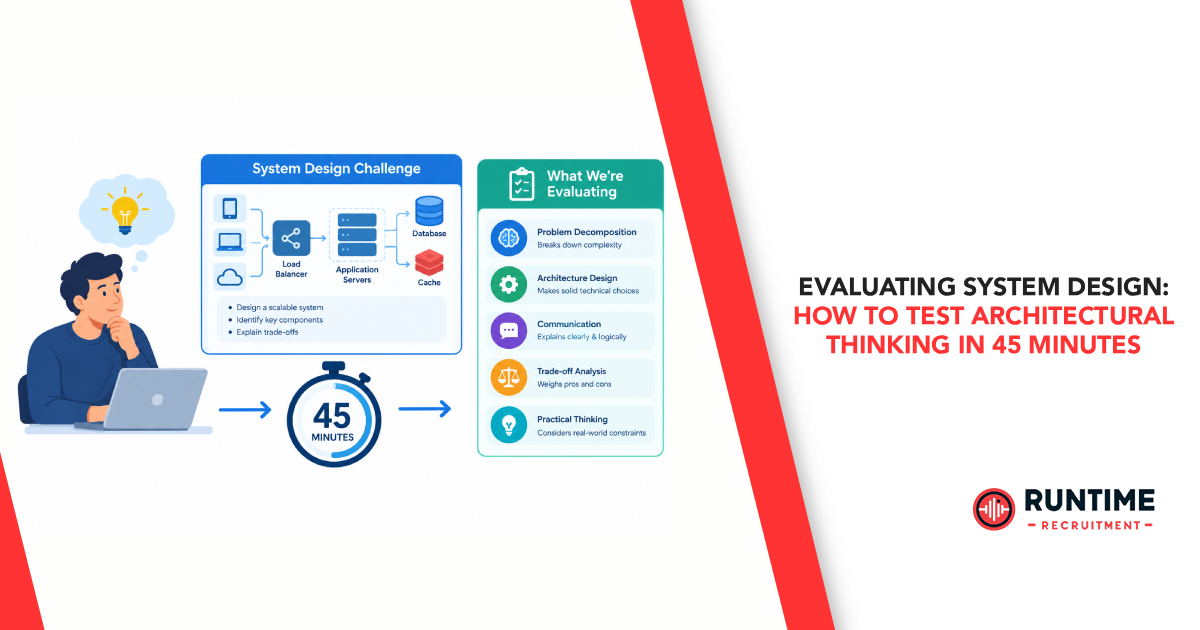
If you have ever sat across the table (or a virtual whiteboard) trying to evaluate an experienced embedded systems engineer, you have likely run into a frustrating paradox. LeetCode-style algorithm puzzles tell you whether a candidate can invert a binary tree or sort an array, but they say almost nothing about whether that same candidate can design a robust, low-power medical telemetry device that will not crash when a brownout hits.
In the world of embedded engineering, code is only a fraction of the solution. The real magic — and the real risk — lies in architecture. Hardware choices, memory maps, power budgets, interrupt priorities, and real-time operating system (RTOS) task boundaries define the success or catastrophic failure of a product.
Evaluating these skills in a compressed 45-minute interview window is daunting. How do you separate a candidate who has memorized design patterns from one who possesses genuine, battle-tested architectural intuition? This guide breaks down how to design and execute a high-signal, 45-minute embedded system design interview that cuts through the noise.
The Core Dilemma: Software vs. Embedded Architecture
In enterprise or web software, architectural thinking often revolves around microservices, database scaling, caching layers, and asynchronous event queues. If a service runs out of memory, you scale the container. If a network call drops, you retry.
Embedded systems engineering operates under an entirely different set of physics.
Physical Constraints: Flash and RAM are fixed. You cannot simply spin up a new virtual machine when your heap fragments.
Deterministic Real-Time Requirements: Missing a deadline by 50 microseconds might mean a motor controller fails, an industrial arm crashes, or a packet drops off a high-speed CAN bus.
Cost and Power Limitations: A few cents extra per unit on a microcontroller or an extra milliampere of idle current can kill a product’s profit margin or battery life before it ever hits the market.
Because of these unforgiving constraints, an embedded architect must think holistically across the hardware-software boundary. They must weigh silicon capabilities against software complexity, development time against long-term maintainability, and safety compliance against time-to-market.
A 45-minute interview cannot cover every nuance of a complex SoC, but it can reveal how a candidate approaches trade-offs under uncertainty.
Anatomy of a Great 45-Minute Embedded Prompt
A successful system design prompt for embedded engineers must hit a delicate sweet spot. If it is too abstract (e.g., “Design a smart city network”), the candidate will drown in high-level fluff without writing a single line of structured thought. If it is too granular (e.g., “Configure the DMA controller registers for SPI3 on an STM32F4”), it becomes a trivia quiz rather than an architecture evaluation.
The ideal prompt focuses on a realistic, constrained edge device. Good examples include:
An Industrial Asset Tracker: Reports GPS location, temperature, and shock data over cellular LTE-M, powered by a single coin cell battery meant to last for 5 years.
A Smart Home Smoke Detector: Requires ultra-low quiescent power, dual-sensor fusion (optical and thermal), local audio alarm generation, and mesh networking.
A Connected Infusion Pump: Safety-critical medical device requiring strict deterministic control, redundant monitoring, fail-safe mechanisms, and secure OTA firmware updates.
Let us use a variant of the Industrial Asset Tracker as our benchmark scenario throughout this framework. It forces the candidate to immediately juggle power management, communication bandwidth, sensor sampling rates, and memory constraints.

Step-by-Step Breakdown of the 45-Minute Interview Blueprint
To make the most of 45 minutes, you need a disciplined timeline. Let your candidate drive the whiteboard, but act as an active facilitator to keep them moving through distinct phases.
Phase 1: Clarification & Constraint Gathering (Minutes 0 to 10)
Junior engineers jump straight into drawing block diagrams and choosing microcontrollers. Senior architects pause, ask hard questions, and define the boundaries of the problem.
During this opening window, listen closely to what questions the candidate asks. Do they inquire about production volume and cost targets? Do they ask about the operating environment (temperature ranges, vibration, moisture)? Do they clarify certification standards (like IP ratings, FCC, or medical ISO standards)?
Key Signals:
Red Flag: Accepting the prompt at face value with zero clarifying questions, immediately launching into a pre-baked solution they used at their last job.
Green Flag: Systematically drilling down into requirements, identifying constraints, and writing down quantifiable goals (e.g., “Max active current draw of 50mA, average sleep current under 15 microamps”).
Phase 2: High-Level Component & Boundary Mapping (Minutes 10 to 25)
Once constraints are established, the candidate should map out the major hardware-software blocks. For our asset tracker, this means deciding on the primary microcontroller unit, sensor interfaces, wireless modem integration, and power management IC (PMIC).
Encourage them to articulate why they are choosing certain interfaces. Why use SPI instead of I2C for a high-speed external flash? How are the accelerometer data interrupts handled?
At this stage, they should also define the software architecture framework:
Will they use a bare-metal super-loop with interrupt service routines (ISRs), or a Real-Time Operating System (RTOS)?
If an RTOS, how many tasks will there be, and how will inter-task communication occur (queues, semaphores, mutexes)?
Key Signals:
Red Flag: Hand-waving the software layer by saying, “We’ll just run Linux on a Cortex-A,” for a low-power coin-cell application that requires microamp-level sleep modes and instant-on telemetry.
Green Flag: Thoughtful justification of architecture. For instance: “Given the need for deterministic sensor sampling and ultra-low power, a Cortex-M4 running a lightweight preemptive RTOS like FreeRTOS or ThreadX is ideal over a heavy OS.”
Phase 3: Deep Dive into a Critical Bottleneck (Minutes 25 to 35)
Every embedded system design has a fatal flaw waiting to happen. In Phase 3, you should inject a targeted constraint or bottleneck to test how the candidate handles real-world friction.
For example, ask: “The cellular module takes 3 seconds to register on the network and consumes 200mA during transmission. If the device needs to send hourly updates, our battery calculation shows it will die in 6 months instead of 5 years. How do you solve this architecturally?”
This forces the candidate to think about aggressive power optimization strategies:
Batching telemetry data in local external flash and waking up the cellular radio only once every 24 hours.
Using a low-power co-processor (or an ultra-low-power RTC/MCU domain) to monitor sensor thresholds and wake the main MCU only when an anomaly occurs.
Optimizing the cellular handshake payload size to minimize airtime.
Key Signals:
Red Flag: Suggesting superficial software tweaks like “optimizing the C code loop” or throwing a bigger battery at the problem without calculating energy budgets.
Green Flag: Performing back-of-the-envelope math on milliamps-hours (mAh), discussing duty cycles, utilizing direct memory access (DMA) to offload CPU work during data transfers, and leveraging hardware low-power states.
Phase 4: Scalability, Maintenance, and Edge Cases (Minutes 35 to 45)
The final 10 minutes should test how the candidate thinks about the product’s lifecycle outside the laboratory. Embedded systems live in the field for years, often in hard-to-reach locations.
Ask questions addressing edge cases and long-term maintenance:
How do you handle firmware updates safely in the field? (Discussing dual-bank bootloaders, image verification, and rollback mechanisms).
What happens if a peripheral bus locks up or a sensor stops responding due to electromagnetic interference (EMI)? (Discussing hardware watchdog timers, software state recovery, and bus reset lines).
How do you ensure configuration data isn’t corrupted during a sudden power loss? (Discussing wear-leveling algorithms for flash, circular buffers, or atomic writes).
Key Signals:
Red Flag: Dismissing edge cases with statements like “we can just reboot the device if it freezes” without considering safety implications or bricked devices in the field.
Green Flag: Proactive discussion of defensive programming, watchdog architecture, fail-safe states, and robust flash memory management.
Evaluating the Output: Traits of a True Embedded Architect
When the 45 minutes conclude, you should have a clear picture of the candidate’s engineering mindset. True architectural thinking in embedded systems is defined by specific behavioral and technical traits:
First-Principles Thinking: They do not rely solely on what worked at their previous company. They analyze the physics, data rates, power constraints, and cost targets of the current problem from scratch.
Trade-Off Awareness: They understand that engineering is an exercise in compromise. Every decision — choosing an external memory chip over internal flash, selecting an RTOS over bare-metal, prioritizing code size over execution speed — has a cost. A great architect articulates those trade-offs clearly.
Hardware-Software Empathy: Software engineers who hate hardware make poor embedded architects. Conversely, hardware engineers who ignore software maintainability create firmware nightmares. The best candidates seamlessly bridge both domains.
By shifting your interview process away from rote coding puzzles and toward high-context, time-boxed architectural discussions, you can accurately identify engineers who won’t just write code that compiles, but who will design resilient systems that survive the harsh realities of the physical world.
Looking to Build Your Embedded Engineering Team?
Finding top-tier embedded systems, firmware, and hardware talent can be challenging. Connect with RunTime Recruitment to find specialized engineering professionals who match your technical architecture needs.