
Eliminating Hiring Bias in Engineering: Standardizing Technical Evaluation Rubrics for Embedded Roles
26 October 2026 · Lance Harvie
In the fast-evolving landscape of embedded systems engineering, the stakes for hiring have never been higher. Whether an organization is designing low-power IoT medical devices, automotive electronic control units (ECUs), or high-reliability aerospace flight software, the margin for error is razor-thin. A single memory leak, unhandled race condition, or poorly prioritized interrupt service routine (ISR) can result in catastrophic field failures, costly product recalls, or severe safety violations.
Yet, despite the immense technical rigor required to build robust firmware and hardware-software co-designs, many engineering organizations continue to rely on antiquated, highly subjective hiring practices. When evaluating embedded candidates, hiring managers frequently fall back on unstructured interviews, "gut feeling" assessments, and pop-quiz style technical interrogations. These unstandardized methods not only fail to predict on-the-job success; they also introduce insidious hiring biases that systematically filter out exceptional engineering talent.
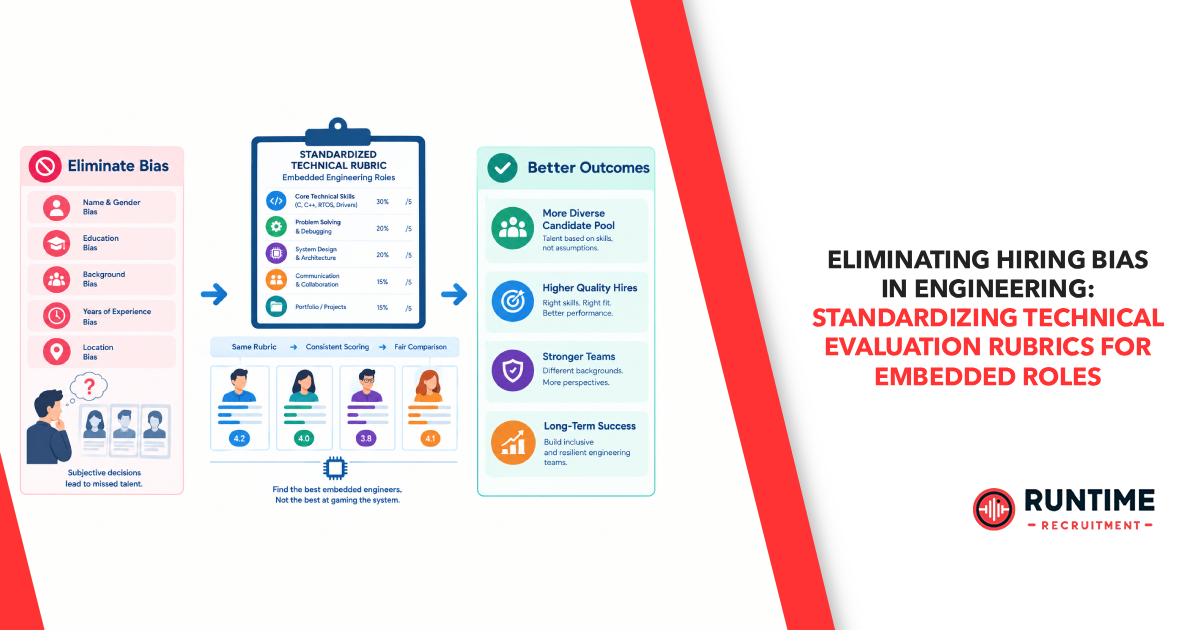
To build world-class embedded teams, engineering leadership must move away from arbitrary evaluation metrics and embrace standardized technical rubrics. By replacing subjective impressions with objective, competency-based evaluation frameworks, organizations can eliminate bias, improve retention, and identify engineers who possess the deep systems-level thinking required to master constrained hardware.
The Unique Challenges of Embedded Engineering Interviews
Evaluating an embedded software engineer is fundamentally different from interviewing a web or mobile developer. Traditional software engineering interview pipelines often prioritize rapid algorithmic puzzle-solving, dynamic web framework familiarity, and whiteboarding sorting algorithms that are rarely written from scratch in professional practice.
Embedded systems, however, exist at the messy, unforgiving intersection of hardware and software. An exceptional embedded engineer must juggle competing physical constraints that do not exist in the cloud or browser:
Strict Resource Constraints: Limited flash memory, RAM limits measured in kilobytes rather than gigabytes, and strict power budgets.
Real-Time Determinism: Meeting hard and soft deadlines where missing a microsecond-level window causes system failure.
Low-Level Hardware Interaction: Direct manipulation of memory-mapped registers, configuration of peripheral clocks, understanding bus protocols (I2C, SPI, CAN, UART), and interpreting complex semiconductor datasheets.
Concurrency and Asynchronicity: Managing interrupt contexts, context switching overhead, priority inversion, and atomic operations without modern garbage collection safety nets.
Because embedded domains are so specialized, interviewers often make the mistake of testing candidate recall on specific toolchains or proprietary vendor SDKs rather than evaluating foundational competence. If a hiring manager spent the last five years working exclusively with STM32 microcontrollers and FreeRTOS, they may unconsciously penalize a brilliant candidate whose primary experience is with NXP chips and Zephyr RTOS, even though the underlying principles of concurrency, register configuration, and memory management are identical. This is where bias creeps in disguised as "domain familiarity."
Common Pitfalls and Unconscious Biases in Technical Screens
Unstructured interviews are breeding grounds for cognitive bias. When an engineering panel lacks a standardized rubric, evaluation devolves into a subjective exercise influenced by psychological shortcuts.
1. The "Like Me" Bias and Pedigree Worship
Engineering managers frequently favor candidates who mirror their own career paths. An interviewer with a degree from a top-tier university who cut their teeth writing bare-metal C in the defense sector may unconsciously favor candidates with identical backgrounds. This bias marginalizes self-taught engineers, bootcamp graduates with strong portfolio projects, non-traditional career switchers, and engineers from underrepresented demographic backgrounds. Pedigree tells you where someone sat, not what they actually built or how they solve hard concurrency bugs.
2. Communication Penalties vs. Technical Competence
Embedded engineering attracts a wide spectrum of personality types, many of whom are deeply analytical introverts. In an unstructured interview setting, extroverted candidates who excel at charismatic self-promotion often score higher than introverted engineers who communicate deliberately and thoughtfully. Furthermore, international engineers or those working in a second language may struggle with rapid-fire verbal articulation under pressure, even if their written code and architectural instincts are world-class.
3. The Trivia Trap
Asking trivia questions—such as reciting the exact nuances of the volatile keyword or explaining obscure preprocessor macro tricks—does not measure an engineer's ability to architect a reliable system. It measures memorization. Candidates who have recently crammed for interviews perform well, while experienced engineers who routinely look up reference manuals or datasheets are penalized for not knowing syntax by heart.
Anatomy of a Standardized Evaluation Rubric for Embedded Roles
Eliminating bias requires replacing unstructured conversation with a structured, multi-dimensional evaluation rubric. A robust rubric breaks down embedded engineering competency into discrete, observable domains, assigning clear behavioral anchors for every scoring tier (typically on a scale of 1 to 4).
Here is how engineering organizations can structure their technical evaluation rubrics across four core domains:
Domain 1: Low-Level Proficiency & Hardware Understanding
This domain assesses how well the candidate bridges the gap between software instructions and physical silicon.
Score 1 (Novice): Relies entirely on high-level HAL (Hardware Abstraction Layer) libraries without understanding underlying register structures. Cannot explain memory-mapped I/O.
Score 2 (Competent): Understands how to configure peripherals using datasheets and reference manuals. Grasps basic pointer arithmetic and memory layout (text, data, bss, heap, stack).
Score 3 (Proficient): Deeply understands linker scripts, memory alignment, endianness, and vector tables. Can write clean, low-level drivers directly interacting with control registers.
Score 4 (Expert): Demonstrates master-level insight into hardware-software trade-offs, custom memory protection unit (MPU) configurations, cache coherency, and direct memory access (DMA) controller orchestration.
Domain 2: Concurrency, Safety, and Determinism
Embedded systems operate in concurrent, interrupt-driven environments. This domain evaluates how candidates handle shared state and timing constraints.
Score 1 (Novice): Unaware of race conditions in interrupt service routines (ISRs). Uses global variables haphazardly across contexts without protection.
Score 2 (Competent): Identifies race conditions and applies basic synchronization primitives (mutexes, semaphores, critical sections) with guidance.
Score 3 (Proficient): Proactively designs lock-free data structures or correctly applies RTOS primitives, cognizant of priority inversion risks and deadlocks.
Score 4 (Expert): Designs highly deterministic, fault-tolerant execution pipelines. Expertly analyzes stack usage, prevents priority inversion using priority inheritance, and implements robust watchdog strategies.
Domain 3: Debugging Methodology & Toolchain Fluency
An embedded engineer spends more time debugging than writing net-new code. Evaluating debugging methodology is critical.
Score 1 (Novice): Relies solely on printf debugging. Panics when faced with a hard fault or watchdog reset.
Score 2 (Competent): Uses hardware debuggers (GDB, OpenOCD) effectively. Can set breakpoints, inspect registers, and trace call stacks during a fault.
Score 3 (Proficient): Methodically uses oscilloscopes, logic analyzers, and protocol decoders (SPI/I2C/CAN) to verify timing and signal integrity alongside software debug output.
Score 4 (Expert): Master of post-mortem analysis. Capable of interpreting core dumps, analyzing memory corruption anomalies, utilizing static analysis tools (MISRA-C, lint), and tracking down intermittent hardware-induced timing glitches.
Domain 4: Architecture, Scalability, and Trade-Off Decisions
Engineering is the art of compromise. This domain measures how candidates balance conflicting constraints like power consumption, cost, and maintainability.
Score 1 (Novice): Proposes overly complex solutions without considering hardware limitations or power budgets.
Score 2 (Competent): Understands standard design patterns for embedded systems (state machines, event-driven loops) and acknowledges hardware limitations.
Score 3 (Proficient): Articulates clear architectural trade-offs between bare-metal execution and RTOS/embedded Linux adoption based on latency and throughput requirements.
Score 4 (Expert): Designs modular, testable, and hardware-agnostic architectures. Implements effective abstraction layers that insulate business logic from underlying chip-vendor dependencies, easing long-term maintenance.
Designing a Bias-Resistant Interview Pipeline
Implementing a standardized rubric is only half the battle; the hiring pipeline itself must be designed to minimize human bias at every stage.
1. Blind Resume Screening and Project-Centric Evaluation
Resume bias occurs when recruiters and hiring managers make snap judgments based on candidate names, gender indicators, university names, or previous employer prestige. Transitioning to a blind initial review process—where personal identifiers are masked—focuses evaluators strictly on tangible technical contributions. In embedded engineering, a candidate's GitHub repository featuring a custom bare-metal bootloader, an open-source Zephyr driver, or an oscilloscope-verified CAN bus sniffer speaks far louder than corporate brand names on a CV.
2. Calibrated Panel Training
Every interviewer on the hiring panel must be thoroughly trained on how to use the evaluation rubric. Interviewers should be calibrated using historical candidate profiles to ensure that all team members interpret scoring anchors identically. Furthermore, interviewers should be instructed to document specific behavioral evidence rather than vague impressions (e.g., writing "Candidate correctly identified a race condition in the ring buffer pointer update and proposed a thread-safe atomic swap" instead of "Candidate seemed smart").
3. Asynchronous Code Reviews over Live Coding Under Duress
Live coding on a whiteboard or a shared screen while an interviewer silently watches is notoriously stressful and heavily favors candidates who perform well under performance anxiety. For embedded roles, asynchronous take-home assignments or code review exercises simulate actual day-to-day engineering tasks far more accurately. Providing a deliberately flawed firmware snippet containing a subtle pointer corruption or priority inversion bug and asking the candidate to review and refactor it provides rich insight into their code comprehension and attention to safety-critical standards.
The Measurable ROI of Standardization
Organizations that transition to standardized technical evaluation rubrics quickly realize profound organizational benefits:
Higher Quality of Hire: By focusing strictly on validated engineering competencies, teams experience fewer mis-hires and significantly lower turnover rates.
Enhanced Diversity and Inclusion: Objective rubrics strip away pedigree worship and demographic proxies, widening the talent funnel to include high-potential engineers from diverse educational and professional backgrounds.
Reduced Time-to-Hire: Structured interviews eliminate circular debates during debrief meetings. When every interviewer scores against the exact same rubric, hiring decisions are reached faster and with greater consensus.
Stronger Employer Branding: Candidates appreciate structured, transparent, and respectful interview processes that test their actual craft rather than subjecting them to arbitrary trivia tests.
Conclusion
Embedded systems engineering is an exacting discipline that demands precision, methodical problem-solving, and deep technical mastery. It is time for engineering recruitment and hiring pipelines to reflect those exact same standards.
By eliminating unstructured interviews, abandoning trivia traps, and implementing rigorous, competency-based technical rubrics, engineering leaders can remove bias from their hiring processes. More importantly, they can build resilient, diverse, and exceptionally skilled engineering teams capable of building the next generation of safe, reliable, and high-performance embedded technologies.
Looking to scale your engineering team with top-tier embedded talent? Connect with RunTime Recruitment today to streamline your hiring process and secure elite firmware and hardware professionals.