
Death of the Take-Home Coding Test: How Copilot and ChatGPT Changed Embedded Vetting Forever
8 July 2026 · Lance Harvie
The traditional technical hiring pipeline for embedded systems engineers is broken. For over a decade, the take-home coding assignment stood as the gatekeeper of technical competence. Engineering managers would hand out a specification: perhaps implementing a ring buffer, configuring a UART driver state machine, or writing a bare-metal task scheduler, and grant candidates a weekend to prove their worth.
Then came November 2022. With the commercial explosion of Large Language Models (LLMs) like ChatGPT, followed closely by the deep integration of GitHub Copilot into modern IDEs, the ground shifted permanently. Today, any mid-level developer armed with a well-engineered prompt can solve a standard 4-hour C/C++ take-home test in less than 90 seconds.
For hiring managers, this reality introduces an existential crisis: How do you vet an engineer's true capability when their digital assistant can instantly generate flawless, optimized, and commented firmware code? The era of evaluating an embedded engineer by their ability to write boilerplate driver code in isolation is officially dead. This article explores why the take-home coding test collapsed, how Generative AI exploits traditional testing models, and how forward-thinking engineering firms must adapt to vet talent effectively in an AI-saturated world.
The Fatal Flaw of Traditional Embedded Take-Home Tests
To understand why AI killed the take-home test, we must first examine what these tests actually measured. Historically, take-home assignments were designed to evaluate:
Syntactic fluency in C or C++.
Familiarity with standard micro-architectural patterns (interrupt handling, register-level configuration, bitwise manipulation).
Adherence to coding standards (MISRA C compliance, modularity).
Basic debugging and structuring logic.
While these skills remain critical, traditional take-home tests evaluated them through silos of isolation. A candidate sat alone in their room, interacting purely with a compiler and a written prompt.
Enter the Prompt Engineer
When generative AI models are fed these isolated specifications, they do not just perform adequately; they outperform the average human candidate in terms of speed and structural consistency. Consider a classic embedded hiring prompt:
"Write a thread-safe circular buffer (FIFO) in C for a Cortex-M4 microcontroller. Implement initialization, enqueue, and dequeue functions. Ensure proper handling of overflow conditions and interrupt safety using critical sections."
To a modern LLM, this is trivial. The model has ingested thousands of variations of circular buffers from open-source repositories. It understands the ARM Cortex-M4's __disable_irq() and __enable_irq() intrinsic commands. Within seconds, it outputs perfectly modular, self-documenting code complete with Doxygen comments.
Because traditional take-home tests evaluate the artifact (the final code file) rather than the process (how the architectural trade-offs were weighed), they have effectively become a test of who has the best AI workflow, not who is the best embedded systems architect.
How AI Exploits the Metrics of Static Code Evaluation
Many recruitment pipelines utilize automated grading scripts or static analysis tools to review candidate submissions. Generative AI tools are uniquely optimized to beat these exact evaluation metrics.
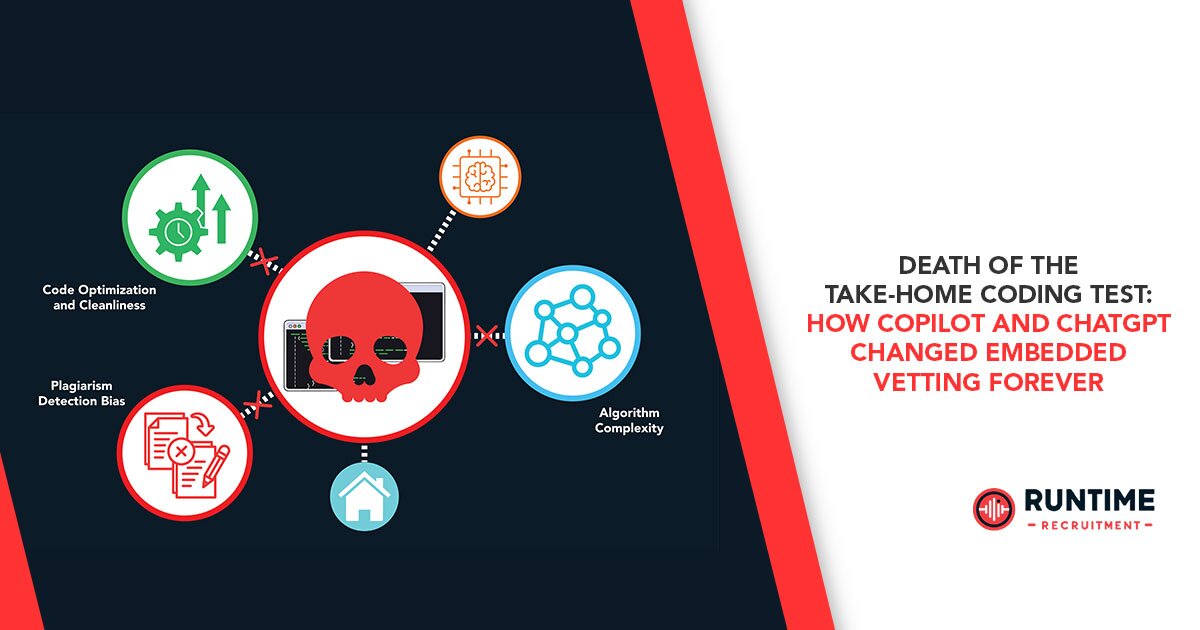
1. Code Optimization and Cleanliness
Human engineers under time pressure make minor formatting errors, skip comments, or write suboptimal loops. AI does not. LLMs can be explicitly instructed to write code that adheres strictly to specific guidelines:
"Rewrite this C code to comply perfectly with MISRA C:2012 guidelines, optimize for minimal RAM footprint, and generate comprehensive unit tests using the Unity framework."
The resulting code looks immaculate. To an unsuspecting engineering manager, the submission appears to come from a meticulously thorough, senior-level systems engineer. In reality, it was generated via a single API call.
2. Algorithmic Complexity (Time & Space)
Embedded systems demand an acute awareness of resource constraints. If a take-home test asks a candidate to optimize a digital filtering algorithm (e.g., an FIR or IIR filter) for speed, an LLM can instantly apply loop unrolling, SIMD intrinsics, or fixed-point math conversions that would take a human hours of manual calculation to verify.
3. Plagiarism Detection Bypass
In the past, recruiters used tools like MOSS (Measure of Software Similarity) to detect if candidates copied code from GitHub. LLMs render these tools useless. Because LLMs generate text probabilistically, a candidate can simply ask Copilot to "variable-rename, re-factor, and structurally vary this implementation so it is completely unique," easily bypassing signature-based plagiarism checkers.
The Collateral Damage: Why Good Candidates Hate Take-Home Tests
The collapse of the take-home test is not solely driven by AI cheating; it is also accelerated by a cultural shift among top-tier talent.
High-performing embedded engineers—especially those with deep expertise in complex domains like Real-Time Operating Systems (RTOS), FPGA integration, high-frequency power electronics, and Edge AI—are in incredibly high demand. When a company demands that a senior candidate spend 6 to 10 hours of their personal time writing uncompensated code for a basic vetting stage, the best candidates simply drop out of the pipeline.
Candidate Receives Test ──> Evaluates Time Commitment (6-10 hrs) ──> Drops Out
│
Best Talent Avoids Friction ◄──────┘
Knowing that other candidates are likely utilizing AI to pad their submissions creates an environment of cynicism. Honest candidates feel penalized for writing code from scratch, while dishonest candidates are rewarded for managing an LLM effectively. This asymmetry degrades the employer brand and pollutes the talent pool.
Beyond the Syntax: Shifting from "Code Writers" to "Systems Thinkers"
If writing code is no longer a differentiator, what is?
In modern product development, the value of an embedded engineer has shifted up the abstraction layer. Writing lines of C code is increasingly a commoditized task. The true value of a premium engineer lies in systems architecture, debugging under constraint, hardware-software co-design, and defensive engineering.
To build a resilient hiring process, engineering managers must transition from testing syntax production to testing holistic problem-solving.
Code Competency
Old Method: Writing an isolated peripheral driver from scratch.
New Method: of an AI-generated driver containing intentional architectural flaws.
System Architecture
Old Method: Submitting a static diagram of an application layer.
New Method: Real-time whiteboarding of data flow, race conditions, and memory mapping.
Hardware Familiarity
Old Method: Answering textbook questions about DMA or SPI.
New Method: Live debugging scenario using a logic analyzer capture or telemetry logs.
Framework for a Modern Embedded Vetting Pipeline
To successfully identify elite embedded talent in the age of ChatGPT and Copilot, hiring teams must redesign their technical interviews around three core pillars.
Phase 1: The Interactive Collaborative Code Review (The "Reverse" Test)
Instead of asking a candidate to write code, provide them with a pre-written, highly complex code snippet generated by an LLM. This snippet should look clean at first glance but contain deep, structural embedded vulnerabilities, such as:
Priority inversion bugs within an RTOS environment.
Missing volatile qualifiers on registers modified within an Interrupt Service Routine (ISR).
Race conditions in a multi-threaded shared-memory architecture.
Hidden memory leaks in an environment lacking a memory management unit (MMU).
Ask the candidate to share their screen and review the code live. A candidate who relies on AI for basic syntax will struggle to spot the nuanced behavioral bugs that static compilers miss. A true systems engineer will immediately point out the hardware-level implications of the flawed code.
Phase 2: Live Debugging and Oscilloscope/Logic Analyzer Analysis
Embedded engineering cannot be divorced from physical hardware. A software engineer writes code that executes in a virtualized sandbox; an embedded engineer writes code that interacts with physics.
During a live technical interview, present the candidate with a simulated or real-world problem:
"Our firmware is dropping packets over the I2C bus whenever the brushless DC motor ramps up to full speed. Here is the logic analyzer capture of the SDA and SCL lines, and here is the schematic of the pull-up resistors. Walk us through your diagnostic checklist."
An LLM cannot look at an erratic oscilloscope trace, factor in electromagnetic interference (EMI), analyze PCB layout constraints, and deduce that parasitic capacitance is ruining the signal integrity. This requires experiential engineering intuition—the exact quality that makes an engineer valuable.
Phase 3: The Edge AI and System Resource Crucible
As intelligence moves to the edge, engineers must design firmware that balances strict thermal and power envelopes. Challenge your candidates to architect a system under severe real-world constraints:
How do you structure an execution pipeline when your machine learning model causes thermal throttling?
How do you optimize an application to comply with the European Cyber Resilience Act (CRA) while constrained to a ultra-low-power micro with only 256KB of flash?
These systemic design problems require a balance of regulatory awareness, security practices, and hardware limitations that cannot be copied and pasted into a prompt.
Conclusion: Adapting to the New Frontier of Embedded Talent Acquisition
The death of the take-home coding test should not be viewed as a loss. Rather, it is an evolutionary leap forward. By stripping away the reliance on administrative, boilerplate coding assignments, companies are forced to engage with candidates on what truly matters: deep technical intellect, architectural curiosity, and real-world execution.
The organizations that continue to rely on automated, asynchronous coding tests will find themselves hiring candidates who are excellent at manipulating AI tools but completely lost when an undocumented hardware bug locks up the system bus on production silicon. Conversely, companies that embrace interactive, system-level vetting will build elite hardware teams capable of navigating the complex future of connected devices.
Partner with the Experts in Technical Engineering Talent
Navigating this paradigm shift requires more than just updated interview questions; it requires a fundamentally different approach to sourcing, screening, and validating technical expertise.
At RunTime Recruitment, we specialize exclusively in matching world-class embedded systems, firmware, and electronic design engineers with forward-thinking technical companies. We understand the nuances of modern engineering vetting because we live in the industry every day. We help firms bypass the noise of AI-padded resumes to uncover the genuine systems architects your projects need to succeed.
Let's Future-Proof Your Engineering Team
Are you ready to transform your engineering hiring pipeline and connect with elite talent who thrive under real-world constraints?
Connect with RunTime Recruitment today to consult with our specialized engineering recruiters and discover how we can streamline your technical sourcing strategy.