
The Dirty Data Dilemma: Filtering Sensor Noise Before It Poisons On-Device Adaptation
13 July 2026 · Lance Harvie
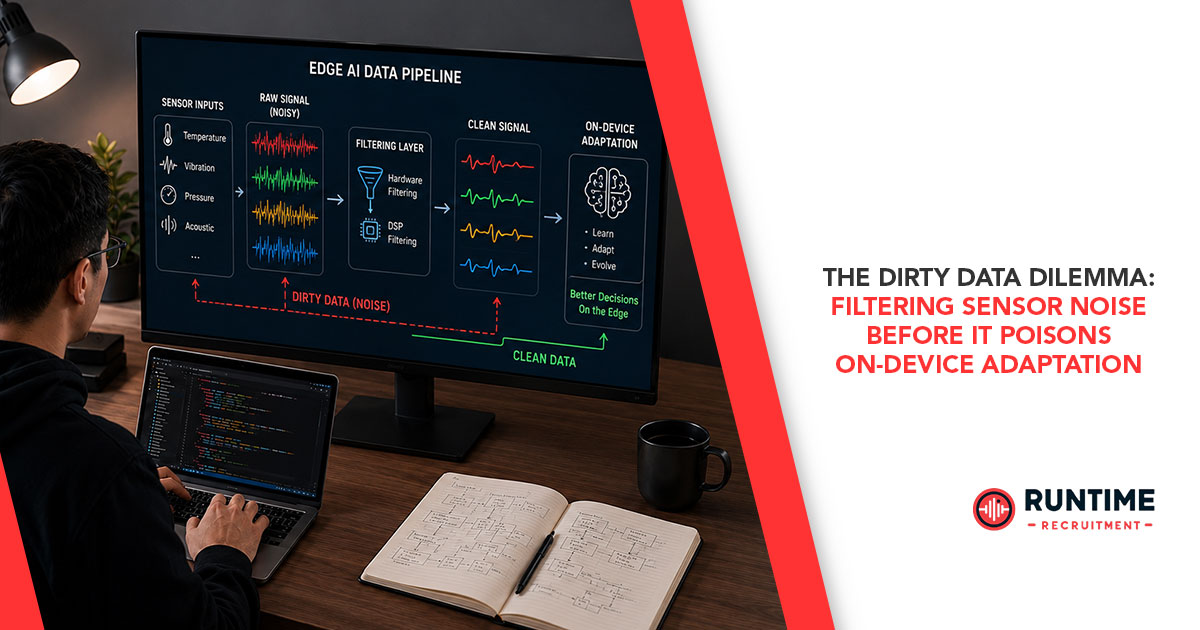
The promise of Edge AI is no longer simply about running static, pre-trained machine learning models on resource-constrained devices. The technological frontier has shifted drastically toward on-device adaptation: embedded systems that actively learn, calibrate, and evolve based on their deployment environments without requiring a costly round-trip to the cloud. From predictive maintenance sensors strapped to heavy industrial machinery to autonomous navigational modules, the ability to adapt natively at the edge is a revolutionary leap.
However, this autonomy introduces a critical vulnerability: the dirty data dilemma. When an embedded system learns continuously from its environment, it is entirely at the mercy of the sensors feeding it. If those hardware sensors capture electrical noise, environmental glitches, or transient errors, the on-device model is not merely making a bad prediction; it is actively internalizing bad behavior. Filtering sensor noise before it poisons these adaptive models is arguably the most pressing challenge in modern embedded engineering, standing at the intersection of hardware design, digital signal processing, and machine learning.
The Anatomy of Sensor Noise at the Edge
To effectively solve this dilemma, embedded engineers must first dissect the diverse types of noise that plague edge systems. In the pristine, highly controlled environments of cloud-based AI training, datasets are meticulously scrubbed, normalized, and validated by data scientists. At the harsh edge, reality is messy. The physical world is inherently chaotic, and the hardware required to bridge the analog physical world with the digital realm introduces its own unavoidable artifacts.
Thermal Noise (Johnson-Nyquist Noise): This is an ever-present reality caused by the thermal agitation of electrons inside electrical conductors. As edge devices operate—particularly those integrating high-frequency power semiconductors and high-density power modules—temperatures fluctuate wildly. This thermal drift directly impacts sensor baselines and introduces a steady hiss of electrical variance.
Electromagnetic Interference (EMI): In robust industrial settings, an embedded microcontroller might be deployed mere inches away from a massive three-phase motor or a high-frequency switching power supply. The resulting EMI can induce sharp voltage spikes on analog signal lines, masquerading to the processor as legitimate transient events.
Quantization Noise: This occurs during the Analog-to-Digital Conversion (ADC) process. When mapping a continuous, infinitely variable analog voltage to a discrete digital value, the resolution of the ADC inherently introduces rounding errors. In edge systems that rely on low-power, lower-resolution ADCs to strictly conserve battery life, this quantization noise becomes a highly significant portion of the overall signal floor.
Mechanical and Microphonic Artifacts: Vibrations and sudden physical shock can cause microphonic effects in certain types of hardware, such as MEMS accelerometers and piezoelectric devices. A sudden physical jolt to an industrial chassis might register as a catastrophic operational anomaly to an untrained algorithm, rather than a benign, temporary environmental artifact.
The Threat to Continuous Learning
Why is this noise so exceptionally dangerous specifically to on-device adaptation? Traditional, static Edge AI models certainly suffer from noise, but their failure mode is transient. A noisy temperature reading might trigger a false alarm or a momentary misclassification, but the underlying machine learning model itself remains fundamentally intact. Tomorrow, when the noise subsides, the model will effortlessly return to making accurate predictions.
On-device adaptation, however, fundamentally alters the neural network's internal weights or the algorithmic parameters based strictly on incoming data. It relies on advanced techniques like federated learning, transfer learning, or continual learning algorithms operating directly on the local silicon. When dirty, unfiltered data enters this learning pipeline, the system undergoes what is effectively negative training.
If an adaptive algorithm processes an EMI-induced voltage spike as a genuine, permanent environmental change, it will incorrectly adjust its baseline. Over time, continuous exposure to unfiltered thermal drift or mechanical vibration leads to a devastating phenomenon known as catastrophic forgetting. The adaptive model gradually unlearns its highly accurate, base-case training to accommodate the persistent, chaotic noise of its current environment. It slowly drifts into obsolescence, making critical decisions based on a distorted version of reality.
The end result is an embedded system that confidently and repeatedly makes the wrong decisions. In critical applications, this jeopardizes operational safety, system efficiency, and increasingly, regulatory compliance under frameworks like the Cyber Resilience Act (CRA), which mandates strict operational reliability for connected devices.
Hardware-Level Mitigation: The First Line of Defense
The most efficient and mathematically sound way to handle physical noise is to prevent it from ever reaching the digital domain. Hardware-level filtering is paramount, especially when rigid power constraints dictate that processor cycles cannot be wasted on heavy mathematical filtering algorithms.
Passive Analog Filtering
Analog low-pass filters constructed from passive components (resistors and capacitors) must be positioned as close to the sensor output as physically possible. These filters actively reject high-frequency EMI and prevent aliasing artifacts before they ever reach the ADC pins. Proper PCB layout techniques are non-negotiable fundamentals here. Engineers must isolate analog and digital ground planes, utilize differential signaling for long trace runs, and employ strategic decoupling capacitors near all active components to ensure a clean power supply.
Architectural Trade-offs: FPGA vs. MCU
When evaluating overall system architecture for exceptionally noisy environments, the debate between Field Programmable Gate Arrays (FPGAs) and Microcontroller Units (MCUs) becomes a critical design choice.
For extremely noisy, high-frequency environments, an FPGA offers distinct and powerful advantages. Its hardware-level parallelism allows it to ingest, buffer, and filter massive amounts of sensor data concurrently with near-zero latency. FPGAs can implement highly complex hardware filters without consuming a single software instruction cycle, presenting a pristine, pre-filtered data stream to a secondary MCU or an Edge AI accelerator that handles the actual adaptive learning.
Conversely, modern MCUs are highly competitive, featuring dedicated hardware Digital Signal Processing (DSP) instructions and tightly coupled memory arrays that drastically accelerate filtering operations. Choosing the right silicon architecture requires a careful, heavily calculated balancing act between the severity of the environmental noise, the strict latency requirements of the AI model, and the uncompromising power budgets of remote edge deployments.
Software-Level Filtering: Algorithms and Efficiency
Despite the absolute best hardware designs, some noise will inevitably breach the digital divide. This is where advanced software-level DSP comes into play. The exact choice of filtering algorithm drastically impacts both the cleanliness of the data and the overall energy consumption of the embedded device.
FIR and IIR Filtering
Finite Impulse Response (FIR) and Infinite Impulse Response (IIR) filters are the standard algorithmic tools. FIR filters offer a linear phase response, meaning they delay all frequencies equally. This characteristic is absolutely crucial for maintaining the precise temporal relationship of sensor data used in complex time-series AI models. However, FIR filters require significant computational overhead and memory allocation.
IIR filters, on the other hand, require exponentially fewer computational resources to achieve a mathematically similar frequency cutoff, making them highly attractive for severely power-constrained MCUs. The primary trade-off is non-linear phase distortion, which can slightly warp the physical shape of the incoming digital signal—a complex variable that the adaptive AI model must be robust enough to withstand.
Kalman Filters and State Estimation
For more sophisticated multi-sensor applications, Kalman filters provide an elegant mathematical solution. A Kalman filter does not merely block specific frequencies; it uses a dynamic mathematical model of the entire system to estimate the true state of the sensor in the presence of Gaussian noise. By continuously comparing predicted states against noisy incoming measurements, the filter optimally smooths the data. The core discrete-time prediction relies on state equations such as xk=Axk−1+Buk+wk, where the algorithm constantly minimizes the estimated error covariance. This approach is particularly vital in complex sensor fusion applications, where the adaptive AI model relies heavily on the perfectly synchronized harmony of accelerometers, gyroscopes, and magnetometers to understand spatial orientation.
The RTOS, Scheduling, and Determinism
In modern, highly complex embedded systems, software filtering does not occur in a vacuum; it is strictly orchestrated by a Real-Time Operating System (RTOS). As sensor data streams rapidly from ADCs via Direct Memory Access (DMA) controllers, the RTOS must carefully and efficiently schedule the DSP filtering tasks.
A poorly configured RTOS implementation can inadvertently introduce an entirely new kind of digital noise: timing jitter. If the critical DSP filtering task is frequently preempted by lower-priority system operations—such as network polling or logging—the data delivered to the adaptive AI model will arrive with highly inconsistent timing. For AI models relying on strict time-series analysis (such as predictive maintenance algorithms analyzing the exact vibration frequencies of industrial bearings), this unpredictable timing jitter can completely destroy the model's predictive accuracy.
Embedded engineers must rigorously utilize advanced RTOS features. Hardware timers, precise DMA interrupts, and carefully prioritized task queues are necessary to ensure absolute deterministic execution. The filtering pipeline must act as a seamless, mathematically invisible layer between the raw silicon hardware and the adaptive machine learning model.
Modern Tooling: Rust, Zig, and Memory Safety
Implementing these complex DSP algorithms safely and efficiently brings us to the rapid evolution of embedded programming languages. While C and C++ have historically dominated the embedded landscape, there is a massive generational shift currently underway. Forward-thinking engineering teams, particularly those driven by younger engineers and project managers, are increasingly championing memory-safe languages like Rust and Zig.
Rust's incredibly strict compiler guarantees actively prevent entire classes of memory leaks, race conditions, and buffer overflows. In the context of on-device adaptation, these vulnerabilities can be physically disastrous if an adaptive model corrupts its own restricted memory space during a heavy filtering operation. Zig offers unparalleled bare-metal performance and seamless, native C integration, allowing engineers to write highly optimized DSP routines that consume an absolute minimum of clock cycles while maintaining total control over memory allocation. For teams aiming to build future-proof, highly resilient edge hardware, adopting these modern languages is becoming less of a trend and more of an operational mandate.
The Carbon Cost of Constrained Coding
Beyond raw processing performance and algorithmic accuracy, there is a broader ethical and practical imperative at play in modern engineering: sustainability. The global technology industry is rapidly waking up to the massive, compounding carbon footprint generated by billions of deployed IoT devices.
Every single CPU cycle spent filtering mathematically dirty data or processing an unnecessary AI inference consumes tangible electrical power. In remote, battery-operated edge devices, inefficient code directly translates to shorter product lifecycles, drastically increased electronic waste (e-waste) from frequently discarded lithium batteries, and a significantly larger cumulative carbon footprint over the lifetime of the deployment.
Filtering sensor noise effectively is not strictly about protecting the integrity of the machine learning model; it is fundamentally about energy-efficient coding. By aggressively utilizing hardware accelerators, deliberately selecting a highly efficient IIR filter over an overly complex FIR algorithm, and writing heavily optimized Rust or Zig code, software engineers can drastically reduce the active duty cycle of the processor.
When optimized correctly, the device spends significantly more time in deep sleep modes, efficiently sipping microamps of power instead of wastefully burning milliamps. The carbon cost of constrained coding is a vital metric that modern project managers are now permanently integrating into their key performance indicators. Hiring for engineering sustainability means purposefully looking for talent who deeply understand that elegant mathematical execution translates directly to environmental responsibility and extended hardware longevity.
Robustness: Distinguishing Anomalies from Noise
A final, highly nuanced challenge in filtering dirty data is the algorithmic ability to distinguish between mere baseline noise and genuine, critical anomalies. On-device adaptation is often deployed specifically to learn about new, unexpected environmental conditions. If a hardware or software filtering algorithm is configured to be too aggressive, it will carelessly scrub away the very anomalies the AI model desperately needs to learn from.
This operational reality requires a massive paradigm shift from static, hard-coded filtering to dynamic, statistical outlier rejection. Instead of relying solely on fixed-frequency cutoffs, advanced edge systems utilize highly lightweight statistical models to actively assess the variance and standard deviation of incoming data streams in real-time.
If a specific data point falls outside a dynamically calculated, rolling confidence interval, it is flagged by the system. The processor can then make an intelligent, contextual decision: Is this a transient, meaningless EMI noise spike to be instantly discarded, or is it a sustained, legitimate shift in the physical environment that the adaptation algorithm needs to incorporate into its neural weights? Balancing this delicate sensitivity requires deep, ongoing collaboration between hardware DSP engineers and software machine learning specialists.
Conclusion
The dirty data dilemma represents one of the most formidable and complex technical hurdles in realizing the absolute full potential of Edge AI. As the industry rapidly pushes the physical boundaries of what microcontrollers and edge processors can achieve autonomously, the integrity of the data pipeline becomes the ultimate system bottleneck. On-device adaptation is an incredibly powerful tool, allowing embedded systems to evolve, calibrate, and optimize in the wild without human intervention.
However, without incredibly rigorous hardware design, highly optimized and mathematically sound DSP algorithms, modern memory-safe coding practices, and fiercely deterministic RTOS scheduling, this adaptation will inevitably be poisoned by the chaotic, unpredictable noise of the physical world. The embedded engineers who deeply master the complex art of physical data purification are the ones who will successfully bridge the widening gap between artificial intelligence and physical reality.
Is your team ready to conquer the dirty data dilemma? Building the next generation of resilient, adaptive edge devices requires top-tier talent who understand the complex intersection of hardware constraints, modern languages, and Edge AI.
Connect with RunTime Recruitment today to find the highly specialized embedded engineers and forward-thinking technical leaders who can future-proof your next major hardware project.