
The CTO’s Dilemma: Buy, Build, or Rent Embedded System Competencies?
13 October 2026 · Lance Harvie
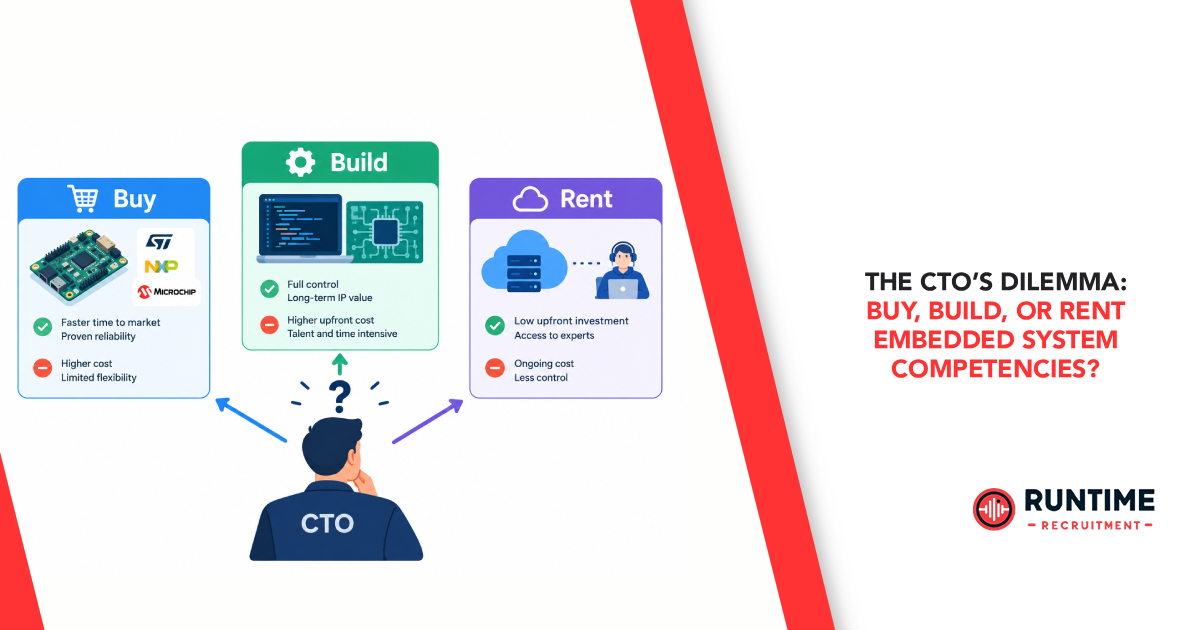
The role of the Chief Technology Officer in hardware-adjacent tech companies has fundamentally shifted. Not long ago, leading an embedded systems team meant balancing board layouts, managing microcontrollers (MCUs), and writing firmware in C to interface with custom peripherals. Product lifecycles were measured in years, and the tech stack evolved at a predictable pace.
That world no longer exists.
Modern embedded systems are sprawling, software-defined platforms. Today’s embedded engineering leaders are under pressure to deploy Edge AI models onto power-constrained silicon, build zero-trust security chains to satisfy strict mandates like the EU’s Cyber Resilience Act (CRA), and manage over-the-air (OTA) updates for long-lived device fleets.
When market demands outpace internal capabilities, CTOs face a critical resource allocation question: How do we acquire the specialized embedded competencies required to ship on time without blowing up the engineering budget or taking on crushing technical debt?
The decision comes down to three strategic levers: Build (hire and train internal talent), Buy (acquire COTS software/hardware or off-the-shelf IP), or Rent (engage specialized contractors, design houses, or staff augmentation partners). Choosing the wrong path can lead to delayed product launches, bloated payrolls, or brittle codebases that burn through capital.
The New Embedded Competency Matrix
Before making a strategic resource decision, an engineering leadership team must audit the modern embedded stack. The skills required to ship a viable product have bifurcated into Core Differentiators and Baseline Infrastructure.

Core Domain Logic: Proprietary algorithms, IP-protected trade secrets, and unique customer-facing features. This is why customers buy your product.
Advanced Frontier Capabilities: On-device neural network optimization (TinyML), custom DSP pipeline development, or high-density wireless protocol design. High value, but requires hyper-specialized engineering.
Commodity Baseline Infrastructure: Hardware Abstraction Layers (HALs), file systems, basic RTOS kernels, and peripheral drivers. High necessity, low competitive differentiation.
Niche & Compliance Capabilities: Secure Boot, Hardware Root of Trust (HRoT), cryptographic key management, and regulatory compliance (e.g., IEC 62304, ISO 26262, CRA). Complex and high-risk, but non-differentiating.
With this matrix established, let’s analyze the tradeoffs of the Build, Buy, and Rent strategies.
Path 1: BUILD — In-House Talent Development
Building internal competencies means recruiting full-time embedded software, hardware, and systems engineers to develop and maintain capabilities in-house.
The Argument for “Build”
Ownership and retention of institutional knowledge are the primary advantages of building in-house teams. When your team develops the firmware architecture from the ground up, they understand every edge case, timing hazard, and register setting.
Long-Term Strategic Agility: If a core capability represents your primary intellectual property (e.g., a custom motor control algorithm for a medical pump), keeping it strictly in-house protects your competitive moat.
Deep Domain Integration: Internal staff understand your full product ecosystem, customer pain points, and company culture better than external contractors.
Rent a RecruiterNo Vendor Lock-In: You own the codebase, the build scripts, the CI/CD pipelines, and the test benches.
The Hidden Pitfalls of “Build”
Building is often the default choice for engineering leaders, but it carries hidden costs and risks:
The Recruitment Trap: Sourcing senior embedded engineers — especially those fluent in Rust, modern embedded Linux, or secure silicon provisioning — is difficult and time-consuming. Average time-to-hire for specialized embedded roles routinely exceeds 50 days, stalling product roadmaps.
Fixed Overhead and Misalignment: Full-time headcount represents a permanent, fixed operating cost. If you hire a team of RF specialists to design a custom antenna array for a V1 product, what do those engineers do during V2, when the primary focus shifts to cloud-side connectivity or application logic?
“Not Invented Here” (NIH) Syndrome: Embedded teams are notoriously prone to reinventing the wheel. Re-writing a custom bootloader or logging library instead of leveraging mature open-source or commercial alternatives wastes valuable engineering cycles.
When to BUILD: Choose this path strictly for competencies that sit in Box 1 (Core Domain Logic) — the direct drivers of your company’s market value and competitive advantage.
Path 2: BUY — Commercial Off-The-Shelf (COTS) and IP Licensing
Buying involves acquiring commercial software stacks, third-party intellectual property (IP) blocks, or turn-key hardware modules (e.g., System-on-Modules or SOMs) to eliminate ground-up development.
The Argument for “Buy”
Time-to-market is the ultimate metric for modern CTOs. Buying allows you to trade capital for time, bypassing years of R&D.
Dramatically Compressed Timelines: Integrating a pre-certified, commercially supported RTOS or a third-party protocol stack (like a BLE or industrial Ethernet stack) takes weeks, compared to years for an in-house build.
Risk Transfer: Commercial vendors take on the burden of maintaining, testing, and bug-fixing complex baseline software. If a vulnerability is found in a commercial networking stack, the vendor is responsible for providing a patch.
Predictable Upfront Costs: Licensing fees and royalties are explicit, making budgeting more straightforward than estimating the hours required for a ground-up internal build.
The Hidden Pitfalls of “Buy”
“Buying” is rarely a simple plug-and-play solution in the embedded world:
Integration Debt: Off-the-shelf software rarely fits your system architecture perfectly. Engineers often spend months writing wrapper code, adapting HALs, or debugging subtle interaction bugs between third-party IP and custom hardware.
The “Black Box” Problem: When a system crash occurs deep inside a closed-source third-party binary, your team is at the mercy of the vendor’s support ticketing queue.
Recurring Royalty Costs: Unit royalties that look negligible during prototyping can severely erode gross margins once you scale production into hundreds of thousands of units.
When to BUY: Choose this path for Box 3 (Commodity Baseline Infrastructure). Do not waste internal engineering hours rewriting file systems, basic bootloaders, or standard protocol stacks.
Path 3: RENT — On-Demand Expertise and Staff Augmentation
Renting means partnering with external engineering consultants, design houses, or specialized staff augmentation providers to access niche talent on a flexible basis.
The Argument for “Rent”
The modern embedded landscape changes too quickly for any single internal team to maintain total mastery over every layer of the stack. Renting offers target capability injection without long-term organizational overhead.
Rapid Capability Injection: When a product roadmap suddenly demands compliance with a complex security framework (e.g., establishing a secure chain-of-trust with hardware cryptographic engines), renting an experienced embedded security specialist allows you to execute immediately.
Operational Flexibility: Renting converts fixed payroll costs into variable project expenditures. You can bring in world-class expertise for an intense 6-month development burst and offboard them once the subsystem is integrated and verified.
Knowledge Transfer: High-caliber contractors don’t just write code; they upskill your permanent engineering team, establishing best practices, architectural patterns, and testing frameworks that remain long after the contract ends.
The Hidden Pitfalls of “Rent”
Without active leadership, external engineering engagements can veer off course:
Alignment and Quality Overhead: External teams require clear architectural boundaries, strict acceptance criteria, and active technical management. Poorly managed contracting engagements yield disjointed codebases.
Transitory Knowledge: If external specialists work in isolation without a formal knowledge-transfer mandate, your internal team will struggle to maintain or modify the code once the contract ends.
When to RENT: Choose this path for Box 4 (Niche & Compliance Capabilities) and Box 2 (Advanced Frontier Capabilities) when speed is paramount or internal expertise is lacking. Renting is ideal for high-risk, periodic, or highly specialized engineering tasks.
The Strategic Decision Framework for CTOs
To determine the right execution model for a given capability, evaluate it against four variables:

Strategic Value: Does this capability differentiate your product in the eyes of the end customer?
High Strategic Value → BUILD or RENT-TO-BUILD (rent specialists to establish the architecture while training your internal core).
Low Strategic Value → BUY or RENT.
2. Frequency and Duration: Is this a permanent operational need or a temporary project milestone?
Permanent/Continuous Need → BUILD.
One-off/Periodic Need (e.g., board bring-up, security audit, regulatory certification) → RENT.
3. Market Scarcity: How rare is the skill set in the local talent pool?
Abundant Skills (e.g., standard C/C++ firmware engineers) → BUILD.
Ultra-Scarce Skills (e.g., Edge AI quantization, custom RTOS porting, low-level DSP optimization) → RENT.
4. Time-to-Market Urgency: What is the cost of delaying release by six months?
Low Urgency → BUILD.
High Urgency → BUY (for software/hardware baselines) or RENT (for talent-driven execution).
Real-World Case Studies
Scenario A: The Smart Medical Device Startup
Challenge: A medical tech company needed to build an AI-powered diagnostic wearable. They had world-class algorithms for signal processing (Core IP), but lacked internal expertise in hardware security provisioning and BLE stack optimization required for FDA clearance.
Strategy:
BUILD: Internal core team focused entirely on the proprietary biosensor software and signal-processing pipeline.
BUY: Licensed a pre-certified, commercially supported RTOS with an integrated networking stack.
RENT: Brought in specialized embedded security contractors for a 4-month engagement to architect the secure boot sequence, implement encrypted key storage, and prepare documentation for regulatory submission.
Outcome: The product shipped four months ahead of schedule, with zero fixed overhead added for one-off compliance tasks.
Scenario B: The Industrial IoT OEM
Challenge: An established industrial equipment manufacturer wanted to add predictive maintenance (Edge AI) to its existing machinery line. Their internal engineering team was highly skilled in traditional PLC programming and basic C firmware, but lacked modern machine learning experience.
Strategy:
RENT-TO-BUILD: Rather than spending a year attempting to recruit hard-to-find Edge AI engineers, the CTO brought in an augmented team of senior embedded ML specialists. The contractors built the initial model compression and inference pipeline alongside the internal team, pairing with full-time engineers throughout the project.
Outcome: The OEM deployed its first intelligent fleet within seven months while upskilling its existing staff to maintain and iterate on the models independently.
The Hybrid Reality: Hybrid Competency Sourcing
The decision is rarely an all-or-nothing choice across the entire tech stack. The most successful engineering organizations use a Hybrid Model:
Total System Velocity=Build(Core IP)+Buy(Standard Baselines)+Rent(Niche Expertise)
By restricting your full-time internal engineering headcount strictly to your core competitive differentiators, you preserve culture, agility, and equity. By buying commodity layers and renting specialized talent for complex execution spikes, you keep your team lean, responsive, and focused on building real business value.
The CTO’s goal isn’t to build every line of code under your roof — it’s to architect an agile organization that delivers reliable hardware and software to market faster than the competition.
Accelerate Your Embedded Strategy with RunTime Recruitment
Navigating the build-buy-rent dynamic requires immediate access to specialized engineering talent. RunTime Recruitment connects engineering leaders with vetted, high-caliber embedded systems talent—whether you need permanent hires to build out your core IP or specialized contract specialists to execute critical project milestones.
Need to bridge a critical embedded skills gap on your team? Connect with the engineering recruitment specialists at RunTime Recruitment today.