
Securing the Silicon: Hardware Countermeasures Against Electromagnetic Fault Injection (EMFI) and Side-Channel Attacks
23 October 2026 · Lance Harvie
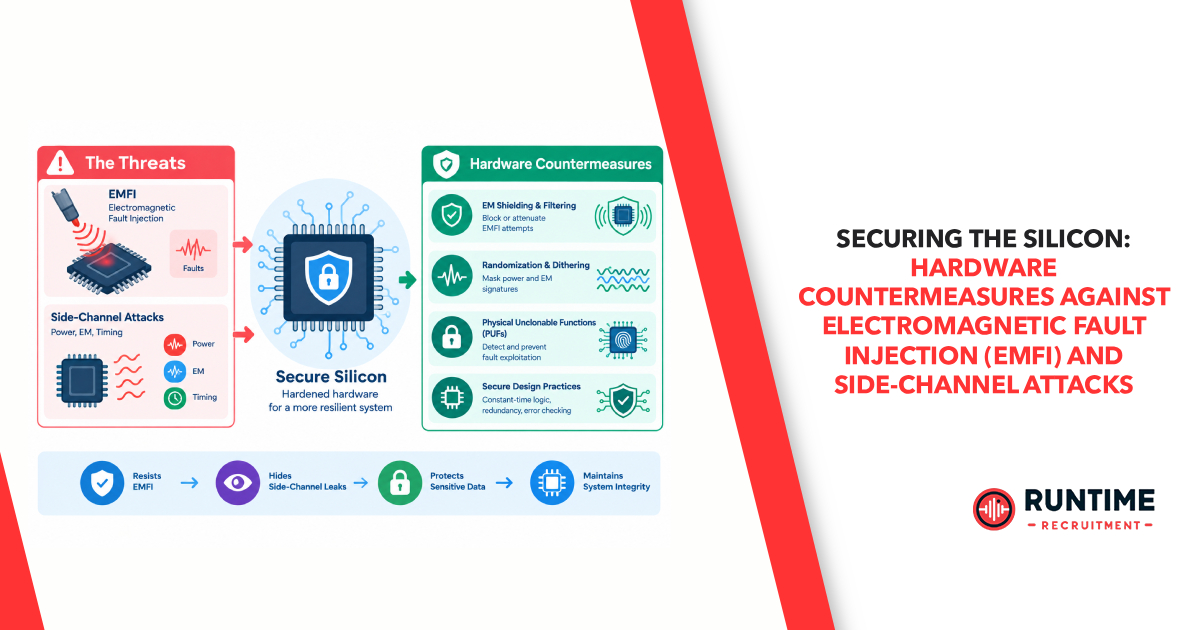
For embedded systems engineers, the perimeter of security has radically shifted. Historically, embedded security meant implementing secure boot chains, hardening firmware against buffer overflows, and applying robust cryptographic algorithms like AES or Elliptic Curve Cryptography (ECC). However, as software-layer defenses mature, sophisticated attackers have shifted their focus downward into the physical domain.
Today, physical hardware attacks — specifically Side-Channel Attacks (SCA) and Electromagnetic Fault Injection (EMFI) — represent some of the most formidable threats to connected devices, industrial IoT, automotive electronic control units (ECUs), and payment terminals. Because these attacks bypass logical code boundaries by exploiting the fundamental laws of physics, embedded engineers can no longer treat silicon as a trusted black box. Designing secure hardware requires an intimate understanding of how microelectronic chips leak information and how they react to external physical disturbances.
1. Deconstructing the Physical Threat Landscape
Before diving into defensive architectures, it is vital to understand the nature of the adversaries we are designing against. Physical attacks generally fall into two broad categories: passive observation and active manipulation.
Side-Channel Attacks (SCA): These are passive, non-invasive techniques where an attacker monitors a device’s physical manifestations during normal operation. This includes analyzing power consumption (Simple and Differential Power Analysis — SPA/DPA) or electromagnetic emanations (Electromagnetic Analysis — EMA). By correlating these physical leakages with cryptographic operations, an attacker can extract secret keys without ever altering the device’s code or behavior.
Electromagnetic Fault Injection (EMFI): In contrast to passive attacks, EMFI is an active, invasive or semi-invasive technique. An attacker uses a specialized micro-coil (injection probe) placed close to the chip package or decapsulated die to discharge a high-current, fast-rising pulse. This transient magnetic field induces localized eddy currents inside the silicon substrate, corrupting data in registers, altering instruction execution flows, or bypassing critical security branches (like a password-verification check).
While power supply or clock glitching requires physical or electrical access to pins, EMFI can often be performed locally through plastic packaging without direct pin contact, making it exceptionally dangerous.
2. Hardware Countermeasures Against Side-Channel Attacks (SCA)
Side-channel leaks occur because switching transistors consume dynamic power and emit localized magnetic fields proportional to the data being processed. To protect cryptographic modules, hardware engineers must decouple the data processed by the chip from its physical footprint.
Masking and Shuffling
At the register-transfer level (RTL), masking is one of the most powerful software-hardware co-design techniques. Masking splits every sensitive intermediate variable into multiple random shares. For instance, a data byte xxx is represented as x1⊕x2⊕⋯⊕xnx_1 \oplus x_2 \oplus \dots \oplus x_nx1⊕x2⊕⋯⊕xn, where each share is processed independently. This breaks the linear correlation between the processed data and the power or electromagnetic trace.
Complementary to masking is shuffling, which randomizes the execution order of independent operations (such as individual rounds in an AES block cipher or independent scalar multiplication steps). By introducing random delay slots and instruction reordering, the time-alignment of power traces is disrupted, rendering classical Differential Power Analysis (DPA) statistically infeasible.
Dual-Rail with Precharge Logic (WDDL)
To defeat fine-grained power and electromagnetic analysis at the gate level, standard CMOS logic is often replaced with specialized secure logic styles, such as Waveform Dynamic Differential Logic (WDDL) or Dual-Rail logic.
Precharge Phase: Every cycle is split into a precharge phase (where all internal nodes are set to a fixed state, usually low) and an evaluation phase (where actual data is computed).
Constant Activity: Regardless of whether a bit changes from 0 to 1 or 1 to 0, the total number of transitions per clock cycle remains constant.
Power Balancing: Because the power consumption and electromagnetic signature are data-independent, the side-channel leakage is heavily suppressed.

3. Defending Against Electromagnetic Fault Injection (EMFI)
Mitigating EMFI requires a multi-layered defense strategy spanning the silicon die, package design, and system architecture. Because EMFI relies on inducing localized electrical currents via transient magnetic fields, hardware countermeasures must focus on detection, absorption, redundancy, and rapid recovery.
Active Shielding and Metal Meshes
One of the most effective physical defenses against both micro-probing and localized EMFI is the implementation of active metal shields. Manufacturers route dense, serpentine meshes of sensitive metal wires across the top and bottom metal layers of the integrated circuit.
These wires carry a continuous, pseudo-random dynamic challenge-response or parity signal.
If an attacker attempts to mill through the package, drill a hole, or position an EM injection probe close to the active silicon surface, they inevitably sever or couple into these mesh lines.
The hardware instantly detects the breach, triggering an immediate hardware reset, zeroizing secure key storage (RAM-based ephemeral keys), or placing the chip into a permanent dead state (“fuse-blown” secure lock).
Integrated Environmental and Glitch Sensors
Embedded microcontrollers designed for high-security environments (such as banking cards, automotive secure elements, and military hardware) feature an array of built-in analog and digital sensors:
Voltage and Clock Glitch Detectors: Fast analog comparators monitor core supply rails (VccV_{cc}Vcc) and clock frequencies. If a sudden drop, spike, or jitter exceeds predefined tolerance windows, an internal reset is asserted.
Localized EM and Light Sensors: Integrated sensor cells detect abnormal electromagnetic transients or photonic emissions (useful against combined laser and EM attacks), ensuring that active environmental disturbances are caught within nanoseconds before instructions commit to architectural state registers.
Redundancy and Concurrent Error Detection (CED)
Even with robust physical shielding, an extremely precise EMFI pulse can occasionally flip a flip-flop or corrupt a register value. To ensure that such faults do not translate into security breaches, embedded architects utilize structural redundancy:
Dual-Modular Redundancy (DMR) & Lockstep Execution: Critical state machines and arithmetic logic units (ALUs) are duplicated. Two identical logic blocks process the same data in parallel, and their outputs are continuously compared via hardware voting logic. If a mismatch occurs due to a localized EM pulse, an immediate exception is raised.
Parity and Error-Correcting Code (ECC) Registers: Critical configuration registers, cryptographic key caches, and memory buses are protected with parity bits or Hamming codes, preventing single-bit or multi-bit upsets from propagating unnoticed through the system pipeline.
4. System-Level Integration and Firmware Co-Design
Hardware countermeasures do not operate in a vacuum. Designing a resilient embedded system requires a symbiotic relationship between silicon features and low-level firmware architecture. An engineer must configure and orchestrate these hardware blocks correctly to prevent bypass scenarios.
Secure Boot and Hardware Root of Trust (RoT)
The system must establish an immutable Hardware Root of Trust (RoT) housed in secure read-only memory (ROM) or one-time programmable (OTP) fuses. When power is applied, the RoT verifies the integrity of the primary bootloader using cryptographic signatures. Hardware countermeasures must protect these verification routines from being bypassed via clock or electromagnetic glitching. For example, conditional branch instructions following a signature check should be protected by hardware-enforced redundant branch checks or execution path tracking.
Trap Handling and Secure Fail-Safe States
When a hardware sensor detects an anomaly — such as an electromagnetic glitch or an active mesh violation — the device must handle the event securely.
Zeroization: Volatile memory blocks containing sensitive cryptographic material or session keys must be immediately wiped (zeroized) using dedicated hardware clear paths.
Controlled Shutdown: The system should enter a locked, unrecoverable error state or execute a controlled power cycle rather than falling back into an insecure degraded mode. In high-security applications, repeated sensor trips can trigger physical self-destruct fuses or permanent software bricking to protect intellectual property.
5. Balancing PPA (Power, Performance, Area) and Verification Challenges
For embedded engineers, implementing these rigorous countermeasures introduces classic engineering trade-offs. Hardening a standard microcontroller against SCA and EMFI typically incurs penalties in:
Silicon Area: Dual-rail logic and redundant lockstep cores can increase die size by 30%30\%30% to over 200%200\%200%, impacting manufacturing costs.
Power Consumption: Constant activity logic styles (like WDDL) eliminate the power-saving benefits of data-dependent CMOS switching, increasing dynamic power consumption.
Performance: Random delay insertion, error-checking pipelines, and secure arithmetic protocols introduce latency cycles.
Furthermore, verifying these countermeasures requires specialized test benches. Engineers must use physical evaluation laboratories equipped with automated EMFI test benches, high-bandwidth digital storage oscilloscopes, near-field magnetic micro-probes, and laser fault injection stations to validate the device’s resilience against real-world attack vectors before tape-out or firmware deployment.
Conclusion
The evolution of hardware security demands that embedded engineers look far beyond traditional software bugs. As side-channel analysis and electromagnetic fault injection tools become more accessible, physical resilience is no longer an optional feature reserved exclusively for banking smart cards. Whether designing automotive electronic control units (ECUs), medical implants, or industrial IoT nodes, understanding and implementing hardware countermeasures — from masking and WDDL to active metal meshes and concurrent error detection — is critical to safeguarding modern embedded infrastructure against physical compromise.
Mitigating EMFI requires a multi-layered defense strategy spanning the silicon die, package design, and system architecture. Because EMFI relies on inducing localized electrical currents via transient magnetic fields, hardware countermeasures must focus on detection, absorption, redundancy, and rapid recovery.
Looking to Build Your Next Secure Embedded Team?
Are you looking to scale your engineering team with top-tier talent specialized in hardware security, firmware, and embedded systems? Connect with RunTime Recruitment today to find the right professionals for your next mission-critical project.