
De-risking Senior Hires: Vetting System Architecture Skills Before Making a Director-Level Offer
9 November 2026 · Lance Harvie
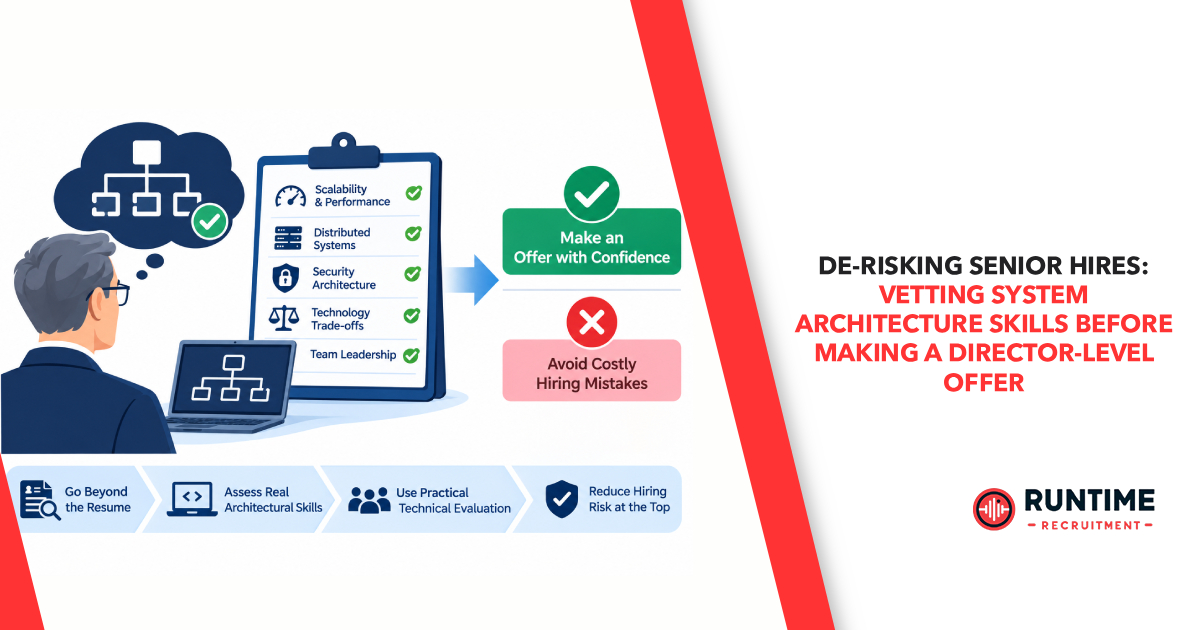
Hiring an executive or director-level leader in embedded systems engineering is one of the highest-stakes decisions a hardware or firmware organization will make. At the senior executive level, a bad hire is exceptionally expensive. Beyond recruiters’ fees and onboarding costs, an ill-fit Director of Embedded Engineering can derail technical roadmaps, select sub-optimal silicon architectures, lock a product into brittle firmware patterns, or trigger critical field failures.
Most traditional hiring panels struggle to evaluate candidates at this level. Executive interviews frequently slide into high-level management talk — focusing on agile processes, team sizing, headcount budgeting, and vendor negotiations. While leadership acumen is essential, a Director of Embedded Engineering must ultimately safeguard the technical integrity of your product platform. If they lack sharp system architecture intuition, they will fail to catch multi-million-dollar technical risks before silicon is spun or firmware design patterns are locked.
To de-risk your next senior hire, your interview process must rigorously vet system architecture capability without forcing a seasoned leader into low-level whiteboard coding contests. Here is how engineering organizations can evaluate real-world architectural leadership before issuing a director-level offer.
1. The High Cost of Architectural Blind Spots at the Director Level
In pure software domains, architectural refactoring is often cheap, managed via continuous integration and rapid over-the-air patches. In embedded systems, software is fundamentally tied to physical hardware constraints, thermal boundaries, timing guarantees, and regulatory safety margins.
When a Director of Engineering suffers from architectural blind spots, the failure modes ripple across the business:
Mismatch Between Silicon and Application Scope: Selecting an oversized application processor running Linux for a project that required a low-cost, ultra-low-power micro-controller (MCU) inflates unit economics. Conversely, under-specifying memory footprint or hardware peripherals forces firmware teams into endless optimization cycles.
Brittle Hardware/Software Boundaries: Lacking insight into custom hardware acceleration versus firmware tasks can lead to thermal spikes, interrupt latency overheads, or excessive power consumption.
Vendor and Supply Chain Lock-In: Failing to mandate modular HAL (Hardware Abstraction Layer) architecture leaves the company vulnerable when key components face extended lead times or reach end-of-life (EOL).
Evaluating architecture skills at the director level is not about verifying whether candidates remember C syntax rules or register map layouts. It is about evaluating their ability to navigate complex hardware/software trade-offs under rigid constraints.
2. Shift from “Coding Syntax” to “Architectural Trade-Off Analysis”
Traditional engineering interviews often fail when scaled up to executive candidates. Asking a prospective Director of Embedded Engineering to implement a linked list on a whiteboard yields zero signal regarding their capacity to architect complex industrial control systems or medical IoT devices.
Instead, structure technical evaluation around trade-off dynamics. System architecture is the art of balancing competing constraints: cost, latency, power, security, compute density, memory footprint, and development velocity.
Key Trade-Off Areas to Probe

3. The Interactive “System Design & Stress Test” Method
To truly vet a candidate’s architecture intuition, move past canned resume walkthroughs and introduce an interactive system architecture session.
Provide the candidate with a high-level system specification 48 hours prior to the interview or present it live during a 90-minute session. Keep the prompt intentionally ambiguous to reflect real-world product development realities.
Sample Scenario Prompt:
“Design the core system architecture for a high-reliability medical gateway device. It must run on battery power during transit, sample multiple analog sensors continuously via SPI/I2C, transmit real-time telemetry over cellular/BLE, store local backup data, and support secure over-the-air (OTA) updates.”
During the discussion, do not simply listen to their initial presentation — stress-test their assumptions:
Inject Hard Constraints Mid-Session:
“The supply chain team informs us the primary SoC lead time has ballooned to 52 weeks, forcing a switch to a dual-core MCU. How does your software partition change?”Challenge Memory & Bandwidth Budgets:
“If sensor sampling frequency doubles due to regulatory requirement updates, where does the bus bottleneck occur first?”Probe OTA and Resilience Scenarios:
“A power drop occurs exactly halfway through writing the secondary memory bank during a field update. How does your design guarantee device recovery?”
Signal vs. Noise Indicators
Strong Signal: The candidate systematically breaks down memory allocation, bus topologies, queue management, interrupt strategies, and fault recovery. They draw clear boundaries between hardware peripherals and software responsibilities.
Weak Signal: The candidate stays abstract, resorting to buzzwords (“AI on the edge,” “cloud integration”) without detailing inter-task communication, DMA setup, or hardware abstraction strategies.
4. Evaluating Hardware/Firmware Co-Design Expertise
A Director of Embedded Engineering must serve as the primary bridge between hardware engineering, firmware teams, and product management. Candidates who view software in a vacuum without understanding physical hardware behaviors present a major operational risk.
Questions to Assess Co-Design Capability
Debugging System-Level Failures:
“Describe a scenario where a complex bug straddled the hardware-firmware boundary — such as signal integrity issues, timing jitter, or unexpected peripheral resets. How did you guide the cross-functional root-cause analysis?”Design for Manufacturing & Testability (DFM/DFT):
“What architectural hooks do you mandate in early hardware designs to facilitate automated factory testing, key provisioning, and firmware flashing at production scale?”Thermal and Power Constraints:
“How do you collaborate with hardware engineers when PCB space limitations degrade passive heat dissipation?”
Candidates who have led real-world hardware/software product cycles will recall specific instances where unexpected hardware quirks — such as bus contention, brownout behavior, or noisy sensor lines — required clever architectural mitigation in firmware.
5. Assessing Architectural Governance and Technical Leadership
Technical skill alone does not make a successful Director of Engineering. The candidate must be capable of establishing governance processes so that their architectural vision translates across multiple engineering sub-teams.

Ask the candidate how they scale architectural excellence across teams:
RFC & Design Review Frameworks: How do they introduce Request for Comments (RFC) processes for major firmware modules before code is written?
Managing Technical Debt: How do they balance aggressive feature roadmaps with necessary platform refactoring?
Platforming vs. Customization: How do they architect modular product platforms so that new product variants require minimal new codebase branches?
A capable technical director knows how to maintain platform discipline, preventing developers from taking architectural shortcuts that compromise system safety or scalability.
6. Red Flags to Watch for in Director-Level Interviews
When vetting high-level technical candidates, keep an eye out for these subtle red flags:
The Oversimplifier: Dismisses complex real-time constraints, assuming modern microprocessors have enough memory and speed to resolve inefficient coding structures.
The Legacy Purist: Insists on exact architectural blueprints from past projects without adapting to modern low-power wireless SoCs, open-source tooling, or automated testing integration.
The Disconnected Executive: Has spent so many years in pure management that they can no longer critique an architectural diagram, evaluate a block topology, or spot flawed peripheral bus choices.
The Lone Genius: Focuses heavily on personal technical brilliance rather than establishing scalable design patterns and mentoring senior staff engineers.
Conclusion
Securing the right Director of Embedded Engineering is vital to safeguarding your product pipeline, unit margins, and market reputation. By shifting interview frameworks away from generic executive management talk and implementing structured system design stress-tests, your hiring team can systematically de-risk senior hires. Evaluating high-level architecture vision alongside practical hardware/software co-design ensures your next engineering leader can build scalable, resilient embedded platforms.
Partner with Engineering Recruitment Experts
Building a world-class embedded team starts with sourcing proven technical leaders. Connect with RunTime Recruitment to find pre-vetted, high-caliber embedded hardware and firmware engineering talent tailored to your company's growth goals.