
Biometric Data Bottlenecks: Processing High-Resolution Health Telemetry on Low-Power MCUs
20 July 2026 · Lance Harvie
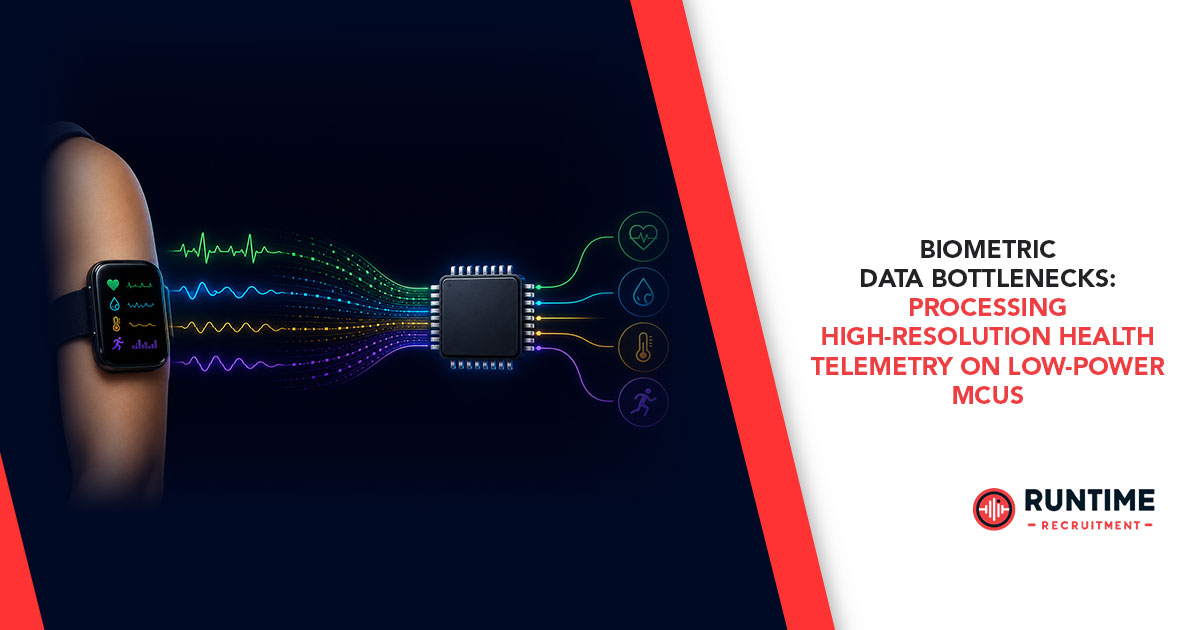
The demand for wearable medical devices, continuous health monitors, and remote patient telemetry systems is exploding. Modern clinical-grade wearables are no longer just counting steps; they are tasked with tracking multi-lead electrocardiograms (ECG), photoplethysmography (PPG) pulse oximetry, photoplethysmogram-derived blood pressure, bioimpedance spectroscopy, and multi-axis inertial data simultaneously.
For the embedded systems engineer, this introduces a brutal engineering paradox. Healthcare providers and ML-driven diagnostic platforms demand high-resolution, uncompressed, high-frequency telemetry to detect subtle cardiac anomalies or neurological tremors. Simultaneously, end-users and product managers demand weeks of battery life out of a sleek, ultra-compact form factor.
This technical deep dive explores the architectural bottlenecks encountered when running high-resolution biometric pipelines on resource-constrained, low-power microcontrollers (MCUs) and outlines the hardware-software co-design strategies required to break the data choke point.
1. The Anatomy of the Telemetry Choke Point
To understand the bottleneck, we must look at the data velocity generated by modern biometric analog front-ends (AFEs) relative to the clock cycles and power budgets of an ARM Cortex-M4F, M33, or RISC-V low-power core running at 32 MHz to 96 MHz.
Data Generation vs. Processing Runway
Consider a high-fidelity wearable patch running a 3-lead ECG array alongside a multi-wavelength PPG sensor:
ECG Sampling: 3 channels sampled at 1 kHz with a 24-bit Delta-Sigma ADC.
PPG Sampling: 3 channels (Red, IR, Green) sampled at 250 Hz with 20-bit resolution to capture precise pulse wave velocity.
IMU Sampling: 6-axis inertial data at 100 Hz (16-bit) for motion artifact cancellation.
Let’s calculate the raw data throughput:
ECG: 3×1000 Hz×4 bytes (packed as 32-bit integers)=12,000 bytes/sec
PPG: 3×250 Hz×4 bytes=3,000 bytes/sec
IMU: 6×100 Hz×2 bytes=1,200 bytes/sec
Total Raw Ingress≈16.2 KB/sec
While 16.2 KB/sec sounds trivial for a desktop processor, in a low-power embedded domain, this data arrives continuously. If the MCU wakes up via an interrupt for every single sample arriving over SPI or I2C, the context-switching overhead alone will completely obliterate the power budget.
Memory Architecture Constraints
Low-power MCUs typically feature tightly coupled SRAM architectures ranging from 64 KB to 512 KB. When processing health telemetry, memory is consumed rapidly by:
Ping-Pong Buffers: Necessary to prevent data overwrites during DMA transfers.
FIR/IIR Filter States: High-order filters require historical sample history.
Feature Extraction Arrays: Algorithms like QRS complex detection or FFTs for Heart Rate Variability (HRV) require windows of data (e.g., 5-second or 30-second epochs). A 30-second window of multi-channel data quickly eats into available SRAM, limiting space for RTOS stacks and BLE network buffers.
2. Silicon Slumber vs. Compute Reality: The Energy Equation
The fundamental law of low-power design is simple: Keep the MCU in its deepest sleep state (Isleep<2 μA) for as long as possible, wake up rapidly, execute at maximum efficiency, and sleep immediately.
When high-resolution biometric telemetry flows into the system, three primary bottlenecks break this paradigm:
I/O Interruption and the Wakeup Penalty
Every time an AFE asserts a hardware interrupt pin indicating a sample is ready, the MCU core must transition from a deep sleep state (like STOP or STANDBY) back to RUN mode. This transition incurs a latency penalty (often 5 to 30 microseconds) where the internal phase-locked loops (PLLs) stabilize and regulators ramp up. During this wakeup window, energy is wasted without executing code.
The Math Tax of Real-Time Filtering
Raw biometric data is notoriously noisy. High-resolution health monitoring demands aggressive digital signal processing (DSP) to remove:
Baseline Wander: Low-frequency breathing artifacts (0.05 Hz−1 Hz).
Powerline Interference: 50 Hz/60 Hz hum.
Electromyography (EMG) Noise: High-frequency muscle twitching.
Executing floating-point mathematics without a dedicated Floating-Point Unit (FPU) or utilizing inefficient loops for Vector Dot Products will peg CPU utilization at 100%, pinning the MCU in high-power RUN states.
3. Architectural Solutions: Breaking the Choke Point
To handle clinical-grade biometrics on low-power silicon, developers must implement a layered defense across hardware peripherals, memory management, and algorithmic execution.
Autonomous Data Ingress via DMA and Autonomous Peripherals
The CPU should never handle raw serial communication bytes. Modern MCUs feature advanced Direct Memory Access (DMA) controllers capable of routing data straight from SPI or UART peripherals directly into SRAM without CPU intervention.
+-------------------+ SPI +-----------------------------+
| Biometric AFE | -----------> | SPI Peripheral FIFO |
+-------------------+ +-----------------------------+
|
| Hardware Request
v
+-----------------------+ SRAM Buffer +------------------------------+
| Processing Stack | <---------------- | DMA Controller (Ping) |
+-----------------------+ +------------------------------+
By leveraging a Circular Ping-Pong Buffer strategy, the DMA controller fills Buffer A while the CPU processes Buffer B. Once Buffer A is full, the DMA switches automatically to Buffer B via hardware scattering/gathering and triggers a single block-level interrupt. This reduces the core's wake-up frequency by orders of magnitude—from 1,000 times per second down to once every few seconds.
Furthermore, vendors like STMicroelectronics (with Smart Run Domain) and Renesas offer autonomous peripherals that can monitor incoming sensor data levels or match thresholds before waking up the main core, ensuring the CPU sleeps unless a significant physiological event occurs.
Hardware-Accelerated DSP
When the core wakes up to process a data block, standard C-loops for executing digital filters are highly inefficient. Engineers should make exclusive use of hardware acceleration:
ARM CMSIS-DSP Library: Tailored for Cortex-M processors, utilizing Single Instruction Multiple Data (SIMD) instructions. CMSIS-DSP executes operations like vector additions, matrix multiplications, and Q15/Q31 fixed-point math in a fraction of the clock cycles required by standard standard library math.
Dedicated Math Co-Processors: Devices featuring embedded cordic accelerators (for trigonometric calculations) or hardware filter accelerators (such as ST's FMAC) handle IIR and FIR filtering entirely in hardware, freeing up CPU cycles and saving massive amounts of power.
4. Algorithmic Optimization: Fixed-Point and Downsampling
To prevent data bottlenecks, algorithmic efficiency must match architectural optimizations.
The Shift to Fixed-Point Arithmetic
While many modern low-power MCUs feature hardware single-precision FPUs, float operations still consume more clock cycles and energy than native integer operations. Transforming processing pipelines into fixed-point math (Q1.15 or Q1.31 formats) allows algorithms to treat fractional biometric data as standard integers.
For instance, scaling an ECG amplitude by a factor of 215 allows an entire filtering pipeline to run via native 16-bit integer assembly instructions, maximizing throughput and reducing the core's active run-time.
Intelligent Multi-Stage Cascaded Downsampling
Not all components of a diagnostic pipeline require maximum sampling resolution at all times. By implementing multi-stage downsampling, you can scale back data size cleanly:

By routing the data through successive decimation stages, high-intensity processing algorithms operate only on lower-frequency representations of the signal, vastly lowering the overall computation matrix.
5. Wireless Transmission Bottlenecks: Edge Compute vs. Raw Streaming
The largest power consumer on any wearable medical device is not the MCU; it is the wireless radio (Bluetooth Low Energy, Wi-Fi, or Cellular IoT). Streaming uncompressed high-resolution telemetry continuously will deplete a lithium-polymer pouch battery in a matter of hours.
The Energy Cost Matrix
An analysis of the energy expenditure per bit highlights the stark reality facing embedded designers:
The Golden Rule of Edge Devices: It is mathematically and energetically cheaper to perform thousands of mathematical calculations locally on an MCU to compress or analyze data than it is to transmit a single raw byte over a wireless radio link.

Because transmitting a bit via BLE requires roughly 1,000x more energy than processing it locally, edge feature extraction becomes mandatory.
Local Compression and Feature Extraction
Instead of sending raw waveforms, the low-power MCU must act as an intelligent gateway:
Run Local Peak Detection: Extract heart rate, RR-intervals, and oxygen saturation percentages locally on the device.
Transmit Metadata Only: Send only the extracted physiological features (e.g., a packet of 4 bytes containing the current heart rate and pulse transit time) once every few seconds rather than sending 1,000 bytes of raw waveform data every second.
On-Device Anomaly Buffering: Continuously write raw uncompressed data into a circular local buffer (or an external low-power SPI NAND flash chip). If the local edge algorithm detects a critical cardiac event (such as atrial fibrillation), the MCU wakes up the radio and dumps the raw historical high-resolution buffer to the cloud for clinical validation. This "Report by Exception" methodology cuts radio duty cycles down by up to 95%.
6. Real-Time OS (RTOS) Scheduling Strategies
To ensure that real-time health processing occurs deterministically without missing incoming sensor frames, the RTOS scheduling architecture must be designed carefully.
Task Prioritization Hierarchy
A typical architecture uses a pre-emptive RTOS (like FreeRTOS or Zephyr) utilizing three core thread tiers:
Priority High: The Ingress Consumer. Wakes up when the DMA buffer fills. It copies data from the peripheral zone to the processing queue and performs minimal fixed-point pre-filtering. Execution time must be tightly bounded.
Priority Medium: Algorithmic Analytics. Processes the filtered arrays to perform peak detection, anomaly evaluation, and data compression. This task is pre-emptible by the ingress consumer to ensure no raw samples are dropped.
Priority Low: Telemetry & Network Layer. Packages the data into BLE characteristic buffers and handles network handshakes.
Tickless Idle Mode Optimization
Standard RTOS environments utilize a periodic system timer tick interrupt (typically every 1 ms) to manage delays and task switching. This constant scheduling overhead prevents the MCU core from dropping into its lowest-power sleep modes.
Enabling Tickless Idle Mode suspends the periodic system tick during periods of inactivity. The RTOS calculates the exact duration until the next application task is scheduled to run (or until a DMA buffer full interrupt is expected) and programs a low-power hardware timer (like an LPTIM) to wake the system up at precisely that point. This turns a noisy power profile with continuous 1 ms spikes into a smooth, flattened consumption curve.
Conclusion: Balancing Performance and Power
Overcoming biometric data bottlenecks on low-power microcontrollers demands a meticulous, holistic balance between hardware capabilities and software execution. By replacing sample-by-sample interrupts with autonomous DMA pipelines, shifting floating-point math to optimized fixed-point DSP libraries, and embracing on-device edge analytics over raw wireless streaming, embedded engineers can successfully build clinical-grade medical hardware that operates reliably within restricted power boundaries.
The future of healthcare rests squarely on the edge—and on the embedded architectures designed to sustain it.
Accelerate Your Next Engineering Milestone
Designing cutting-edge, low-power medical and industrial IoT architectures requires top-tier technical expertise. Whether you are an embedded software designer looking for your next challenge in advanced telemetry pipelines or an engineering manager looking to secure specialized engineering talent, navigating the technical recruitment landscape can be demanding.
Partner with RunTime Recruitment, the specialists in embedded systems and technical engineering placement. Connect with our dedicated recruitment team today to find unmatched talent or discover your next specialized role in the advanced embedded ecosystem.