
Addressing Soft Errors in Flash Memory: Advanced ECC Implementations for High-Altitude Avionics
10 November 2026 · Lance Harvie
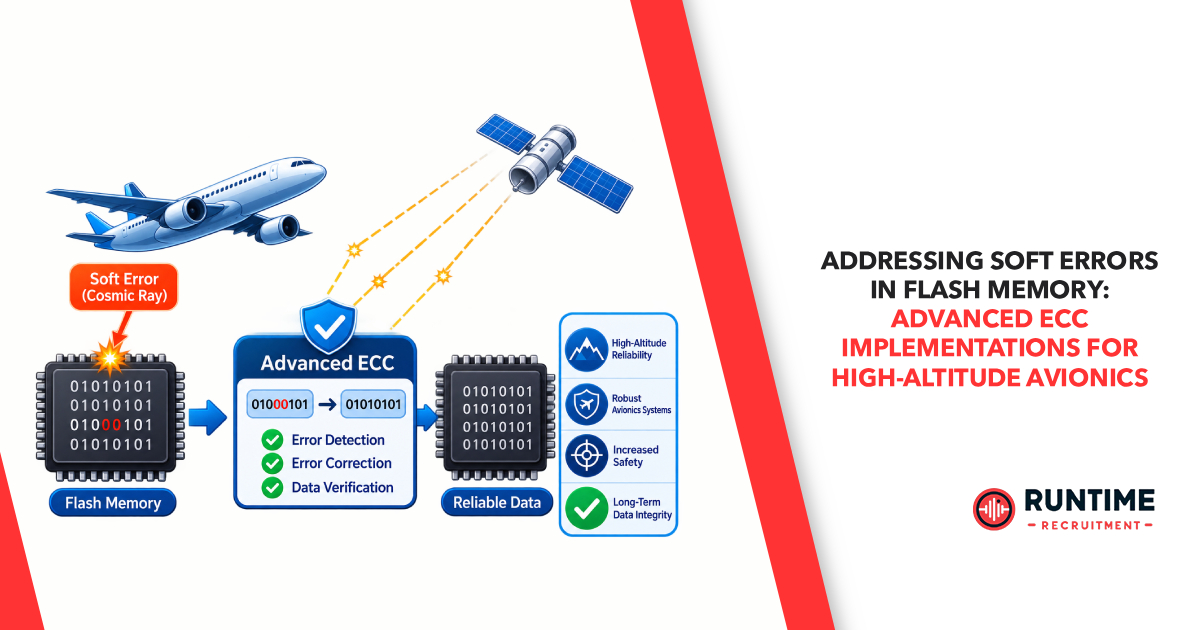
As commercial aviation pushes higher into the stratosphere and unmanned aerospace systems, satellite constellations, and high-altitude pseudo-satellites (HAPS) expand operational envelopes, embedded systems face an increasingly hostile environment. At cruising altitudes exceeding 35,000 feet — and escalating sharply into near-space — the protective shielding of Earth’s dense atmosphere thins exponentially. Here, avionics hardware is continuously bombarded by cosmic radiation, galactic cosmic rays (GCRs), and secondary neutron fluxes.
For embedded systems designers, this atmospheric reality introduces a severe engineering hurdle: soft errors in non-volatile flash memory. While once a challenge primarily reserved for deep-space probes or terrestrial DRAM, the shrinking process nodes of modern NAND and NOR flash architectures mean that even non-volatile storage is increasingly susceptible to radiation-induced bit flips.
Ensuring deterministic reliability in flight-critical avionics demands moving far beyond legacy error correction schemes. This article explores the underlying physics of high-altitude radiation failures, the limitations of traditional mitigation techniques, and how advanced Error Correction Code (ECC) architectures — specifically high-performance BCH and Low-Density Parity-Check (LDPC) codes — safeguard modern aerospace flash memory.
1. The Physics of Failure: Radiation Environments at Altitude
To engineer robust avionics storage, firmware and hardware engineers must first understand the microscopic mechanisms governing radiation-induced memory corruption.
At sea level, terrestrial electronic systems are shielded by a thick column of air equivalent to roughly 1,000 g/cm2g/cm²g/cm2. At high altitudes (20,000 to 60,000 feet), that protective column decreases drastically. Here, high-energy galactic cosmic rays (primarily protons and heavy ions) collide with atmospheric nitrogen and oxygen nuclei, triggering spallation reactions that shower the troposphere and stratosphere with secondary neutrons, protons, and pions.
Single Event Upsets (SEUs) and Multi-Bit Upsets (MBUs)
When a high-energy secondary neutron or proton traverses a semiconductor substrate, it can undergo elastic or inelastic scattering with silicon nuclei, producing a dense track of electron-hole pairs. If this ionization track occurs near a sensitive storage node — such as a floating gate, a charge-trap cell, or the internal registers of a flash memory controller — the collected charge can momentarily pull a node below or above its logic threshold.
Single Event Upsets (SEUs): Transient, non-destructive bit flips where a single logical ‘1’ becomes ‘0’ (or vice versa).
Multi-Bit Upsets (MBUs): Critical events where the ionization track bridges multiple adjacent physical memory cells. Because modern 3D NAND and high-density NOR flash pack billions of cells into tightly packed geometries, a single particle strike can corrupt multiple bits within the same physical wordline or erase block.
Crucially, while flash memory is non-volatile and retains its programmed charge state without continuous power, the physical floating gates or charge-trapping nitrides are still susceptible to charge leakage or sudden charge injection induced by heavy ion strikes. Furthermore, read and write operations performed at high altitudes occur within microscopic voltage margins that can be easily skewed by transient noise or radiation-induced threshold voltage (VthV_{th}Vth) shifts.
2. Limitations of Legacy Error Correction in Aerospace
For decades, embedded systems relied on straightforward algebraic error correction codes, most notably Hamming codes or basic Bose-Chaudhuri-Hocquenghem (BCH) implementations capable of correcting single-bit errors or detecting double-bit errors (SECDED). While adequate for consumer electronics or ground-based industrial systems, these legacy approaches fall dangerously short in high-altitude avionics.
The Weaknesses of Hard-Decision Algebraic Codes
Traditional BCH and Reed-Solomon codes operate via hard-decision decoding. The flash memory controller reads each memory cell, applies a hard binary threshold (interpreting the voltage level strictly as a definitive ‘0’ or ‘1’), and passes this discrete binary array to the ECC engine.
The MBU Blind Spot: If a cosmic ray strike induces an MBU that flips three or four adjacent bits within a localized codeword block, a standard SECDED or low-capability BCH code will experience uncorrectable error decoding failure (UECC).
Wear-Out and Radiation Synergy: Flash memory naturally degrades over program/erase (P/E) cycles due to electron trapping in the oxide layers. In high-altitude environments, radiation-induced trapping compounds this degradation, widening the voltage threshold distributions of individual cells. As raw bit error rates (RBER) climb steeply over the operational lifecycle of the avionics unit, legacy algebraic decoders quickly run out of correction headroom.
Lack of Soft Information: Hard-decision decoders discard valuable analog context. When a cell’s voltage sits precariously close to the sensing reference threshold, a hard-decision scheme treats it with the same binary certainty as a pristine, deeply saturated cell, discarding the probability metrics that could prevent a miscorrection.
3. Advanced ECC Strategies: Modern Architectural Solutions
To maintain zero-failure tolerances in flight-control computers, flight data recorders (FDRs), and navigation systems, modern aerospace flash controllers incorporate advanced, high-overhead ECC architectures designed to handle severe noise profiles and high RBERs.
High-Performance BCH Codes with Extended Parity
While basic BCH is limited, highly optimized, multi-symbol correcting BCH engines configured with deep parity matrices remain popular in high-reliability NOR and lower-density NAND flash. By expanding the Galois Field (GF(2m)GF(2^m)GF(2m)) order and dedicating a larger percentage of the physical page space to parity bits (sometimes exceeding 10–15% of total raw storage capacity), engineers can scale correction capability up to 24, 40, or even 64 random bit errors per 512-byte or 1KB sector.
However, as flash densities scale toward multi-level (MLC) and triple-level (TLC) cells, the parity overhead required for pure high-capacity BCH becomes economically and spatially prohibitive. This has driven the industry toward graph-based codes.
Low-Density Parity-Check (LDPC) Codes
Originally conceptualized in the 1960s but only recently viable for high-speed embedded flash controllers due to silicon area and power constraints, Low-Density Parity-Check (LDPC) codes have become the gold standard for high-reliability data storage.
Soft-Decision Decoding: Unlike hard-decision schemes, advanced LDPC implementations utilize soft information. When a raw read fails or encounters high noise, the flash controller executes multi-reference read voltages — sampling the cell current at various fine-grained voltage offsets to construct a probability distribution map of each cell’s charge state.
Iterative Belief Propagation: The LDPC decoder uses a sparse parity-check matrix and iterative message-passing algorithms (such as sum-product or min-sum algorithms) to evaluate the likelihood ratios of individual bits. By performing multiple decoding passes, the engine resolves ambiguities that would instantly trigger a UECC fault in a legacy system.
Resilience to Extreme RBER: LDPC can comfortably operate at raw bit error rates that would paralyze standard algebraic decoders, extending the usable operational life of commercial-off-the-shelf (COTS) flash memory deployed in high-altitude pods.
4. Firmware and Hardware-Level Mitigation Techniques
Deploying advanced ECC algorithms in firmware requires a holistic hardware-software co-design approach. Relying solely on the ECC engine during read operations is insufficient; the system must actively manage data health across the entire storage sub-system.

Proactive Memory Scrubbing
Because high-altitude radiation continually introduces transient soft errors over time, static data stored in flash memory is vulnerable to error accumulation. If a bit is flipped by an SEU today, and a second bit in the same codeword is flipped weeks later, two separate single-bit anomalies compound into an uncorrectable multi-bit failure.
To combat this, embedded firmware must implement background memory scrubbing:
A low-priority background task systematically sweeps through stored blocks during idle CPU windows.
The scrubber reads blocks, passes them through the ECC engine, and — if minor bit corrections are made — rewrites the refreshed, pristine data back to the media.
This proactive maintenance resets the error accumulation clock, preventing cumulative degradation.
Dynamic Read Retries and Voltage Tracking
As temperature fluctuations in the stratosphere alter silicon conductivity and radiation accumulation shifts threshold voltages, standard reference voltages fail. Advanced avionics flash controllers implement adaptive read retry tables. If an initial read yields an excessive number of ECC corrections, the controller automatically shifts the internal reference sense amplifiers to custom voltage offsets, compensating for environmental drift before a hard read failure occurs.
5. Engineering Trade-offs: Latency, Power, and Determinism
Embedded engineers working on flight control systems face strict determinism requirements. Hard real-time operating systems (RTOS) cannot tolerate unpredictable interrupt latencies or variable storage access times.
Decoding Latency: While a pristine flash page reads out in microseconds using a fast hard-decision pass, a heavily degraded page requiring soft-decision LDPC iterative decoding may require multiple re-reads and extensive matrix calculations, introducing latency spikes.
Mitigation: Firmware architects must partition storage carefully. Critical boot loaders, configuration parameters, and immediate flight telemetry should reside in radiation-hardened or heavily over-provisioned SLC (Single-Level Cell) flash with deterministic, low-overhead BCH protection. Non-critical logging storage can utilize high-density TLC/QLC flash backed by aggressive LDPC engines with bounded worst-case execution time (WCET) profiles.
6. Conclusion
As avionics systems grow increasingly software-defined and data-intensive, the reliability of on-board non-volatile storage becomes a pillar of mission success. High-altitude radiation environments will continue to challenge embedded hardware with relentless soft errors and multi-bit upsets. By replacing legacy Hamming and basic BCH codes with advanced, soft-decision LDPC architectures, and pairing them with rigorous firmware memory scrubbing and wear-leveling strategies, embedded engineers can build fault-tolerant, aerospace-grade storage systems capable of enduring the harshest stratospheric conditions.
Connect with RunTime Recruitment
Looking to scale your engineering team with top-tier embedded systems, firmware, and hardware specialists who understand mission-critical design? Connect with RunTime Recruitment today to find the expert talent your next aerospace project demands.