
Synthetic Testbench Generation: Leveraging Generative AI to Simulate Edge Sensor Inputs in Virtual Environments
28 September 2026 · Lance Harvie
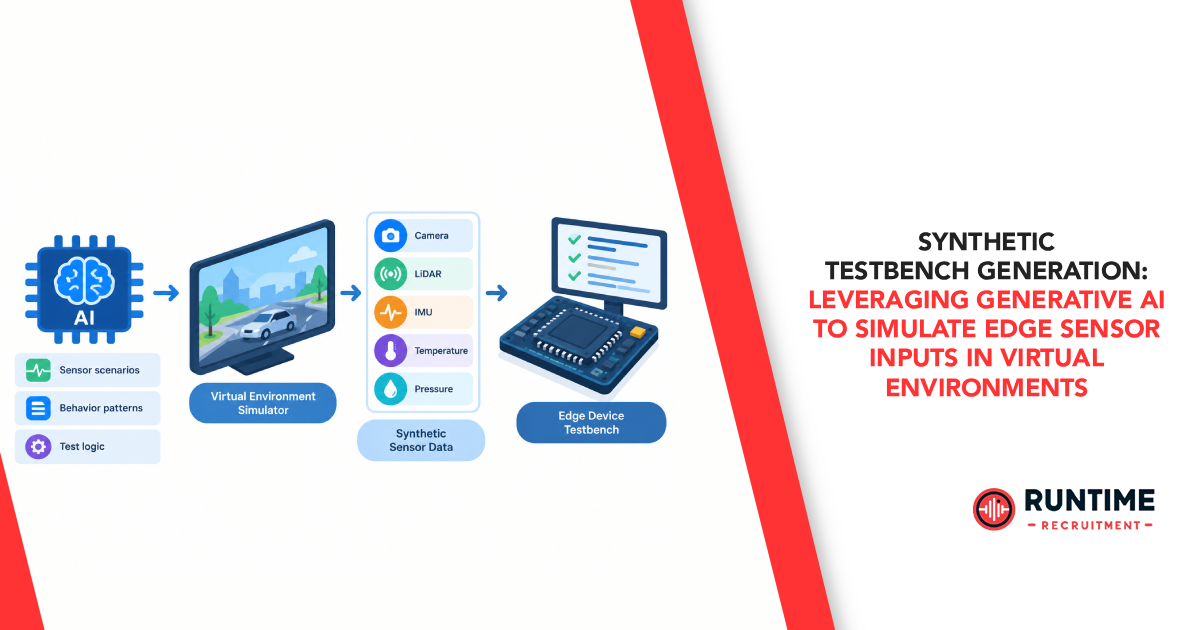
Embedded systems are transitioning from isolated controllers to highly autonomous edge nodes. Modern microcontrollers (MCUs), System-on-Chips (SoCs), and edge AI accelerators process dense streams of sensory telemetry — ranging from multi-axis MEMS inertial measurement units (IMUs) and optical sensors to Radar, LiDAR, and specialized bio-telemetry probes — in real time. As firmware complexity scales alongside heterogeneous hardware architectures, functional verification has emerged as the primary bottleneck in product development cycles.
Traditionally, embedded verification relies on a combination of Hardware-in-the-Loop (HIL) testing and static, constraint-driven pseudo-random testing in Software-in-the-Loop (SIL) environments. While HIL testing provides physical fidelity, physical test rigs suffer from high maintenance overhead, poor scalability, and an inability to reliably reproduce transient environmental edge cases. Conversely, classical software testbenches rely on hardcoded mathematical approximations — such as ideal sine waves or simplified Gaussian noise vectors — that fail to capture the subtle, non-linear physical interactions present in real-world environments.
This gap has driven the adoption of Synthetic Testbench Generation powered by Generative AI. By training generative models on empirical sensor datasets, verification engineers can generate high-fidelity, physically consistent, and contextually rich sensory telemetry directly within virtual simulation environments. This article explores how generative architectures — ranging from Time-Series Generative Adversarial Networks (TimeGANs) to multi-agent sequence orchestrators — are integrated into SystemVerilog/UVM and SIL pipelines to revolutionize edge sensor simulation.
The Limits of Classical Sensor Emulation
To appreciate the role of Generative AI in modern testbenches, it is essential to examine why deterministic and pseudo-random modeling techniques fall short when validating edge firmware.
Edge sensors operate in noisy, dynamic physical environments. Consider a 6-axis MEMS IMU mounted on an industrial motor drive. The signal received by the onboard MCU is not merely linear acceleration plus Gaussian white noise. It consists of a complex superposition of physical phenomena:
Low-frequency bias instability and thermal drift: Non-linear fluctuations driven by ambient and operational heating.
Quantization and clipping artifacts: Non-linear saturation behavior when dynamic limits are exceeded.
Cross-axis sensitivity and harmonic vibration: Mechanical coupling effects that create complex, phase-aligned interference across multiple measurement channels.
Transient anomalous spikes: Electromagnetic interference (EMI) or mechanical shock events occurring at unpredictable intervals.
In a classical Universal Verification Methodology (UVM) environment, modeling these effects requires hand-crafting intricate SystemVerilog sequences or embedding complex math libraries into C++ Direct Programming Interface (DPI) wrappers. Verification teams spend hundreds of engineering hours attempting to manually script edge cases — such as a sensor dropping packets precisely when a temperature gradient induces a 1/f noise spike.
Because these manual scripts are deterministic or strictly constrained-random, they reflect only the edge cases the verification engineer anticipated. Unanticipated corner cases slip through into production silicon or compiled firmware, resulting in costly late-stage bugs.
Generative AI Architectures for Synthetic Sensor Synthesis
Generative AI transforms synthetic testbench design by shifting from rule-based simulation to data-driven parametric generation. Rather than manually defining every edge case, generative models learn the underlying probability distribution of complex physical signals, allowing them to synthesize realistic, non-deterministic sensor streams.

1. Time-Series GANs (TimeGAN) and Conditional VAEs for Telemetry
Time-Series Generative Adversarial Networks (TimeGANs) and Variational Autoencoders (VAEs) excel at generating continuous, multi-dimensional time-series data while preserving temporal dynamics and cross-channel correlations. By training a conditional VAE or TimeGAN on raw physical captures — collected across varied temperature, voltage, and mechanical stress profiles — the generator can synthesize arbitrary lengths of synthetic sensor data conditioned on specific operational regimes.
For example, a verification engineer can prompt a synthetic generator to produce “10 minutes of 3-axis accelerometer data under 85°C ambient temperature with a 120 Hz structural harmonic overlay.” The generative model outputs a multivariate array that preserves real-world non-Gaussian noise floors, axis coupling, and dynamic thermal drift without requiring a complex, explicit physics engine.
2. Diffusion Models for High-Dimensional Optical and Spatial Inputs
For edge vision systems, thermal imagers, and time-of-flight (ToF) cameras, sensor streams consist of multi-megapixel frames delivered over high-speed buses like MIPI CSI-2. Latent Diffusion Models (LDMs) trained on raw sensor domain data can generate synthetic frame-by-frame image sequences containing dynamic weather variations, lens flare, sensor bloom, and thermal noise patterns. When coupled with synthetic scene rendering tools, diffusion models bridge the “sim-to-real” gap, ensuring edge AI perception firmware encounters sensor-level degradations long before physical hardware deployment.
3. Multi-Agent LLM Orchestrators for Protocol and State Machine Testing
While continuous models handle raw telemetry data, Large Language Models (LLMs) configured as multi-agent frameworks excel at protocol-level stimulus orchestration. In an edge computing SoC, sensors communicate via digital bus interfaces including I2C, SPI, CAN-FD, and SPMI.
An LLM-based verification agent can digest register map specifications, protocol state diagrams, and hardware bug tracker reports to generate complex, protocol-valid (or deliberately corrupt) stimulus sequences. These agents do not merely generate static test vectors; they dynamically monitor assertion flags and functional coverage metrics during simulation, iteratively evolving sequences to drive execution into unexplored state-machine branches.
Architectural Blueprint: Integrating Generative AI with Virtual Testbenches
Integrating generative AI into an embedded verification workflow requires a robust, low-latency bridge between high-level Python AI frameworks (PyTorch, TensorFlow) and industrial verification environments like SystemVerilog/UVM, SystemC, or QEMU/Renode software emulators. To achieve real-time synchronization between the AI engine and the EDA simulator (e.g., Synopsys VCS, Cadence Xcelium, or Siemens Questa), engineers utilize C++ DPI interfaces or shared-memory IPC channels.
Consider a practical implementation snippet where a C++ DPI driver interface pulls synthetic sensor samples generated by an AI co-process and injects them directly into a SystemVerilog UVM sequence item:

In the corresponding SystemVerilog UVM driver, the verification environment invokes fetch_next_synthetic_sample() during clock cycles or register read events, delivering dynamic synthetic telemetry directly to the Device Under Test (DUT) register interfaces.
Automated Corner-Case Generation and Fault Injection
One of the most valuable advantages of AI-generated synthetic testbenches is the ability to perform targeted, automated adversarial fault injection. In safety-critical applications governed by standards like ISO 26262 (Automotive) or IEC 61508 (Industrial Safety), testing how firmware recovers from rare sensor faults is mandatory. Physical hardware tests rarely allow engineers to induce precise internal sensor degradations without destroying components.
Generative models allow verification teams to parameterize adversarial sensor corruptions safely within virtual environments:
Glitch Injection during Bus Arbitration: Synthesizing sensor telemetry where an internal ADC glitch coincides precisely with a CAN bus high-priority message arbitration loss.
Cascading Sensor Failures: Simulating multi-sensor degradation vectors — such as an IMU losing calibration while an optical sensor experiences sudden saturation — to test sensor fusion algorithms (e.g., Extended Kalman Filters).
Adversarial Noise Optimization: Using reinforcement learning agents in loop with generative models to discover the exact noise distribution that triggers a buffer overflow or race condition in the firmware device driver.
Rather than running millions of purely random simulation cycles hoping to hit a rare state, generative agents use functional coverage feedback to actively guide stimulus generation toward uncovered state-machine branches. This closed-loop, coverage-driven generation drastically reduces overall simulation execution time while significantly increasing defect discovery rates.
Engineering Trade-offs, Challenges, and Best Practices
While synthetic testbench generation offers transformative benefits, successful deployment requires navigating key engineering trade-offs:

The Road Ahead for Embedded Verification
As edge SoCs embrace heterogeneous architectures and higher autonomy, manual testbench creation and physical HIL testing are no longer sufficient to keep pace with rapid production schedules. Leveraging Generative AI for synthetic testbench generation bridges the gap between software simulation speed and physical world fidelity. By combining continuous generative models (TimeGANs, VAEs) with LLM-driven test orchestrators, embedded verification teams can uncover edge-case defects early in the design cycle, ensure functional safety compliance, and dramatically accelerate time-to-market.
Partner with RunTime Recruitment
Looking for specialized embedded software, firmware, or verification engineering talent to elevate your development pipeline? Connect with RunTime Recruitment today to find top-tier engineering experts tailored to your team's exact technical requirements.