
Cross-Training Software Developers: Can High-Level Programmers Transition to Low-Level C/C++?
2 October 2026 · Lance Harvie
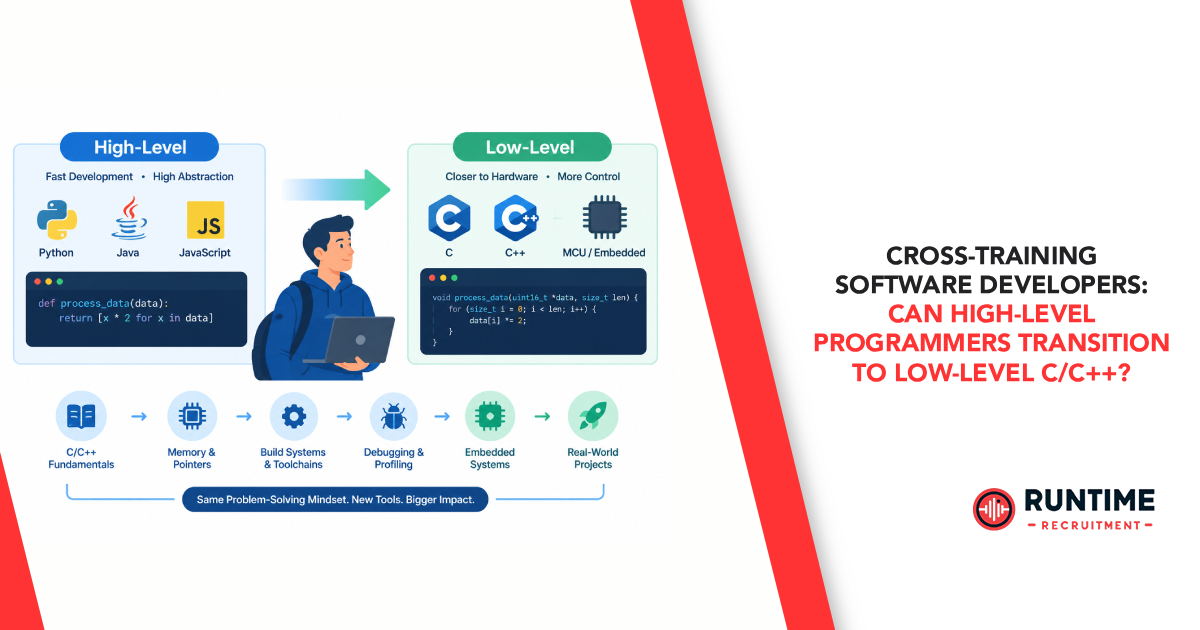
For years, the embedded engineering sector has operated behind a protective moat. Firmly walled off by hardware specifics, intricate register maps, custom toolchains, and strict real-time determinism, bare-metal and RTOS firmware engineering was considered a specialization that required a traditional electrical or computer engineering background.
However, the rapid expansion of Edge AI, smart IoT infrastructure, connected automotive architectures, and advanced medical electronics has created an unprecedented demand for firmware talent. Engineering managers are facing an acute engineering talent shortage. The traditional candidate pipeline — graduates with deep backgrounds in microcontrollers, assembly, and C/C++ — is simply too narrow to keep up with product roadmaps.
To scale teams, engineering leadership is increasingly looking toward a controversial alternative: Cross-training high-level software developers into low-level embedded C/C++ engineers.
Can web, mobile, desktop, or cloud developers who build in Python, JavaScript/TypeScript, Java, or C# successfully make the leap down to bare-metal registers and real-time operating systems? The short answer is yes. However, the path is fraught with conceptual friction, hidden pitfalls, and structural mindset shifts that engineering managers must proactively address.
The Paradigm Shift: What Changes When You Go “Down to the Metal”?
Transitioning a developer from enterprise app development to low-level systems programming is not just a lesson in syntax. C and modern subsets of C++ are syntax-wise relatively straightforward. The true barrier is the psychological shift in how a programmer perceives execution, memory, and time.

High-level developers operate within rich, protective environments. The operating system, runtime virtual machine, and dynamic garbage collector handle the underlying physical universe. When cross-training these engineers to write firmware in C/C++, four core pillars undergo a complete paradigm shift:
1. Memory Management: From Garbage Collection to Manual Precision
In high-level application development, memory is treated as an infinite, elastic ocean. If a Java or Python program needs an object, it instantiates it; when the reference drops, garbage collection cleans up the mess.
In embedded C and restricted C++, memory is a finite, rigidly structured grid.
Dynamic Allocation Hazards: Native embedded development strictly discourages or outright bans dynamic memory allocation (malloc/free or raw new/delete) in real-time execution loops due to heap fragmentation and non-deterministic allocation latency.
Stack Depth Restrictions: High-level programmers routinely write recursive functions or pass large object structures by value. In an embedded target with only 32 KB of SRAM, a deep stack frame will quietly cause a stack overflow, corrupting adjacent memory and triggering hard-fault interrupts.
Pointer Arithmetic and Cache Alignments: Developers must learn to explicitly reason about raw memory addresses, volatile pointers, bit-masking operations, static allocations, and struct alignment padding.
2. Execution Determinism vs. High Throughput
Enterprise software prioritizes throughput (how many requests per second can a microservice handle?). Embedded software prioritizes determinism (does this motor controller respond within exactly 50 microseconds, every single time?).
High-level developers are unaccustomed to real-time constraints. When moving to embedded systems, they must master:
Interrupt Service Routines (ISRs): Understanding that an ISR can pre-empt normal code execution at any millisecond, and that ISRs must be kept extremely lightweight (never blocking, never logging over slow buses).
Jitter and Latency: Recognizing that an algorithm that takes 1 millisecond on average, but occasionally spikes to 10 milliseconds due to background processing, is unacceptable in safety-critical firmware.
3. Hardware Abstraction vs. Register Manipulation
High-level application layers treat hardware as an abstract API call (fetch(), File.Read(), HTTP POST). In firmware engineering, hardware is a collection of physical silicon registers mapped directly into the processor’s memory space.
Cross-training requires teaching developers how code interacts directly with silicon:
Configured via bit manipulation (OR, AND, XOR, bit-shifts) on volatile registers.
Understanding state transitions of physical buses like I2C, SPI, UART, and CAN-bus.
Navigating thousand-page microcontroller reference manuals and datasheets alongside logical circuit schematics.
4. The Toolchain and Debugging Paradigm Shift
When a web app crashes, a detailed stack trace is printed to a console or logging server. When a bare-metal microcontroller crashes, it hangs silently, drops into a HardFault_Handler loop, or brownouts the entire board.
Transitioning engineers must move away from higher-level debuggers and embrace hardware-centric diagnostics:
Logic Analyzers and Oscilloscopes: Probing physical pins to check signal timing, signal integrity, and bus communication.
In-Circuit Debuggers (JTAG/SWD): Reading core CPU registers, setting hardware watchpoints, and inspecting raw memory dumps directly on the target silicon.
Where High-Level Programmers Win (The Unsung Advantages)
While the learning curve is real, assuming high-level developers bring zero value to embedded teams is a mistake. In fact, incoming talent from cloud, mobile, and enterprise backend environments brings modern software engineering practices that traditional firmware teams sometimes lack.

The Cross-Training Framework: A Roadmap for Engineering Managers
If an organization decides to cross-train high-level software engineers to build low-level embedded software, structured onboarding is critical. Dropping a Java developer into a massive, legacy bare-metal C codebase with zero guidance is a recipe for high turnover and broken hardware.
Below is a field-tested, multi-phase framework for bridging the skills gap.

Phase 1: De-Abstracting Software Concepts
Before touching hardware, developers must understand the lower-level execution mechanics of C and system-level C++.
Core Topics: Pointers, double pointers, manual memory layouts, stack frames, bitwise manipulation (&, |, ^, ~, <<, >>), storage classes (static, extern), and the volatile keyword.
Practical Exercise: Build a basic command-line application in C that implements custom memory pools, circular ring buffers, and byte-packing/unpacking routines without using dynamic allocation libraries.
Phase 2: Silicon Onboarding (Bare-Metal)
Introduce cheap, well-documented development boards (such as an ARM Cortex-M based board like the STMicroelectronics STM32 Nucleo or Raspberry Pi Pico).
Core Topics: Memory-mapped I/O registers, GPIO configuration, system clocks, timers, and basic peripheral communication (UART, SPI).
Practical Exercise: Bypass vendor-provided Hardware Abstraction Layers (HAL) for one week. Force the engineer to read the MCU reference manual to configure a timer interrupt and blink an LED by manipulating raw memory addresses directly.
Phase 3: Embracing Real-Time Operating Systems (RTOS)
Once bare-metal execution is understood, introduce multi-threaded real-time programming concepts.
Core Topics: FreeRTOS or Zephyr RTOS fundamentals. Task scheduling, priority inversion, preemptive scheduling, semaphores, mutexes, message queues, and thread-safe ring buffers.
Practical Exercise: Build a multi-tasking sensor reader where a high-priority task handles incoming hardware interrupts and a low-priority background task formats and logs data over UART without blocking execution.
Phase 4: Modern, Constrained C++
Transition from plain C to modern embedded C++ (C++17/C++20 subsets).
Core Topics: Enforcing guidelines that restrict risky language features (disabling RTTI, disabling exceptions, avoiding dynamic allocations), while leveraging high-value language features (templates for zero-cost hardware abstraction, constexpr for compile-time calculation, type-safe register wrappers).
Beningo Embedded GroupPractical Exercise: Refactor a legacy C driver into a zero-overhead, template-based C++ peripheral driver.
Common Traps to Watch For
When evaluating high-level developers undergoing cross-training, senior embedded leads should actively watch for three dangerous anti-patterns:
The “I’ll Just Allocate a Quick Buffer” Trap: A high-level developer trying to quickly format a string or dynamic array using dynamic allocation (malloc or std::string) inside a high-frequency loop or ISR.
Ignoring the Race Condition: Assuming that setting a global boolean flag in an ISR and reading it in a main loop is safe without marking the variable volatile or guarding it with an atomic/critical section.
Over-Abstraction Inflation: Bringing enterprise design patterns (like abstract factory factories or deep class inheritance hierarchies) into an 8-bit or 32-bit MCU project, accidentally blowing up the flash memory size and virtual method table (vtable) overhead.
The Final Verdict: Is It Worth It?
Can high-level programmers transition to low-level C/C++? Absolutely.
While the learning curve is steep during the first three to six months, developers with strong computational foundations, a deep curiosity for how hardware executes instructions, and a structured onboarding program can evolve into outstanding systems engineers. Furthermore, combining modern software design principles with raw hardware awareness yields firmware that is not only ultra-efficient, but also cleaner, more modular, and far easier to maintain.
Cross-training high-level developers isn’t just a workaround for the engineering hiring crunch — it is a sustainable strategy to modernize embedded software engineering teams.
Looking to scale your engineering team or hire specialized firmware talent? Connect with the expert team at RunTime Recruitment today to secure the precise technical candidates your projects demand.