
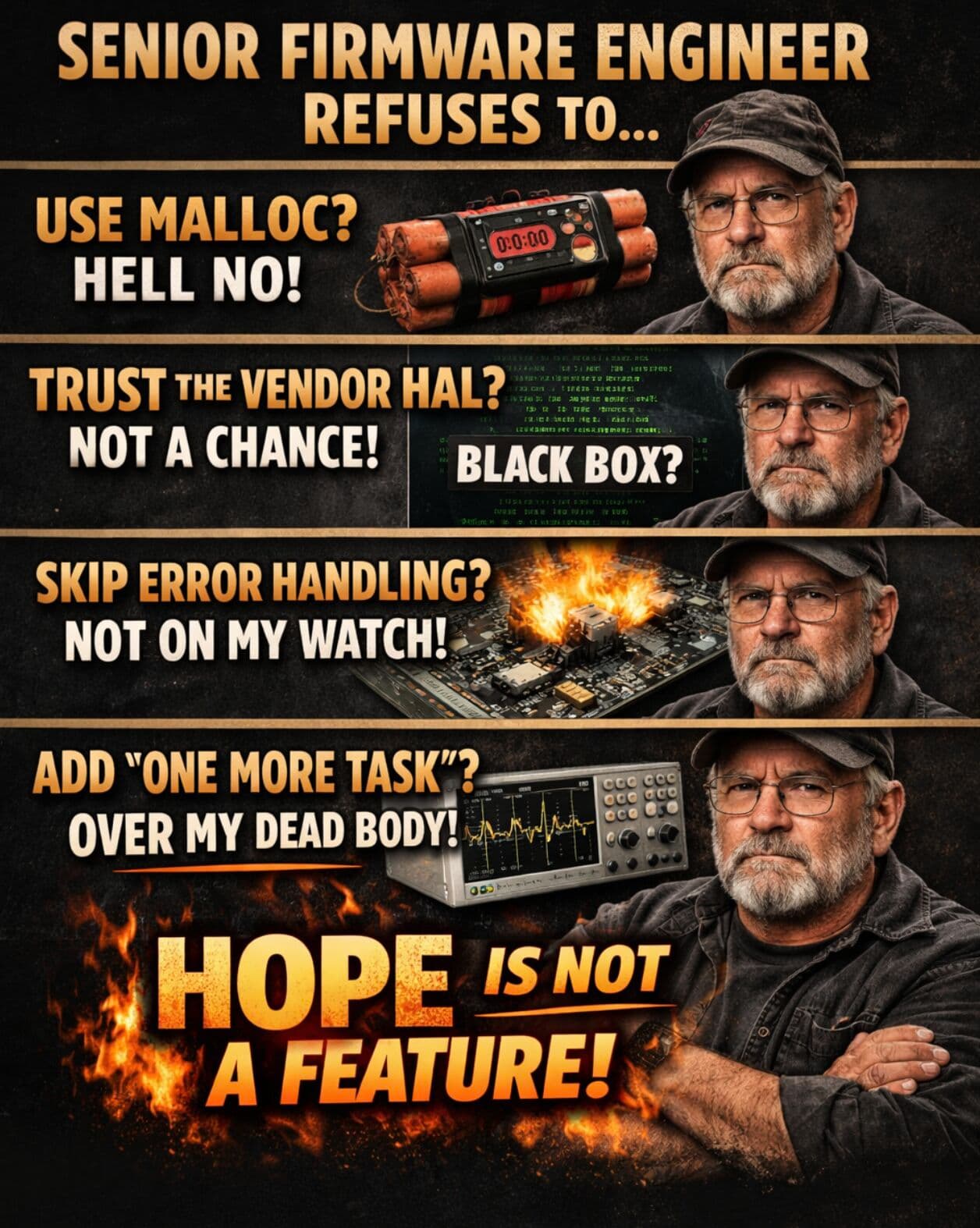
You can learn more about a senior engineer by what they refuse to do than what they will.
A battle-tested firmware engineer doesn't just have a 'No' list. They have a 'Non-Deterministic' list. They refuse to ship 'hope' as a feature.
They refuse unmanaged dynamic allocation. In a system without an MMU, malloc isn't just a choice. It's a ticking time bomb of heap fragmentation. If it’s a long-running system, they demand static allocation or fixed-size pools to guarantee uptime.
They refuse to treat a vendor HAL as a 'Black Box.' They know that 'Code Generated' often means 'Edge Case Ignored.' They verify the register-level implementation against the silicon errata because they know the hardware is the only source of truth.
They refuse to ship without validating the 'Error Paths.' If the system hasn't survived Hardware-in-the-Loop fault injection, simulating the sensor failing or the bus hanging then the error-handling code is just a theory.
They refuse the 'Simple' feature that breaks the timing model. They know that in firmware, 'one more interrupt' or 'one more task' can be the difference between a stable system and a race condition that only appears in the field.
This isn’t about being difficult. It’s about predictability. They are protecting the integrity of the system against the 'quick fixes' that create impossible-to-debug failures three months after launch.
What is the one 'industry standard' shortcut that you refuse to take in production?
#EmbeddedSystems #FirmwareEngineering #SoftwareEngineering #SeniorEngineer #EngineeringLeadership #BareMetal #TechnicalDebt #RTOS #HardwareInTheLoop #SafetyCritical #CodingStandards #LessonsLearned #ProgrammingWisdom #TechCareer #SystemArchitecture