
Autonomous Failure Mitigation: Deploying Micro-Agents for Unsupervised Embedded System Recovery
15 September 2026 · Lance Harvie
For decades, embedded systems engineers have relied on a blunt instrument to handle software crashes in remote devices: the hardware watchdog timer (WDT). When a stack overflow corrupts a pointer, an I2C bus hangs, or an RTOS task deadlocks, the watchdog pulls the hardware reset line. The system power-cycles, volatile RAM is wiped, peripheral clocks clear, and the application attempts a cold boot from address zero.
In simple microcontrollers, this “reboot-and-pray” approach was acceptable. Modern edge deployments — spanning autonomous automotive ADAS platforms, remote satellites, medical implants, and industrial IoT gateways — cannot afford brute-force restarts. A full system reboot introduces multi-second execution blackouts, drops critical network sessions, discards real-time sensor buffers, and risks locking devices into unrecoverable bootloops if corruption persists across flash memory.
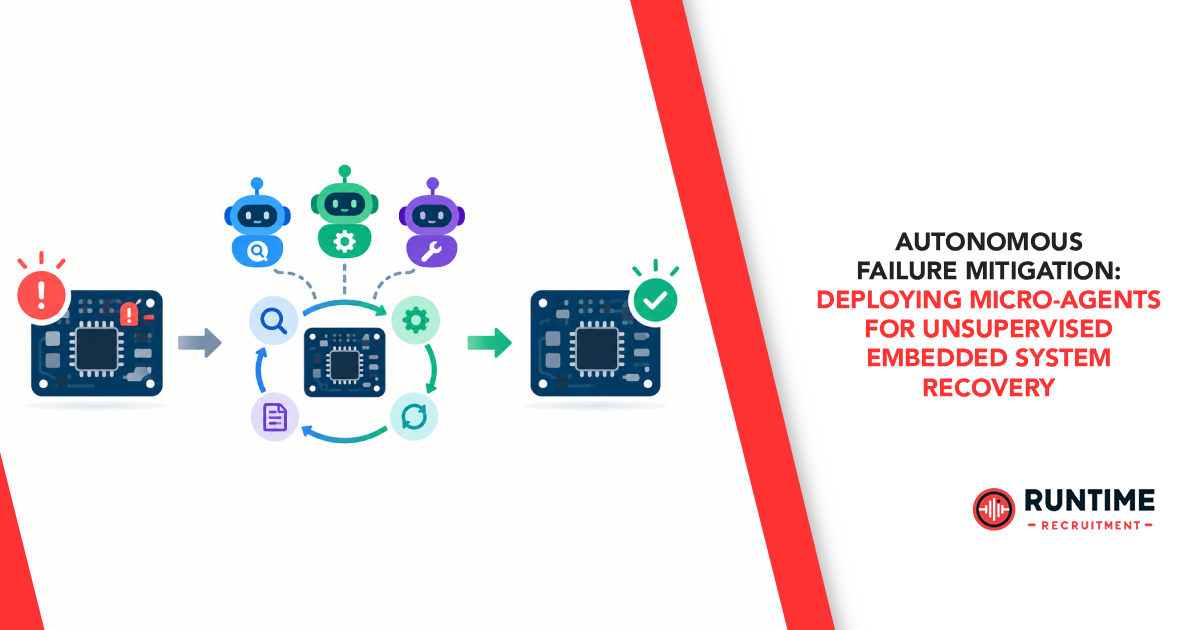
To achieve high availability in mission-critical edge devices, firmware architects are transitioning from reactive resets to Autonomous Failure Mitigation. By deploying lightweight, isolated Micro-Agents into the firmware architecture, embedded systems can monitor runtime integrity, isolate corrupt memory spaces, execute localized thread recycling, and perform surgical state recovery — all without interrupting the broader application or dropping hardware peripherals.
1. The Architectural Bottleneck of Traditional Fault Recovery
To understand why autonomous micro-agents are necessary, we must examine the limitations of traditional recovery techniques. In a conventional RTOS environment, system safety typically relies on Watchdog Timers, Windowed Watchdogs, Stack Overflow Canaries, and default fault handlers such as HardFault or BusFault vectors.

While traditional mechanisms catch fatal exceptions, their response is inherently destructive:
Lack of Granularity: A failure in an unprivileged background logging thread triggers the exact same global system reset as a catastrophic failure in a primary control loop.
Loss of Volatile State: Cold reboots erase high-frequency telemetry, transient sensor calibration parameters, and active cryptographic handshake states stored in Static RAM (SRAM).
Peripheral Disconnection: Reinitializing internal clocks and physical layers forces external communication buses — such as CAN, EtherCAT, or cellular modems — to tear down and renegotiate connections, generating operational latency.
Silent Root-Cause Destruction: Standard watchdog resets provide minimal post-mortem diagnostic data. Registers and memory structures are cleared before stack traces can be analyzed or transmitted off-device.
Traditional Watchdog vs. Autonomous Micro-Agent Recovery

2. Defining the Micro-Agent Architecture
An embedded Micro-Agent is an ultra-lightweight, high-priority, deterministic execution thread or microkernel enclave operating in resource-constrained ARM Cortex-M, RISC-V, or Xtensa microcontrollers. Operating with elevated hardware privileges, it is decoupled from the main application scheduler.

The Micro-Agent acts as an in-system medical triage officer, executing three continuous core responsibilities:
System Health Auditing: Monitoring heap fragmentation, stack watermarks, task execution timing, and inter-process communication queue depth.
Deterministic Triage and Isolation: Intercepting non-maskable interrupts, hardware faults, and memory access violations to prevent fault propagation.
Surgical Restoration: Restarting corrupted application threads, clearing locked hardware buses, reallocating dynamic resources, and rolling back task state machines to verified checkpoints.
3. Hardware Enforcement: Memory Isolation and Sandboxing
A recovery micro-agent cannot repair an unstable system if it is vulnerable to the same memory corruption that caused the fault. Deploying micro-agents requires hardware-enforced spatial and temporal isolation using an on-chip Memory Protection Unit (MPU), ARM TrustZone, or RISC-V Physical Memory Protection (PMP).
Spatial Isolation via MPU Profiling
The hardware MPU divides the microcontroller memory map into distinct protection regions. Main application tasks execute in unprivileged mode, while the Micro-Agent resides in a privileged region inaccessible to standard RTOS tasks.
Region 0 (Kernel & Micro-Agent Domain): Read, Write, and Execute rights restricted strictly to Privileged Mode.
Region 1 (Application Flash Space): Read-Only and Execute rights in Unprivileged Mode to prevent runtime application code mutation.
Region 2 (Task Stack Allocations): Read and Write rights in Unprivileged Mode, dynamically swapped during context switches to prevent cross-stack corruption.
Region 3 (Peripheral Register Space): Restricted memory-mapped I/O access assigned specifically to authorized driver tasks.
When an application task suffers a buffer overflow and attempts to write to an illegal address, the MPU halts instruction execution instantly and triggers a Memory Management Fault exception. The vector handler intercepts the faulting instruction address and stack pointer, revokes execution rights for the offending thread, and passes the context payload — including the Program Counter, Link Register, and fault address register — directly to the Micro-Agent. The agent then redirects the stacked Program Counter to an isolated triage handler, preserving parallel execution threads.
4. State Preservation Strategies: SRAM Retention and Checkpointing
The cornerstone of unsupervised recovery is preserving critical application context across localized thread resets. If a task managing an industrial motor driver crashes, the recovery agent must restore execution without losing absolute encoder positions, telemetry, or target control parameters.
Dual-Layer Checkpointing Mechanism
Architects employ a dual-layer checkpointing strategy combining SRAM Retention Banking and eNVM Non-Volatile Ring Buffering.

Retention SRAM Checkpointing (Transient State): Modern microcontrollers feature specialized SRAM banks that remain powered during low-power modes or localized resets. The Micro-Agent manages a double-buffered structure within retention memory where tasks commit state snapshots containing sequence numbers, operational variables, and a Cyclic Redundancy Check (CRC-32) signature at regular intervals.
eNVM Flash Logging (Persistent Epochs): Major operational transitions — such as Over-The-Air firmware updates or configuration changes — are committed to embedded Non-Volatile Memory (eNVM). The agent maintains a wear-leveled ring buffer in flash to ensure that if complete power loss occurs during recovery, the device boots into a verified operational epoch.
Prior to executing a task recovery cycle, the Micro-Agent computes the CRC-32 checksum across the target retention block. If the checksum matches, state variables are reloaded into the freshly spawned task context. If corruption is detected, the agent falls back to the persistent eNVM snapshot.
5. Algorithmic Heuristics and Circuit Breaking in RTOS
A Micro-Agent must avoid endlessly rebooting a fundamentally broken thread. If a memory corruption fault stems from a deterministic software defect — such as an unhandled edge case in a network packet parser — naive thread recycling creates a high-frequency micro-bootloop that starves remaining RTOS tasks.
To eliminate this risk, Micro-Agents incorporate embedded Circuit Breaker Patterns based on state-machine heuristics.

Micro-Agent State Transitions
CLOSED (Normal Operation): The Micro-Agent passively audits task health. Application tasks post heartbeat signals to RTOS event flags. As long as heartbeats arrive within designated execution windows, the circuit remains closed.
OPEN (Isolated / Quarantined): If a task fails repeatedly within a sliding time window — such as three failures within thirty seconds — the Micro-Agent trips the circuit to Open. The agent suspends the thread handle, releases owned mutexes to prevent deadlocks, purges corrupted queues, and drives connected hardware outputs to safe fail-states.
HALF-OPEN (Provisional Recovery): After a cooldown timer elapses, the Micro-Agent transitions to Half-Open. It allocates a fresh stack frame, loads the last valid state checkpoint, and runs the task in a restricted test mode. If the task executes without error, the circuit resets to Closed; if it fails immediately, the agent escalates recovery to higher-level system fallbacks.
6. Architectural Walkthrough: Autonomous Supervisor Execution Flow
In a practical RTOS architecture, the supervisor thread runs at the highest priority level, blocking on RTOS event flag groups that represent expected subsystem heartbeats. Each monitored application thread must post to its assigned heartbeat flag during its periodic processing loop.
When a task deadlocks, hangs on a bus, or encounters an unhandled exception, it misses its heartbeat deadline. The supervisor unblocks and initiates a deterministic recovery workflow:
Task Suspension: The supervisor calls scheduler API functions to suspend the offending task, halting execution and memory access immediately.
Lock and Resource Sanitation: The supervisor inspects system kernel control blocks to identify any mutexes, semaphores, or spinlocks owned by the deadlocked thread. It forcefully releases these locks, unblocking healthy application threads waiting on shared resources.
Queue Purging: The supervisor flushes inter-process communication queues assigned to the failed thread, discarding corrupt or partial message frames.
Memory Allocation Reset: The supervisor frees or re-initializes the thread’s allocated stack memory and control structures.
Context Re-instantiation: Using the validated retention SRAM checkpoint, the supervisor spawns a new instance of the task with clean stack allocations and restored state values.
Diagnostic Telemetry Recording: The supervisor writes an entry containing the error code, execution timestamp, stack usage watermark, and fault origin into an isolated telemetry buffer before returning to its blocked audit state.
This recovery sequence executes in microseconds, preserving bus states and eliminating the severe multi-second outage of a full system reset.
7. Post-Mortem Telemetry, OTA Integration, and Edge Resilience
Autonomous recovery is incomplete without closed-loop feedback. When a Micro-Agent mitigates a failure, it records a flight recorder payload into dedicated diagnostic flash memory:

When network connectivity is available, the Micro-Agent uploads these diagnostic packages asynchronously to cloud management platforms.
The Closed-Loop Self-Healing Pipeline
Edge Recovery: The device resolves failures locally in microseconds, maintaining safe operational availability without field intervention.
Telemetry Uplink: Compact diagnostic reports are transmitted to edge management systems during standard telemetry windows.
Fleet Analytics: Automated cloud analysis aggregates failure reports across firmware versions to identify recurring software bugs or race conditions.
Targeted OTA Patching: Firmware teams dispatch a targeted Over-The-Air (OTA) patch updating only the affected application binary module, leaving the core operating system and Micro-Agent runtime untouched.
This creates a resilient loop between field deployments and engineering teams, transforming transient crashes into structured diagnostic data.
The Shift Toward Unsupervised Hardware Resilience
As embedded systems become more complex, relying on legacy hardware watchdogs and global system resets introduces unacceptable downtime, data loss, and operational risk.
By implementing isolated Micro-Agents — backed by MPU boundaries, dual-layer state retention, and circuit-breaking recovery heuristics — embedded software engineers can build truly resilient edge systems. These devices self-diagnose, contain memory corruption, recycle failed tasks in milliseconds, and maintain continuous, safe execution in demanding mission-critical environments.
Build Your High-Reliability Engineering Team with RunTime Recruitment
Developing resilient, fault-tolerant embedded architectures requires specialized engineering talent versed in modern RTOS internals, hardware isolation, and safety-critical firmware design.
RunTime Recruitment connects leading technology companies with expert embedded systems software engineers, hardware architects, and firmware developers. Whether you are scaling an edge AI deployment, building medical devices, or designing automotive platforms, we match you with the talent needed to push your technology forward.
Contact RunTime Recruitment today to source top-tier embedded engineering talent.