
Automated Test Case Synthesis: Generating Boundary-Condition Firmware Tests from Peripheral Specs
1 October 2026 · Lance Harvie
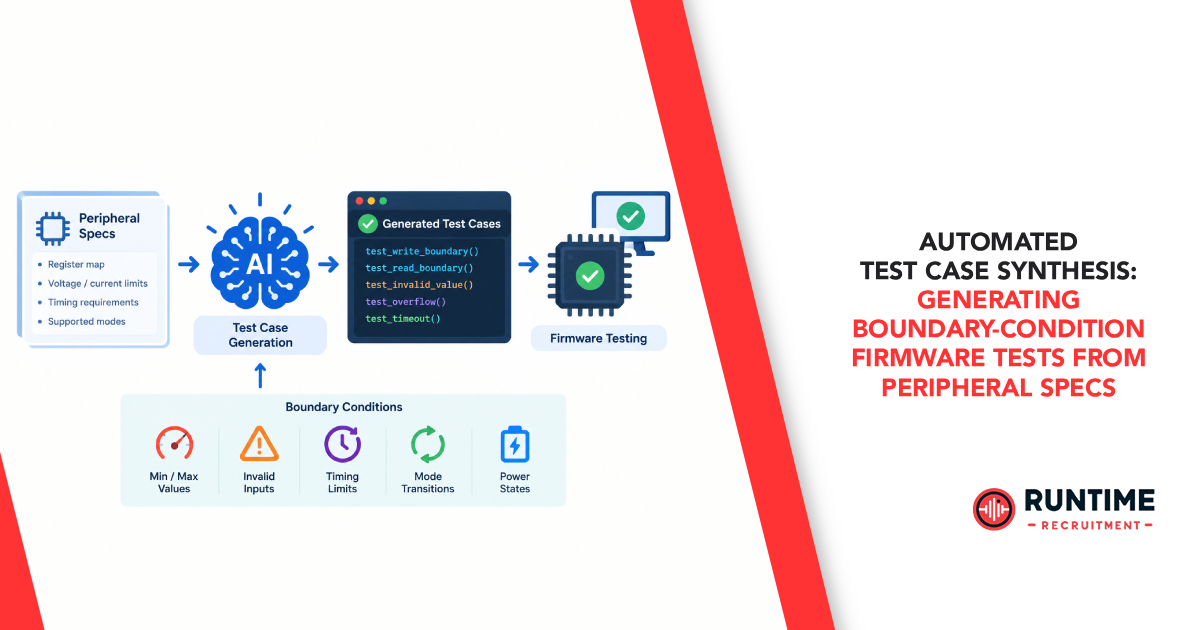
Firmware engineers spend significant time writing unit and integration tests to validate hardware abstraction layers (HALs) and low-level peripheral drivers. When bringing up a new microcontroller (MCU) or System-on-Chip (SoC), verifying that driver code handles register configurations, status flags, and hardware corner cases is often manual and incomplete.
Manual test suites frequently cover happy paths — initializing a UART at 115200 baud, sending SPI frames, or triggering ADC conversions — while missing critical boundary conditions. What happens when an interrupt fires during a bit transition? What occurs when a DMA transfer count is loaded with zero, or a reserved bitfield is mutated during a read-modify-write operation?
The solution lies in shifting left: leveraging machine-readable peripheral specifications, such as CMSIS-SVD (System View Description) and IEEE 1685 IP-XACT, to automatically synthesize comprehensive, boundary-aware test suites. By treating spec files as formal input models, embedded software teams can programmatically generate C test cases, software-in-the-loop (SIL) mocks, and hardware-in-the-loop (HIL) register vectors that stress drivers precisely where human testing falls short.
The Hardware-Software Interface Gap
In embedded engineering, the register map is the explicit contract between hardware silicon and software drivers. Software developers manually translate register tables, bitfield offsets, access permissions (Read-Only, Write-Only, Read-Write, Write-1-to-Clear), and reset values into standard C headers and driver logic from reference manuals.

This manual workflow introduces two major liabilities:
Specification Divergence: Driver logic and manual unit tests are derived from human interpretation. If a manual contains errata or a developer misinterprets hardware behavior (such as W1C status flags where writing 1 clears the bit and 0 is a no-op), both the driver and test suite share the same flawed assumption.
Combinatorial Boundary Explosion: A modern peripheral — such as an AES accelerator or eDMA controller — contains dozens of 32-bit registers, each housing multiple bitfields. Manually generating test vectors for every valid boundary, overflow condition, and illegal state configuration is intractable.
Machine-readable specification files bridge this gap. Vendor-supplied SVD or IP-XACT files provide structured XML/JSON definitions of memory-mapped peripherals, register offsets, bitfields, and access rules. These metadata files serve as an authoritative single source of truth for automated test synthesis engines.
Anatomy of Peripheral Specifications
A CMSIS-SVD or IP-XACT description explicitly defines:
Base Addresses & Offsets: Memory-mapped physical locations for registers.
Bit Spans & Masks: Starting bit positions (bitOffset) and widths (bitWidth).
Access Policies: Read-write, read-only, or write-only constraints.
Modified Write Behavior: Actions such as oneToClear (writing 1 clears the bit), zeroToClear, or oneToSet.
Enumerated Values: Valid symbolic constants for bitfields (e.g., clock prescalers).
Reset Values: The exact bit pattern following a system reset.
Consider a simplified CMSIS-SVD snippet representing a Control Register (CTRL):

From this metadata, an automated engine derives critical boundary conditions:
Valid Range Boundaries: PRESCALER is an 8-bit field accepting values 0 to 255. Boundaries exist at 0, 1, 254, and 255.
Illegal State Vectors: MODE is a 3-bit field (storing 0 to 7), but only 0, 1, and 2 are defined. Values 3 through 7 represent unmapped or reserved operational states that drivers must safely reject.
Reserved Field Isolation: Unmapped bits must be preserved and not mutated during bitfield update routines.
The Synthesis Pipeline
The architectural pipeline transforms raw peripheral metadata into executable target C code or software-in-the-loop test runners.

Metadata Parsing: Ingests SVD/IP-XACT XML and builds an Abstract Syntax Tree (AST) maintaining relative base offsets, field dimensions, and permissions.
Constraint Solving: Applies boundary identification techniques:
Equivalence Partitioning: Segments bitfields into valid ranges, edges, and illegal sets.
SMT Solving: Calculates valid versus prohibited combinations for cross-register dependencies.
Access Invariants: Synthesizes assertions verifying that Read-Only flags resist write attempts.
3. Code Generation: Translates derived constraints into unit tests targeting frameworks like Unity or CppUTest alongside memory-mapped register mocks.
Practical Implementation: Python Synthesis to Target C Code
A Python generator parses field metadata and outputs executable C boundary tests.
Python Generator Logic

Synthesized Target C Code

Generating these assertions directly in CI pipelines ensures target tests remain synchronized with updated peripheral spec files.
Complex Hardware Behaviors
Automated synthesis also handles dynamic behavior like Write-1-to-Clear (W1C) hardware flags, race conditions, and sequence states.
Write-1-to-Clear (W1C) Invariants
Naive read-modify-write operations on status registers can accidentally clear unintended flags:
// DANGEROUS READ-MODIFY-WRITE ON W1C REGISTER
PERIPHERAL->SR |= (1 << ERROR_FLAG_POS);
When specifications mark a field as oneToClear, the synthesis engine generates test cases that inject concurrent flags into mock registers, verifying the driver writes 1 strictly to the target flag bit while maintaining 0 across adjacent positions.
Sequence and Gating Dependencies
Peripherals like CAN or I2C require modules to be disabled or placed into an initialization state before modifying configuration registers. Synthesizers parse these rules to emit state sequence assertions:
void test_can_prescaler_gating(void) {
driver_can_start(); // Force active state
// Setting prescaler while active must return a state error
TEST_ASSERT_EQUAL(STATUS_ERROR_WRONG_STATE, driver_can_set_prescaler(4));
driver_can_enter_init_mode();
TEST_ASSERT_EQUAL(STATUS_OK, driver_can_set_prescaler(4));
}
SIL vs. HIL Execution Targets
Synthesized test vectors run across a two-tier execution pipeline:

Register Verification Matrix (RVM)
Standard code coverage metrics can be misleading for firmware — a driver function can achieve 100% line coverage while skipping key register permutations. Teams use a Register Verification Matrix (RVM) to track hardware-level coverage:
Bitfield Range Coverage: Percentage of valid enumerations and numeric boundaries tested.
Access Permission Coverage: Proportion of Read-Only and Write-Only constraints verified.
Reset Invariant Coverage: Verification of hardware power-on defaults against emulator states.
State Transition Coverage: Percentage of peripheral state transitions exercised by APIs.
Moving Beyond Manual Verification
Parsing CMSIS-SVD or IP-XACT specifications transforms static hardware descriptions into automated software quality drivers. Integrating test case synthesis into build systems catches boundary defects early, ensuring drivers remain resilient as hardware specs evolve.
Connect with RunTime Recruitment
Looking to elevate your firmware verification and embedded engineering capabilities?
Connect with RunTime Recruitment to access specialized embedded systems talent and verification experts tailored to your team's technical roadmap.